

10 Applications of the Inverse Problem of Pollution Propagation
327
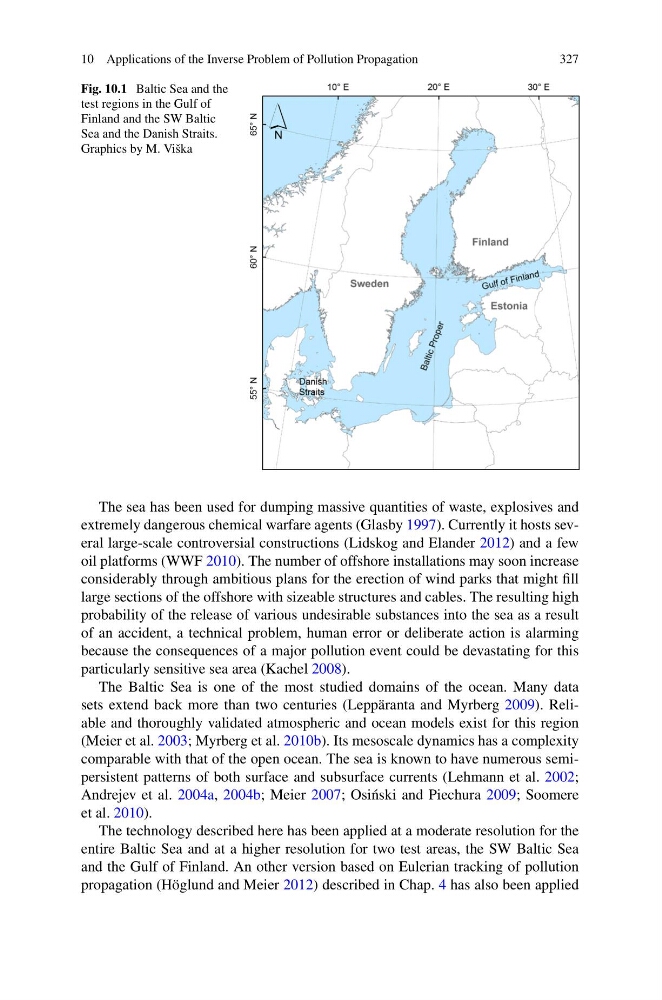
Fig. 10.1 Baltic Sea and the
test regions in the Gulf of
Finland and the SW Baltic
Sea and the Danish Straits.
Graphics by M. Viška
The sea has been used for dumping massive quantities of waste, explosives and
extremely dangerous chemical warfare agents (Glasby 1997). Currently it hosts several large-scale controversial constructions (Lidskog and Elander 2012) and a few
oil platforms (WWF 2010). The number of offshore installations may soon increase
considerably through ambitious plans for the erection of wind parks that might fill
large sections of the offshore with sizeable structures and cables. The resulting high
probability of the release of various undesirable substances into the sea as a result
of an accident, a technical problem, human error or deliberate action is alarming
because the consequences of a major pollution event could be devastating for this
particularly sensitive sea area (Kachel 2008).
The Baltic Sea is one of the most studied domains of the ocean. Many data
sets extend back more than two centuries (Leppäranta and Myrberg 2009). Reliable and thoroughly validated atmospheric and ocean models exist for this region
(Meier et al. 2003; Myrberg et al. 2010b). Its mesoscale dynamics has a complexity
comparable with that of the open ocean. The sea is known to have numerous semipersistent patterns of both surface and subsurface currents (Lehmann et al. 2002;
Andrejev et al. 2004a, 2004b; Meier 2007; Osi´ nski and Piechura 2009; Soomere
et al. 2010).
The technology described here has been applied at a moderate resolution for the
entire Baltic Sea and at a higher resolution for two test areas, the SW Baltic Sea
and the Gulf of Finland. An other version based on Eulerian tracking of pollution
propagation (Höglund and Meier 2012) described in Chap. 4 has also been applied
327
Fig. 10.1 Baltic Sea and the
test regions in the Gulf of
Finland and the SW Baltic
Sea and the Danish Straits.
Graphics by M. Viška
The sea has been used for dumping massive quantities of waste, explosives and
extremely dangerous chemical warfare agents (Glasby 1997). Currently it hosts several large-scale controversial constructions (Lidskog and Elander 2012) and a few
oil platforms (WWF 2010). The number of offshore installations may soon increase
considerably through ambitious plans for the erection of wind parks that might fill
large sections of the offshore with sizeable structures and cables. The resulting high
probability of the release of various undesirable substances into the sea as a result
of an accident, a technical problem, human error or deliberate action is alarming
because the consequences of a major pollution event could be devastating for this
particularly sensitive sea area (Kachel 2008).
The Baltic Sea is one of the most studied domains of the ocean. Many data
sets extend back more than two centuries (Leppäranta and Myrberg 2009). Reliable and thoroughly validated atmospheric and ocean models exist for this region
(Meier et al. 2003; Myrberg et al. 2010b). Its mesoscale dynamics has a complexity
comparable with that of the open ocean. The sea is known to have numerous semipersistent patterns of both surface and subsurface currents (Lehmann et al. 2002;
Andrejev et al. 2004a, 2004b; Meier 2007; Osi´ nski and Piechura 2009; Soomere
et al. 2010).
The technology described here has been applied at a moderate resolution for the
entire Baltic Sea and at a higher resolution for two test areas, the SW Baltic Sea
and the Gulf of Finland. An other version based on Eulerian tracking of pollution
propagation (Höglund and Meier 2012) described in Chap. 4 has also been applied