

284
T. Soomere
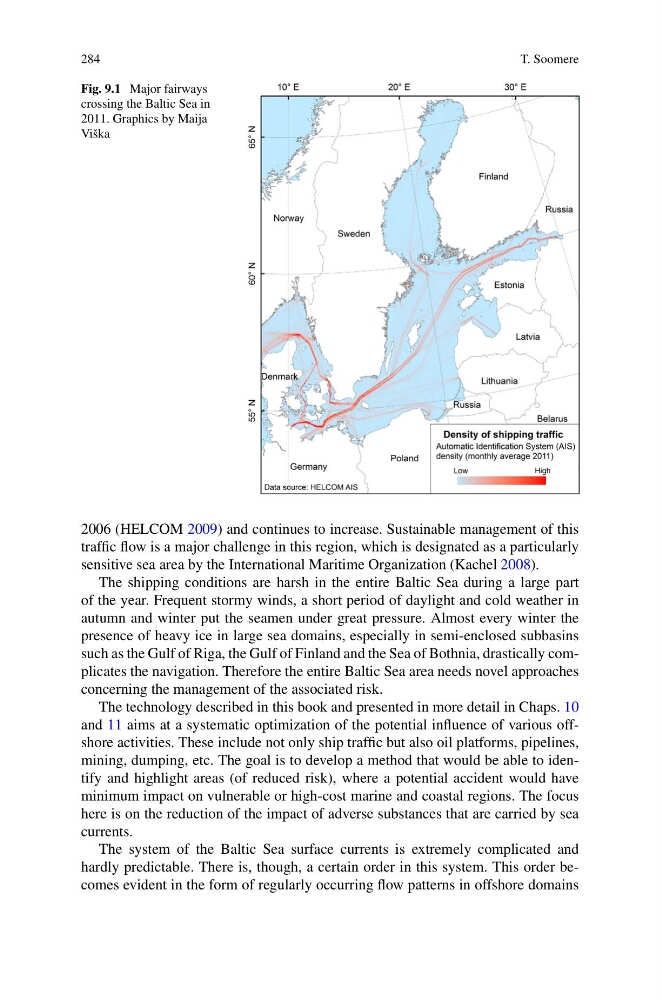
Fig. 9.1 Major fairways
crossing the Baltic Sea in
2011. Graphics by Maija
Viška
2006 (HELCOM 2009) and continues to increase. Sustainable management of this
traffic flow is a major challenge in this region, which is designated as a particularly
sensitive sea area by the International Maritime Organization (Kachel 2008).
The shipping conditions are harsh in the entire Baltic Sea during a large part
of the year. Frequent stormy winds, a short period of daylight and cold weather in
autumn and winter put the seamen under great pressure. Almost every winter the
presence of heavy ice in large sea domains, especially in semi-enclosed subbasins
such as the Gulf of Riga, the Gulf of Finland and the Sea of Bothnia, drastically complicates the navigation. Therefore the entire Baltic Sea area needs novel approaches
concerning the management of the associated risk.
The technology described in this book and presented in more detail in Chaps. 10
and 11 aims at a systematic optimization of the potential influence of various offshore activities. These include not only ship traffic but also oil platforms, pipelines,
mining, dumping, etc. The goal is to develop a method that would be able to identify and highlight areas (of reduced risk), where a potential accident would have
minimum impact on vulnerable or high-cost marine and coastal regions. The focus
here is on the reduction of the impact of adverse substances that are carried by sea
currents.
The system of the Baltic Sea surface currents is extremely complicated and
hardly predictable. There is, though, a certain order in this system. This order becomes evident in the form of regularly occurring flow patterns in offshore domains
T. Soomere
Fig. 9.1 Major fairways
crossing the Baltic Sea in
2011. Graphics by Maija
Viška
2006 (HELCOM 2009) and continues to increase. Sustainable management of this
traffic flow is a major challenge in this region, which is designated as a particularly
sensitive sea area by the International Maritime Organization (Kachel 2008).
The shipping conditions are harsh in the entire Baltic Sea during a large part
of the year. Frequent stormy winds, a short period of daylight and cold weather in
autumn and winter put the seamen under great pressure. Almost every winter the
presence of heavy ice in large sea domains, especially in semi-enclosed subbasins
such as the Gulf of Riga, the Gulf of Finland and the Sea of Bothnia, drastically complicates the navigation. Therefore the entire Baltic Sea area needs novel approaches
concerning the management of the associated risk.
The technology described in this book and presented in more detail in Chaps. 10
and 11 aims at a systematic optimization of the potential influence of various offshore activities. These include not only ship traffic but also oil platforms, pipelines,
mining, dumping, etc. The goal is to develop a method that would be able to identify and highlight areas (of reduced risk), where a potential accident would have
minimum impact on vulnerable or high-cost marine and coastal regions. The focus
here is on the reduction of the impact of adverse substances that are carried by sea
currents.
The system of the Baltic Sea surface currents is extremely complicated and
hardly predictable. There is, though, a certain order in this system. This order becomes evident in the form of regularly occurring flow patterns in offshore domains