

1 Towards Mitigation of Environmental Risks
11
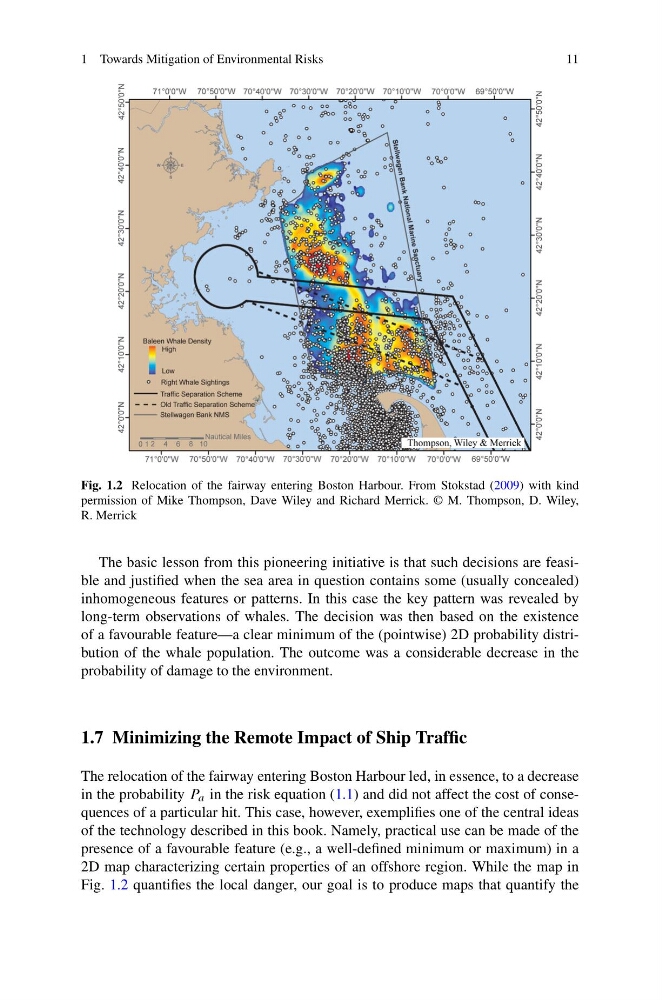
Fig. 1.2 Relocation of the fairway entering Boston Harbour. From Stokstad (2009) with kind
permission of Mike Thompson, Dave Wiley and Richard Merrick. © M. Thompson, D. Wiley,
R. Merrick
The basic lesson from this pioneering initiative is that such decisions are feasible and justified when the sea area in question contains some (usually concealed)
inhomogeneous features or patterns. In this case the key pattern was revealed by
long-term observations of whales. The decision was then based on the existence
of a favourable feature—a clear minimum of the (pointwise) 2D probability distribution of the whale population. The outcome was a considerable decrease in the
probability of damage to the environment.
1.7 Minimizing the Remote Impact of Ship Traffic
The relocation of the fairway entering Boston Harbour led, in essence, to a decrease
in the probability P a in the risk equation (1.1) and did not affect the cost of consequences of a particular hit. This case, however, exemplifies one of the central ideas
of the technology described in this book. Namely, practical use can be made of the
presence of a favourable feature (e.g., a well-defined minimum or maximum) in a
2D map characterizing certain properties of an offshore region. While the map in
Fig. 1.2 quantifies the local danger, our goal is to produce maps that quantify the
11
Fig. 1.2 Relocation of the fairway entering Boston Harbour. From Stokstad (2009) with kind
permission of Mike Thompson, Dave Wiley and Richard Merrick. © M. Thompson, D. Wiley,
R. Merrick
The basic lesson from this pioneering initiative is that such decisions are feasible and justified when the sea area in question contains some (usually concealed)
inhomogeneous features or patterns. In this case the key pattern was revealed by
long-term observations of whales. The decision was then based on the existence
of a favourable feature—a clear minimum of the (pointwise) 2D probability distribution of the whale population. The outcome was a considerable decrease in the
probability of damage to the environment.
1.7 Minimizing the Remote Impact of Ship Traffic
The relocation of the fairway entering Boston Harbour led, in essence, to a decrease
in the probability P a in the risk equation (1.1) and did not affect the cost of consequences of a particular hit. This case, however, exemplifies one of the central ideas
of the technology described in this book. Namely, practical use can be made of the
presence of a favourable feature (e.g., a well-defined minimum or maximum) in a
2D map characterizing certain properties of an offshore region. While the map in
Fig. 1.2 quantifies the local danger, our goal is to produce maps that quantify the