

6 The Gulf of Finland
215
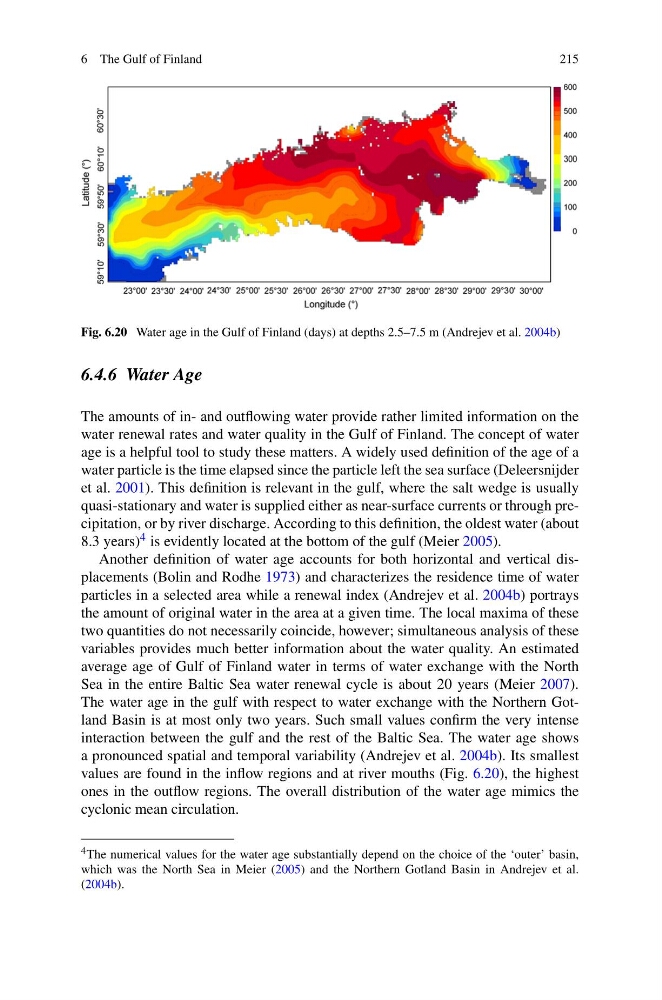
Fig. 6.20 Water age in the Gulf of Finland (days) at depths 2.5–7.5 m (Andrejev et al. 2004b)
6.4.6 Water Age
The amounts of in- and outflowing water provide rather limited information on the
water renewal rates and water quality in the Gulf of Finland. The concept of water
age is a helpful tool to study these matters. A widely used definition of the age of a
water particle is the time elapsed since the particle left the sea surface (Deleersnijder
et al. 2001). This definition is relevant in the gulf, where the salt wedge is usually
quasi-stationary and water is supplied either as near-surface currents or through precipitation, or by river discharge. According to this definition, the oldest water (about
8.3 years) 4 is evidently located at the bottom of the gulf (Meier 2005).
Another definition of water age accounts for both horizontal and vertical displacements (Bolin and Rodhe 1973) and characterizes the residence time of water
particles in a selected area while a renewal index (Andrejev et al. 2004b) portrays
the amount of original water in the area at a given time. The local maxima of these
two quantities do not necessarily coincide, however; simultaneous analysis of these
variables provides much better information about the water quality. An estimated
average age of Gulf of Finland water in terms of water exchange with the North
Sea in the entire Baltic Sea water renewal cycle is about 20 years (Meier 2007).
The water age in the gulf with respect to water exchange with the Northern Gotland Basin is at most only two years. Such small values confirm the very intense
interaction between the gulf and the rest of the Baltic Sea. The water age shows
a pronounced spatial and temporal variability (Andrejev et al. 2004b). Its smallest
values are found in the inflow regions and at river mouths (Fig. 6.20), the highest
ones in the outflow regions. The overall distribution of the water age mimics the
cyclonic mean circulation.
4 The numerical values for the water age substantially depend on the choice of the ‘outer’ basin,
which was the North Sea in Meier (2005) and the Northern Gotland Basin in Andrejev et al.
(2004b).
215
Fig. 6.20 Water age in the Gulf of Finland (days) at depths 2.5–7.5 m (Andrejev et al. 2004b)
6.4.6 Water Age
The amounts of in- and outflowing water provide rather limited information on the
water renewal rates and water quality in the Gulf of Finland. The concept of water
age is a helpful tool to study these matters. A widely used definition of the age of a
water particle is the time elapsed since the particle left the sea surface (Deleersnijder
et al. 2001). This definition is relevant in the gulf, where the salt wedge is usually
quasi-stationary and water is supplied either as near-surface currents or through precipitation, or by river discharge. According to this definition, the oldest water (about
8.3 years) 4 is evidently located at the bottom of the gulf (Meier 2005).
Another definition of water age accounts for both horizontal and vertical displacements (Bolin and Rodhe 1973) and characterizes the residence time of water
particles in a selected area while a renewal index (Andrejev et al. 2004b) portrays
the amount of original water in the area at a given time. The local maxima of these
two quantities do not necessarily coincide, however; simultaneous analysis of these
variables provides much better information about the water quality. An estimated
average age of Gulf of Finland water in terms of water exchange with the North
Sea in the entire Baltic Sea water renewal cycle is about 20 years (Meier 2007).
The water age in the gulf with respect to water exchange with the Northern Gotland Basin is at most only two years. Such small values confirm the very intense
interaction between the gulf and the rest of the Baltic Sea. The water age shows
a pronounced spatial and temporal variability (Andrejev et al. 2004b). Its smallest
values are found in the inflow regions and at river mouths (Fig. 6.20), the highest
ones in the outflow regions. The overall distribution of the water age mimics the
cyclonic mean circulation.
4 The numerical values for the water age substantially depend on the choice of the ‘outer’ basin,
which was the North Sea in Meier (2005) and the Northern Gotland Basin in Andrejev et al.
(2004b).