

202
K. Myrberg and T. Soomere
value corresponds to heating or cooling at a rate of about 0.04 °C/day for the whole
upper layer of a thickness of ∼50 m or 0.2 °C/day for a ∼10 m thick surface layer.
The presence of ice in every winter considerably affects the air–sea fluxes in the
gulf as it radically reduces the terrestrial radiation and turbulent losses. Snowfall
also lowers the surface temperature and weakens the turbulent transfer.
Horizontal advection and diffusive heat transfer can produce an impact to the
upper layer comparable with the atmospheric heating. For typical values of the horizontal net transport speed of 5 cm/s (Soomere et al. 2011a) and temperature gradient
of ∼0.01 °C/km, the advective change will be ∼0.04 °C/day (Soomere et al. 2008).
Assuming the horizontal diffusivity coefficient to be ∼10 6 m 2 /s and temperature
variations of ∼0.01 °C/km, the diffusive smoothing rate will be ∼0.01 °C/day.
6.4 Circulation Dynamics
6.4.1 Scaling of the Equations of Motions and the Rossby Radius
The equations governing large-scale and mesoscale ocean dynamics have been introduced and discussed in Chaps. 2–4. Traditionally, the x-axis is directed to the
east, the y-axis to the north and the z-axis upwards. The molecular viscosity is
generally neglected in the analysis of such motions and only the horizontal part
of the Coriolis acceleration is included into the equations. As the intensity of horizontal currents (about 10 cm/s) exceeds the typical values of vertical velocities
(0.1 mm/s) by several orders of magnitude, the equation for the vertical velocity
w can be simplified using the hydrostatic approximation. The radical difference in
the magnitudes of the vertical and horizontal velocity U = (u, v) is traditionally
expressed by introducing different values for the representative horizontal A H and
vertical A v turbulent (eddy) viscosities with A H ∼ 10 5 m 2 /s and A v ∼ 0.05 m 2 /s.
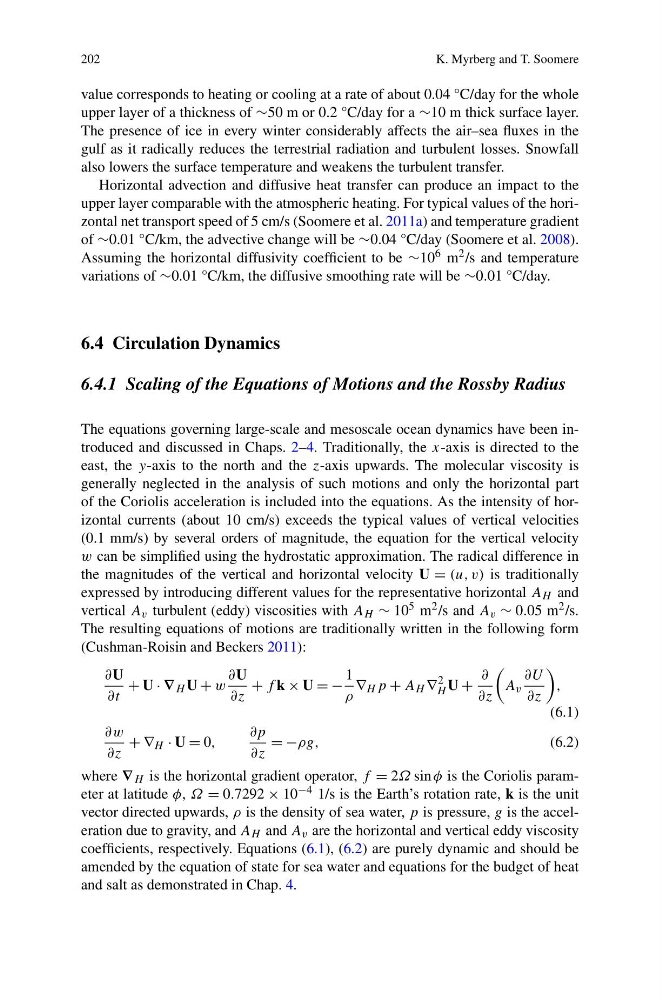
The resulting equations of motions are traditionally written in the following form
(Cushman-Roisin and Beckers 2011):
∂U
∂t
+ U · ∇ H U + w
∂U
∂z
+ f k × U = −
1
ρ
∇ H p + A H ∇
2
H U +
∂
∂z
A v
∂U
∂z
,
(6.1)
∂w
∂z
+ ∇ H · U = 0,
∂p
∂z
= −ρg,
(6.2)
where ∇ H is the horizontal gradient operator, f = 2Ω sin φ is the Coriolis parameter at latitude φ, Ω = 0.7292 × 10 −4 1/s is the Earth’s rotation rate, k is the unit
vector directed upwards, ρ is the density of sea water, p is pressure, g is the acceleration due to gravity, and A H and A v are the horizontal and vertical eddy viscosity
coefficients, respectively. Equations (6.1), (6.2) are purely dynamic and should be
amended by the equation of state for sea water and equations for the budget of heat
and salt as demonstrated in Chap. 4.
K. Myrberg and T. Soomere
value corresponds to heating or cooling at a rate of about 0.04 °C/day for the whole
upper layer of a thickness of ∼50 m or 0.2 °C/day for a ∼10 m thick surface layer.
The presence of ice in every winter considerably affects the air–sea fluxes in the
gulf as it radically reduces the terrestrial radiation and turbulent losses. Snowfall
also lowers the surface temperature and weakens the turbulent transfer.
Horizontal advection and diffusive heat transfer can produce an impact to the
upper layer comparable with the atmospheric heating. For typical values of the horizontal net transport speed of 5 cm/s (Soomere et al. 2011a) and temperature gradient
of ∼0.01 °C/km, the advective change will be ∼0.04 °C/day (Soomere et al. 2008).
Assuming the horizontal diffusivity coefficient to be ∼10 6 m 2 /s and temperature
variations of ∼0.01 °C/km, the diffusive smoothing rate will be ∼0.01 °C/day.
6.4 Circulation Dynamics
6.4.1 Scaling of the Equations of Motions and the Rossby Radius
The equations governing large-scale and mesoscale ocean dynamics have been introduced and discussed in Chaps. 2–4. Traditionally, the x-axis is directed to the
east, the y-axis to the north and the z-axis upwards. The molecular viscosity is
generally neglected in the analysis of such motions and only the horizontal part
of the Coriolis acceleration is included into the equations. As the intensity of horizontal currents (about 10 cm/s) exceeds the typical values of vertical velocities
(0.1 mm/s) by several orders of magnitude, the equation for the vertical velocity
w can be simplified using the hydrostatic approximation. The radical difference in
the magnitudes of the vertical and horizontal velocity U = (u, v) is traditionally
expressed by introducing different values for the representative horizontal A H and
vertical A v turbulent (eddy) viscosities with A H ∼ 10 5 m 2 /s and A v ∼ 0.05 m 2 /s.
The resulting equations of motions are traditionally written in the following form
(Cushman-Roisin and Beckers 2011):
∂U
∂t
+ U · ∇ H U + w
∂U
∂z
+ f k × U = −
1
ρ
∇ H p + A H ∇
2
H U +
∂
∂z
A v
∂U
∂z
,
(6.1)
∂w
∂z
+ ∇ H · U = 0,
∂p
∂z
= −ρg,
(6.2)
where ∇ H is the horizontal gradient operator, f = 2Ω sin φ is the Coriolis parameter at latitude φ, Ω = 0.7292 × 10 −4 1/s is the Earth’s rotation rate, k is the unit
vector directed upwards, ρ is the density of sea water, p is pressure, g is the acceleration due to gravity, and A H and A v are the horizontal and vertical eddy viscosity
coefficients, respectively. Equations (6.1), (6.2) are purely dynamic and should be
amended by the equation of state for sea water and equations for the budget of heat
and salt as demonstrated in Chap. 4.