

6 The Gulf of Finland
199
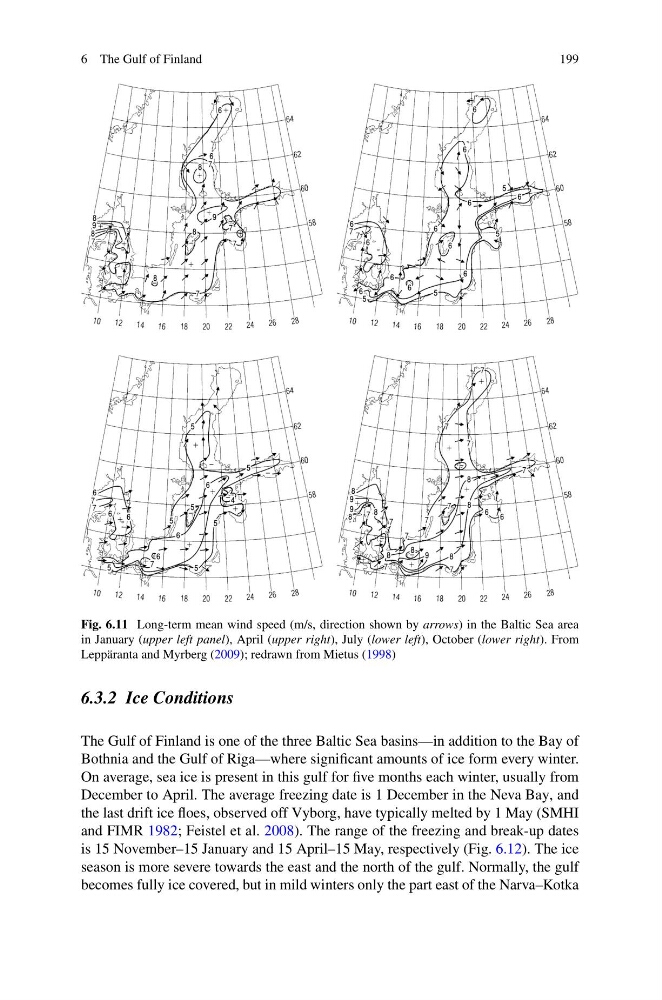
Fig. 6.11 Long-term mean wind speed (m/s, direction shown by arrows) in the Baltic Sea area
in January (upper left panel), April (upper right), July (lower left), October (lower right). From
Leppäranta and Myrberg (2009); redrawn from Mietus (1998)
6.3.2 Ice Conditions
The Gulf of Finland is one of the three Baltic Sea basins—in addition to the Bay of
Bothnia and the Gulf of Riga—where significant amounts of ice form every winter.
On average, sea ice is present in this gulf for five months each winter, usually from
December to April. The average freezing date is 1 December in the Neva Bay, and
the last drift ice floes, observed off Vyborg, have typically melted by 1 May (SMHI
and FIMR 1982; Feistel et al. 2008). The range of the freezing and break-up dates
is 15 November–15 January and 15 April–15 May, respectively (Fig. 6.12). The ice
season is more severe towards the east and the north of the gulf. Normally, the gulf
becomes fully ice covered, but in mild winters only the part east of the Narva–Kotka
199
Fig. 6.11 Long-term mean wind speed (m/s, direction shown by arrows) in the Baltic Sea area
in January (upper left panel), April (upper right), July (lower left), October (lower right). From
Leppäranta and Myrberg (2009); redrawn from Mietus (1998)
6.3.2 Ice Conditions
The Gulf of Finland is one of the three Baltic Sea basins—in addition to the Bay of
Bothnia and the Gulf of Riga—where significant amounts of ice form every winter.
On average, sea ice is present in this gulf for five months each winter, usually from
December to April. The average freezing date is 1 December in the Neva Bay, and
the last drift ice floes, observed off Vyborg, have typically melted by 1 May (SMHI
and FIMR 1982; Feistel et al. 2008). The range of the freezing and break-up dates
is 15 November–15 January and 15 April–15 May, respectively (Fig. 6.12). The ice
season is more severe towards the east and the north of the gulf. Normally, the gulf
becomes fully ice covered, but in mild winters only the part east of the Narva–Kotka