

196
K. Myrberg and T. Soomere
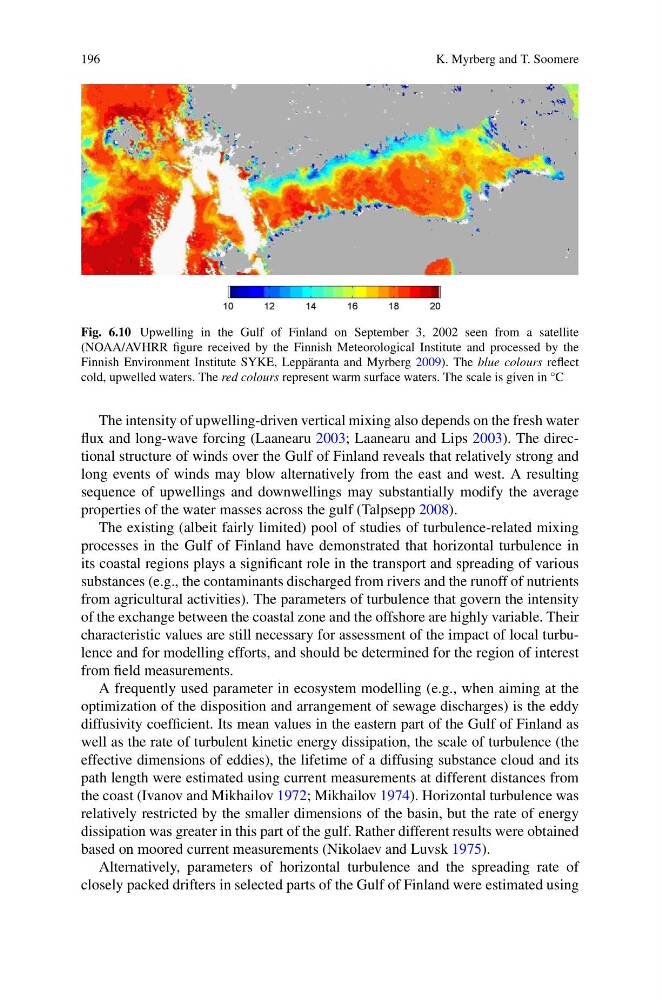
Fig. 6.10 Upwelling in the Gulf of Finland on September 3, 2002 seen from a satellite
(NOAA/AVHRR figure received by the Finnish Meteorological Institute and processed by the
Finnish Environment Institute SYKE, Leppäranta and Myrberg 2009). The blue colours reflect
cold, upwelled waters. The red colours represent warm surface waters. The scale is given in °C
The intensity of upwelling-driven vertical mixing also depends on the fresh water
flux and long-wave forcing (Laanearu 2003; Laanearu and Lips 2003). The directional structure of winds over the Gulf of Finland reveals that relatively strong and
long events of winds may blow alternatively from the east and west. A resulting
sequence of upwellings and downwellings may substantially modify the average
properties of the water masses across the gulf (Talpsepp 2008).
The existing (albeit fairly limited) pool of studies of turbulence-related mixing
processes in the Gulf of Finland have demonstrated that horizontal turbulence in
its coastal regions plays a significant role in the transport and spreading of various
substances (e.g., the contaminants discharged from rivers and the runoff of nutrients
from agricultural activities). The parameters of turbulence that govern the intensity
of the exchange between the coastal zone and the offshore are highly variable. Their
characteristic values are still necessary for assessment of the impact of local turbulence and for modelling efforts, and should be determined for the region of interest
from field measurements.
A frequently used parameter in ecosystem modelling (e.g., when aiming at the
optimization of the disposition and arrangement of sewage discharges) is the eddy
diffusivity coefficient. Its mean values in the eastern part of the Gulf of Finland as
well as the rate of turbulent kinetic energy dissipation, the scale of turbulence (the
effective dimensions of eddies), the lifetime of a diffusing substance cloud and its
path length were estimated using current measurements at different distances from
the coast (Ivanov and Mikhailov 1972; Mikhailov 1974). Horizontal turbulence was
relatively restricted by the smaller dimensions of the basin, but the rate of energy
dissipation was greater in this part of the gulf. Rather different results were obtained
based on moored current measurements (Nikolaev and Luvsk 1975).
Alternatively, parameters of horizontal turbulence and the spreading rate of
closely packed drifters in selected parts of the Gulf of Finland were estimated using
K. Myrberg and T. Soomere
Fig. 6.10 Upwelling in the Gulf of Finland on September 3, 2002 seen from a satellite
(NOAA/AVHRR figure received by the Finnish Meteorological Institute and processed by the
Finnish Environment Institute SYKE, Leppäranta and Myrberg 2009). The blue colours reflect
cold, upwelled waters. The red colours represent warm surface waters. The scale is given in °C
The intensity of upwelling-driven vertical mixing also depends on the fresh water
flux and long-wave forcing (Laanearu 2003; Laanearu and Lips 2003). The directional structure of winds over the Gulf of Finland reveals that relatively strong and
long events of winds may blow alternatively from the east and west. A resulting
sequence of upwellings and downwellings may substantially modify the average
properties of the water masses across the gulf (Talpsepp 2008).
The existing (albeit fairly limited) pool of studies of turbulence-related mixing
processes in the Gulf of Finland have demonstrated that horizontal turbulence in
its coastal regions plays a significant role in the transport and spreading of various
substances (e.g., the contaminants discharged from rivers and the runoff of nutrients
from agricultural activities). The parameters of turbulence that govern the intensity
of the exchange between the coastal zone and the offshore are highly variable. Their
characteristic values are still necessary for assessment of the impact of local turbulence and for modelling efforts, and should be determined for the region of interest
from field measurements.
A frequently used parameter in ecosystem modelling (e.g., when aiming at the
optimization of the disposition and arrangement of sewage discharges) is the eddy
diffusivity coefficient. Its mean values in the eastern part of the Gulf of Finland as
well as the rate of turbulent kinetic energy dissipation, the scale of turbulence (the
effective dimensions of eddies), the lifetime of a diffusing substance cloud and its
path length were estimated using current measurements at different distances from
the coast (Ivanov and Mikhailov 1972; Mikhailov 1974). Horizontal turbulence was
relatively restricted by the smaller dimensions of the basin, but the rate of energy
dissipation was greater in this part of the gulf. Rather different results were obtained
based on moored current measurements (Nikolaev and Luvsk 1975).
Alternatively, parameters of horizontal turbulence and the spreading rate of
closely packed drifters in selected parts of the Gulf of Finland were estimated using