

168
E.V. Stanev and X. Lu
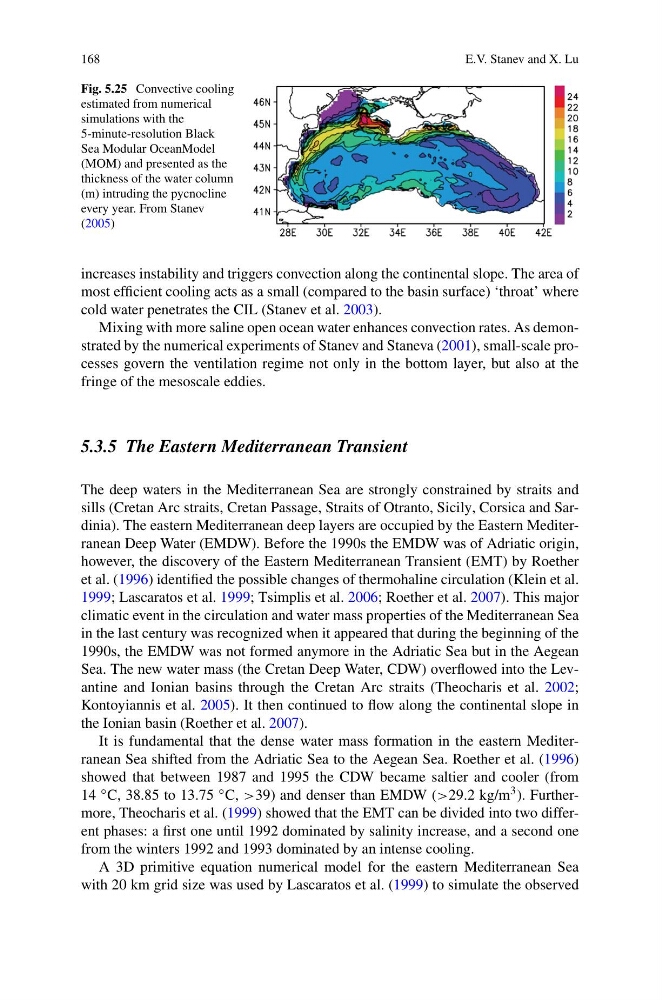
Fig. 5.25 Convective cooling
estimated from numerical
simulations with the
5-minute-resolution Black
Sea Modular OceanModel
(MOM) and presented as the
thickness of the water column
(m) intruding the pycnocline
every year. From Stanev
(2005)
increases instability and triggers convection along the continental slope. The area of
most efficient cooling acts as a small (compared to the basin surface) ‘throat’ where
cold water penetrates the CIL (Stanev et al. 2003).
Mixing with more saline open ocean water enhances convection rates. As demonstrated by the numerical experiments of Stanev and Staneva (2001), small-scale processes govern the ventilation regime not only in the bottom layer, but also at the
fringe of the mesoscale eddies.
5.3.5 The Eastern Mediterranean Transient
The deep waters in the Mediterranean Sea are strongly constrained by straits and
sills (Cretan Arc straits, Cretan Passage, Straits of Otranto, Sicily, Corsica and Sardinia). The eastern Mediterranean deep layers are occupied by the Eastern Mediterranean Deep Water (EMDW). Before the 1990s the EMDW was of Adriatic origin,
however, the discovery of the Eastern Mediterranean Transient (EMT) by Roether
et al. (1996) identified the possible changes of thermohaline circulation (Klein et al.
1999; Lascaratos et al. 1999; Tsimplis et al. 2006; Roether et al. 2007). This major
climatic event in the circulation and water mass properties of the Mediterranean Sea
in the last century was recognized when it appeared that during the beginning of the
1990s, the EMDW was not formed anymore in the Adriatic Sea but in the Aegean
Sea. The new water mass (the Cretan Deep Water, CDW) overflowed into the Levantine and Ionian basins through the Cretan Arc straits (Theocharis et al. 2002;
Kontoyiannis et al. 2005). It then continued to flow along the continental slope in
the Ionian basin (Roether et al. 2007).
It is fundamental that the dense water mass formation in the eastern Mediterranean Sea shifted from the Adriatic Sea to the Aegean Sea. Roether et al. (1996)
showed that between 1987 and 1995 the CDW became saltier and cooler (from
14 ◦ C, 38.85 to 13.75 ◦ C, >39) and denser than EMDW (>29.2 kg/m 3 ). Furthermore, Theocharis et al. (1999) showed that the EMT can be divided into two different phases: a first one until 1992 dominated by salinity increase, and a second one
from the winters 1992 and 1993 dominated by an intense cooling.
A 3D primitive equation numerical model for the eastern Mediterranean Sea
with 20 km grid size was used by Lascaratos et al. (1999) to simulate the observed
E.V. Stanev and X. Lu
Fig. 5.25 Convective cooling
estimated from numerical
simulations with the
5-minute-resolution Black
Sea Modular OceanModel
(MOM) and presented as the
thickness of the water column
(m) intruding the pycnocline
every year. From Stanev
(2005)
increases instability and triggers convection along the continental slope. The area of
most efficient cooling acts as a small (compared to the basin surface) ‘throat’ where
cold water penetrates the CIL (Stanev et al. 2003).
Mixing with more saline open ocean water enhances convection rates. As demonstrated by the numerical experiments of Stanev and Staneva (2001), small-scale processes govern the ventilation regime not only in the bottom layer, but also at the
fringe of the mesoscale eddies.
5.3.5 The Eastern Mediterranean Transient
The deep waters in the Mediterranean Sea are strongly constrained by straits and
sills (Cretan Arc straits, Cretan Passage, Straits of Otranto, Sicily, Corsica and Sardinia). The eastern Mediterranean deep layers are occupied by the Eastern Mediterranean Deep Water (EMDW). Before the 1990s the EMDW was of Adriatic origin,
however, the discovery of the Eastern Mediterranean Transient (EMT) by Roether
et al. (1996) identified the possible changes of thermohaline circulation (Klein et al.
1999; Lascaratos et al. 1999; Tsimplis et al. 2006; Roether et al. 2007). This major
climatic event in the circulation and water mass properties of the Mediterranean Sea
in the last century was recognized when it appeared that during the beginning of the
1990s, the EMDW was not formed anymore in the Adriatic Sea but in the Aegean
Sea. The new water mass (the Cretan Deep Water, CDW) overflowed into the Levantine and Ionian basins through the Cretan Arc straits (Theocharis et al. 2002;
Kontoyiannis et al. 2005). It then continued to flow along the continental slope in
the Ionian basin (Roether et al. 2007).
It is fundamental that the dense water mass formation in the eastern Mediterranean Sea shifted from the Adriatic Sea to the Aegean Sea. Roether et al. (1996)
showed that between 1987 and 1995 the CDW became saltier and cooler (from
14 ◦ C, 38.85 to 13.75 ◦ C, >39) and denser than EMDW (>29.2 kg/m 3 ). Furthermore, Theocharis et al. (1999) showed that the EMT can be divided into two different phases: a first one until 1992 dominated by salinity increase, and a second one
from the winters 1992 and 1993 dominated by an intense cooling.
A 3D primitive equation numerical model for the eastern Mediterranean Sea
with 20 km grid size was used by Lascaratos et al. (1999) to simulate the observed