

94
T. Torsvik
and consider only the averaged variables, we obtain the Reynolds–Averaged Navier–
Stokes (RANS) equation
∂ ¯
u i
∂t
+ ¯
u j
∂ ¯
u i
∂x j
− f f ij 3 ¯
u j = −
1
ρ 0
∂ ¯
p
∂x i
−
¯
ρg
ρ 0
δ i3 −
∂ ˆ
u i ˆ
u j
∂x j
.
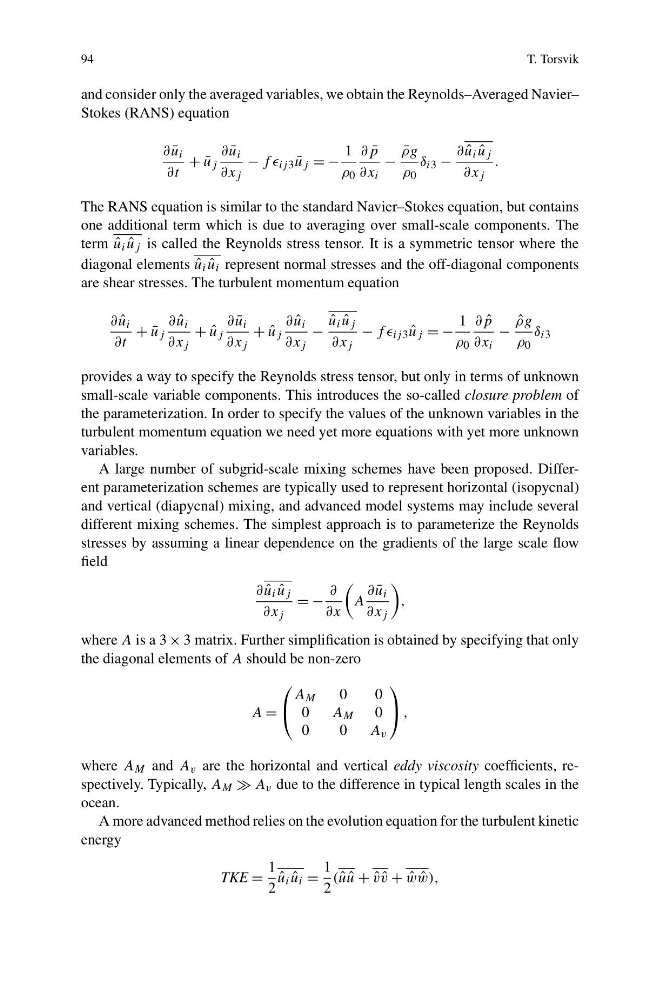
The RANS equation is similar to the standard Navier–Stokes equation, but contains
one additional term which is due to averaging over small-scale components. The
term ˆ
u i ˆ
u j is called the Reynolds stress tensor. It is a symmetric tensor where the
diagonal elements ˆ
u i ˆ
u i represent normal stresses and the off-diagonal components
are shear stresses. The turbulent momentum equation
∂ ˆ
u i
∂t
+ ¯
u j
∂ ˆ
u i
∂x j
+ ˆ
u j
∂ ¯
u i
∂x j
+ ˆ
u j
∂ ˆ
u i
∂x j
−
ˆ
u i ˆ
u j
∂x j
− f f ij 3 ˆ
u j = −
1
ρ 0
∂ ˆ
p
∂x i
−
ˆ
ρg
ρ 0
δ i3
provides a way to specify the Reynolds stress tensor, but only in terms of unknown
small-scale variable components. This introduces the so-called closure problem of
the parameterization. In order to specify the values of the unknown variables in the
turbulent momentum equation we need yet more equations with yet more unknown
variables.
A large number of subgrid-scale mixing schemes have been proposed. Different parameterization schemes are typically used to represent horizontal (isopycnal)
and vertical (diapycnal) mixing, and advanced model systems may include several
different mixing schemes. The simplest approach is to parameterize the Reynolds
stresses by assuming a linear dependence on the gradients of the large scale flow
field
∂ ˆ
u i ˆ
u j
∂x j
= −
∂
∂x
A
∂ ¯
u i
∂x j
,
where A is a 3 × 3 matrix. Further simplification is obtained by specifying that only
the diagonal elements of A should be non-zero
A =
⎛
⎝
A M
0
0
0
A M 0
0
0
A v
⎞
⎠ ,
where A M and A v are the horizontal and vertical eddy viscosity coefficients, respectively. Typically, A M A v due to the difference in typical length scales in the
ocean.
A more advanced method relies on the evolution equation for the turbulent kinetic
energy
TKE =
1
2
ˆ
u i ˆ
u i =
1
2
( ˆ
u ˆ
u + ˆ
v ˆ
v + ˆ
w ˆ
w),
T. Torsvik
and consider only the averaged variables, we obtain the Reynolds–Averaged Navier–
Stokes (RANS) equation
∂ ¯
u i
∂t
+ ¯
u j
∂ ¯
u i
∂x j
− f f ij 3 ¯
u j = −
1
ρ 0
∂ ¯
p
∂x i
−
¯
ρg
ρ 0
δ i3 −
∂ ˆ
u i ˆ
u j
∂x j
.
The RANS equation is similar to the standard Navier–Stokes equation, but contains
one additional term which is due to averaging over small-scale components. The
term ˆ
u i ˆ
u j is called the Reynolds stress tensor. It is a symmetric tensor where the
diagonal elements ˆ
u i ˆ
u i represent normal stresses and the off-diagonal components
are shear stresses. The turbulent momentum equation
∂ ˆ
u i
∂t
+ ¯
u j
∂ ˆ
u i
∂x j
+ ˆ
u j
∂ ¯
u i
∂x j
+ ˆ
u j
∂ ˆ
u i
∂x j
−
ˆ
u i ˆ
u j
∂x j
− f f ij 3 ˆ
u j = −
1
ρ 0
∂ ˆ
p
∂x i
−
ˆ
ρg
ρ 0
δ i3
provides a way to specify the Reynolds stress tensor, but only in terms of unknown
small-scale variable components. This introduces the so-called closure problem of
the parameterization. In order to specify the values of the unknown variables in the
turbulent momentum equation we need yet more equations with yet more unknown
variables.
A large number of subgrid-scale mixing schemes have been proposed. Different parameterization schemes are typically used to represent horizontal (isopycnal)
and vertical (diapycnal) mixing, and advanced model systems may include several
different mixing schemes. The simplest approach is to parameterize the Reynolds
stresses by assuming a linear dependence on the gradients of the large scale flow
field
∂ ˆ
u i ˆ
u j
∂x j
= −
∂
∂x
A
∂ ¯
u i
∂x j
,
where A is a 3 × 3 matrix. Further simplification is obtained by specifying that only
the diagonal elements of A should be non-zero
A =
⎛
⎝
A M
0
0
0
A M 0
0
0
A v
⎞
⎠ ,
where A M and A v are the horizontal and vertical eddy viscosity coefficients, respectively. Typically, A M A v due to the difference in typical length scales in the
ocean.
A more advanced method relies on the evolution equation for the turbulent kinetic
energy
TKE =
1
2
ˆ
u i ˆ
u i =
1
2
( ˆ
u ˆ
u + ˆ
v ˆ
v + ˆ
w ˆ
w),