

a
driving forces
(objectives)
P ressures
b
criteria
State
L.
Rfoducti!Vl
" proc.es
pressures
production
process
product
output
non product
output
performance
indicators
c
Response
J. van der Weide . L. de Vrees
monitoring
and
evaluation
control
control
rameter
production
process
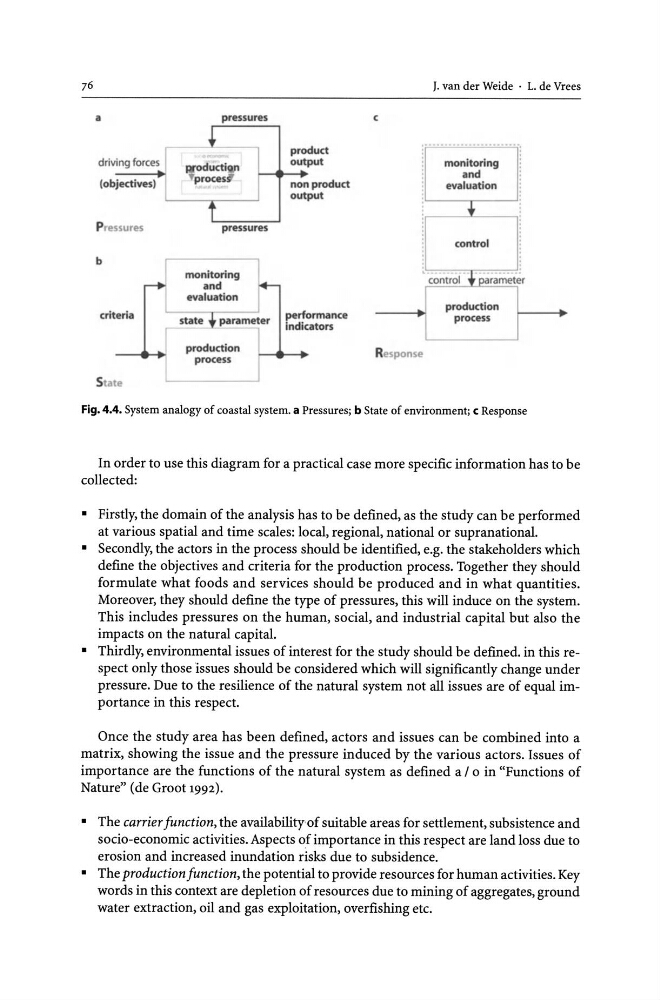
Fig. 4.4. System analogy of coastal system. a Pressures; b State of environment; c Response
In order to use this diagram for a practical case more specific information has to be
collected:
• Firstly, the domain of the analysis has to be defined, as the study can be performed
at various spatial and time scales: local, regional, national or supranational.
• Secondly, the actors in the process should be identified, e.g. the stakeholders which
define the objectives and criteria for the production process. Together they should
formulate what foods and services should be produced and in what quantities.
Moreover, they should define the type of pressures, this will induce on the system.
This includes pressures on the human, social, and industrial capital but also the
impacts on the natural capital.
• Thirdly, environmental issues of interest for the study should be defined. in this respect only those issues should be considered which will significantly change under
pressure. Due to the resilience of the natural system not all issues are of equal importance in this respect.
Once the study area has been defined, actors and issues can be combined into a
matrix, showing the issue and the pressure induced by the various actors. Issues of
importance are the functions of the natural system as defined a / 0 in "Functions of
Nature" (de Groot 1992).
• The carrier function, the availability of suitable areas for settlement, subsistence and
socio-economic activities. Aspects of importance in this respect are land loss due to
erosion and increased inundation risks due to subsidence.
• The production function, the potential to provide resources for human activities. Key
words in this context are depletion of resources due to mining of aggregates, ground
water extraction, oil and gas exploitation, overfishing etc.
driving forces
(objectives)
P ressures
b
criteria
State
L.
Rfoducti!Vl
" proc.es
pressures
production
process
product
output
non product
output
performance
indicators
c
Response
J. van der Weide . L. de Vrees
monitoring
and
evaluation
control
control
rameter
production
process
Fig. 4.4. System analogy of coastal system. a Pressures; b State of environment; c Response
In order to use this diagram for a practical case more specific information has to be
collected:
• Firstly, the domain of the analysis has to be defined, as the study can be performed
at various spatial and time scales: local, regional, national or supranational.
• Secondly, the actors in the process should be identified, e.g. the stakeholders which
define the objectives and criteria for the production process. Together they should
formulate what foods and services should be produced and in what quantities.
Moreover, they should define the type of pressures, this will induce on the system.
This includes pressures on the human, social, and industrial capital but also the
impacts on the natural capital.
• Thirdly, environmental issues of interest for the study should be defined. in this respect only those issues should be considered which will significantly change under
pressure. Due to the resilience of the natural system not all issues are of equal importance in this respect.
Once the study area has been defined, actors and issues can be combined into a
matrix, showing the issue and the pressure induced by the various actors. Issues of
importance are the functions of the natural system as defined a / 0 in "Functions of
Nature" (de Groot 1992).
• The carrier function, the availability of suitable areas for settlement, subsistence and
socio-economic activities. Aspects of importance in this respect are land loss due to
erosion and increased inundation risks due to subsidence.
• The production function, the potential to provide resources for human activities. Key
words in this context are depletion of resources due to mining of aggregates, ground
water extraction, oil and gas exploitation, overfishing etc.