

CHAPTER 2 • The Challenge of Demonstrating the Socio-economic Benefits of ICM
39
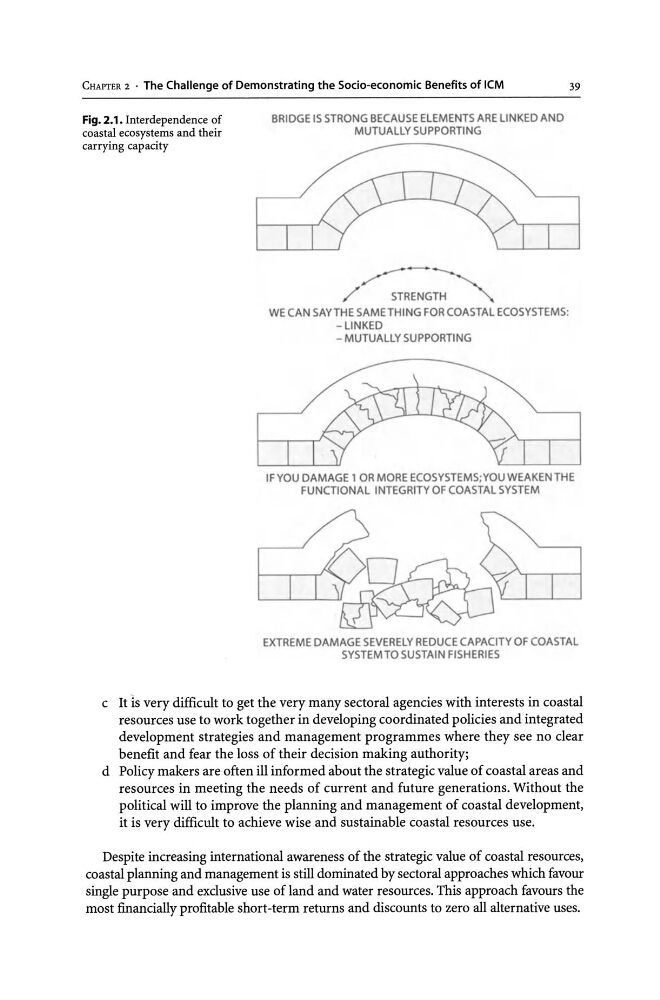
Fig. 2.1. Interdependence of
coastal ecosystems and their
carrying capacity
BRIDGE IS STRONG BECAUSE ELEMENTS ARE LINKED AND
MUTUALLY SUPPORTING
~--/
STRENGTH
WE CAN SAYTHE SAMETHING FOR COASTAL ECOSYSTEMS:
- LINKED
- MUTUALLY SUPPORTING
IF YOU DAMAGE 1 OR MORE ECOSYSTEMS;YOU WEAKEN THE
FUNCTIONAL INTEGRITY OF COASTAL SYSTEM
EXTREME DAMAGE SEVERELY REDUCE CAPACITY OF COASTAL
SYSTEM TO SUSTAIN FISHERI ES
c !tIS very difficult to get the very many sectoral agencies with interests in coastal
resources use to work together in developing coordinated policies and integrated
development strategies and management programmes where they see no clear
benefit and fear the loss of their decision making authority;
d Policy makers are often ill informed about the strategic value of coastal areas and
resources in meeting the needs of current and future generations. Without the
political will to improve the planning and management of coastal development,
it is very difficult to achieve wise and sustainable coastal resources use.
Despite increasing international awareness of the strategic value of coastal resources,
coastal planning and management is still dominated by sectoral approaches which favour
single purpose and exclusive use of land and water resources. This approach favours the
most financially profitable short-term returns and discounts to zero all alternative uses.
39
Fig. 2.1. Interdependence of
coastal ecosystems and their
carrying capacity
BRIDGE IS STRONG BECAUSE ELEMENTS ARE LINKED AND
MUTUALLY SUPPORTING
~--/
STRENGTH
WE CAN SAYTHE SAMETHING FOR COASTAL ECOSYSTEMS:
- LINKED
- MUTUALLY SUPPORTING
IF YOU DAMAGE 1 OR MORE ECOSYSTEMS;YOU WEAKEN THE
FUNCTIONAL INTEGRITY OF COASTAL SYSTEM
EXTREME DAMAGE SEVERELY REDUCE CAPACITY OF COASTAL
SYSTEM TO SUSTAIN FISHERI ES
c !tIS very difficult to get the very many sectoral agencies with interests in coastal
resources use to work together in developing coordinated policies and integrated
development strategies and management programmes where they see no clear
benefit and fear the loss of their decision making authority;
d Policy makers are often ill informed about the strategic value of coastal areas and
resources in meeting the needs of current and future generations. Without the
political will to improve the planning and management of coastal development,
it is very difficult to achieve wise and sustainable coastal resources use.
Despite increasing international awareness of the strategic value of coastal resources,
coastal planning and management is still dominated by sectoral approaches which favour
single purpose and exclusive use of land and water resources. This approach favours the
most financially profitable short-term returns and discounts to zero all alternative uses.