

CHAPTER 15 • Australian Integrated Coastal Management: A Case Study of the Great Barrier Reef 289
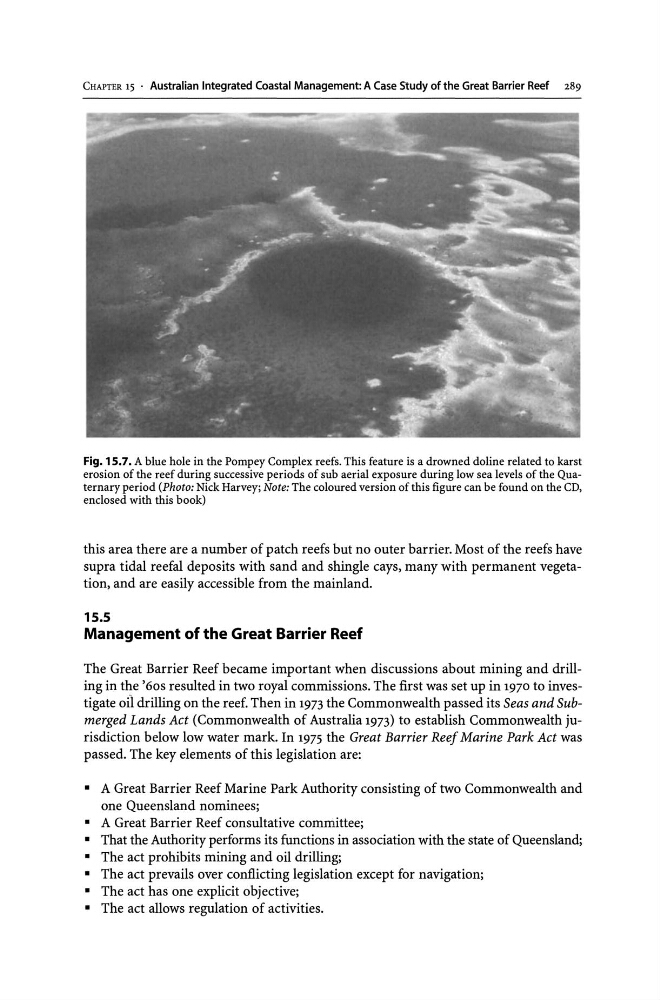
Fig. 1 5.7. A blue hole in the Pompey Complex reefs. This feature is a drowned doline related to karst
erosion of the reef during successive periods of sub aerial exposure during low sea levels of the Quaternary period (Photo: Nick Harvey; Note: The coloured version of this figure can be found on the CD,
enclosed with this book)
this area there are a number of patch reefs but no outer barrier. Most of the reefs have
supra tidal reefal deposits with sand and shingle cays, many with permanent vegetation, and are easily accessible from the mainland.
15.5
Management of the Great Barrier Reef
The Great Barrier Reef became important when discussions about mining and drilling in the '60S resulted in two royal commissions. The first was set up in 1970 to investigate oil drilling on the reef. Then in 1973 the Commonwealth passed its Seas and Submerged Lands Act (Commonwealth of Australia 1973) to establish Commonwealth jurisdiction below low water mark. In 1975 the Great Barrier Reef Marine Park Act was
passed. The key elements of this legislation are:
• A Great Barrier Reef Marine Park Authority consisting of two Commonwealth and
one Queensland nominees;
• A Great Barrier Reef consultative committee;
• That the Authority performs its functions in association with the state of Queensland;
• The act prohibits mining and oil drilling;
• The act prevails over conflicting legislation except for navigation;
• The act has one explicit objective;
• The act allows regulation of activities.
Fig. 1 5.7. A blue hole in the Pompey Complex reefs. This feature is a drowned doline related to karst
erosion of the reef during successive periods of sub aerial exposure during low sea levels of the Quaternary period (Photo: Nick Harvey; Note: The coloured version of this figure can be found on the CD,
enclosed with this book)
this area there are a number of patch reefs but no outer barrier. Most of the reefs have
supra tidal reefal deposits with sand and shingle cays, many with permanent vegetation, and are easily accessible from the mainland.
15.5
Management of the Great Barrier Reef
The Great Barrier Reef became important when discussions about mining and drilling in the '60S resulted in two royal commissions. The first was set up in 1970 to investigate oil drilling on the reef. Then in 1973 the Commonwealth passed its Seas and Submerged Lands Act (Commonwealth of Australia 1973) to establish Commonwealth jurisdiction below low water mark. In 1975 the Great Barrier Reef Marine Park Act was
passed. The key elements of this legislation are:
• A Great Barrier Reef Marine Park Authority consisting of two Commonwealth and
one Queensland nominees;
• A Great Barrier Reef consultative committee;
• That the Authority performs its functions in association with the state of Queensland;
• The act prohibits mining and oil drilling;
• The act prevails over conflicting legislation except for navigation;
• The act has one explicit objective;
• The act allows regulation of activities.