

CHAPTER 15 . Australian Integrated Coastal Management: A Case Study of the Great Barrier Reef
287
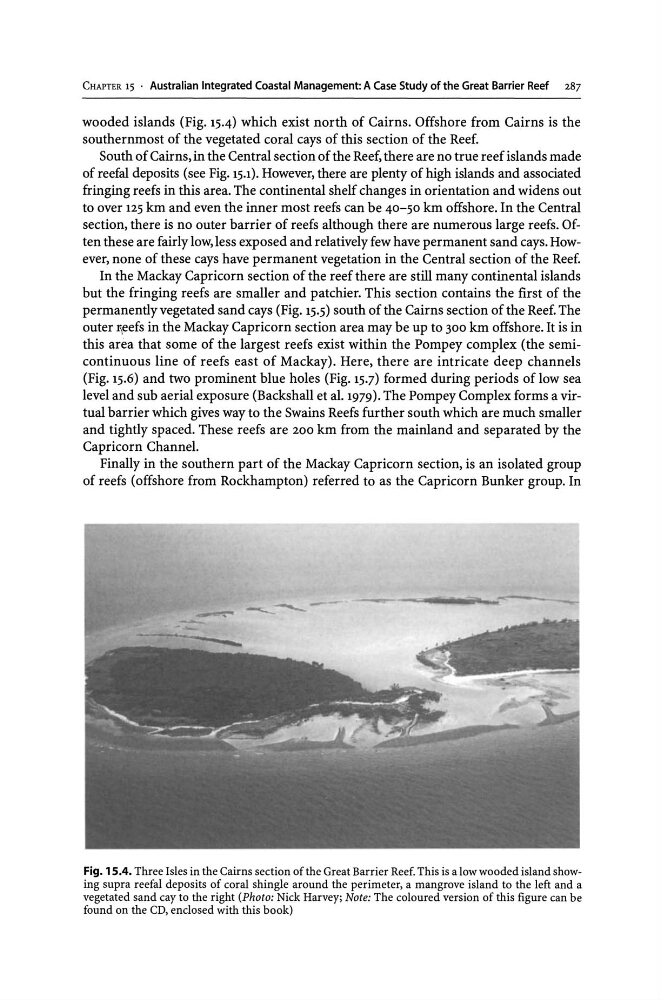
wooded islands (Fig. 15.4) which exist north of Cairns. Offshore from Cairns is the
southernmost of the vegetated coral cays of this section of the Reef.
South of Cairns, in the Central section of the Reef, there are no true reef islands made
of reefal deposits (see Fig. 15.1). However, there are plenty of high islands and associated
fringing reefs in this area. The continental shelf changes in orientation and widens out
to over 125 km and even the inner most reefs can be 40-50 km offshore. In the Central
section, there is no outer barrier of reefs although there are numerous large reefs. Often these are fairly low, less exposed and relatively few have permanent sand cays. However, none of these cays have permanent vegetation in the Central section of the Reef.
In the Mackay Capricorn section of the reef there are still many continental islands
but the fringing reefs are smaller and patchier. This section contains the first of the
permanently vegetated sand cays (Fig. 15.5) south of the Cairns section of the Reef. The
outer F,eefs in the Mackay Capricorn section area may be up to 300 km offshore. It is in
this area that some of the largest reefs exist within the Pompey complex (the semicontinuous line of reefs east of Mackay). Here, there are intricate deep channels
(Fig. 15.6) and two prominent blue holes (Fig. 15.7) formed during periods of low sea
level and sub aerial exposure (Backshall et al. 1979). The Pompey Complex forms a virtual barrier which gives way to the Swains Reefs further south which are much smaller
and tightly spaced. These reefs are 200 km from the mainland and separated by the
Capricorn Channel.
Finally in the southern part of the Mackay Capricorn section, is an isolated group
of reefs (offshore from Rockhampton) referred to as the Capricorn Bunker group. In
Fig. 15.4. Three Isles in the Cairns section of the Great Barrier Reef. This is a low wooded island showing supra reefal deposits of coral shingle around the perimeter, a mangrove island to the left and a
vegetated sand cay to the right (Photo: Nick Harvey; Note: The coloured version of this figure can be
found on the CD, enclosed with this book)
287
wooded islands (Fig. 15.4) which exist north of Cairns. Offshore from Cairns is the
southernmost of the vegetated coral cays of this section of the Reef.
South of Cairns, in the Central section of the Reef, there are no true reef islands made
of reefal deposits (see Fig. 15.1). However, there are plenty of high islands and associated
fringing reefs in this area. The continental shelf changes in orientation and widens out
to over 125 km and even the inner most reefs can be 40-50 km offshore. In the Central
section, there is no outer barrier of reefs although there are numerous large reefs. Often these are fairly low, less exposed and relatively few have permanent sand cays. However, none of these cays have permanent vegetation in the Central section of the Reef.
In the Mackay Capricorn section of the reef there are still many continental islands
but the fringing reefs are smaller and patchier. This section contains the first of the
permanently vegetated sand cays (Fig. 15.5) south of the Cairns section of the Reef. The
outer F,eefs in the Mackay Capricorn section area may be up to 300 km offshore. It is in
this area that some of the largest reefs exist within the Pompey complex (the semicontinuous line of reefs east of Mackay). Here, there are intricate deep channels
(Fig. 15.6) and two prominent blue holes (Fig. 15.7) formed during periods of low sea
level and sub aerial exposure (Backshall et al. 1979). The Pompey Complex forms a virtual barrier which gives way to the Swains Reefs further south which are much smaller
and tightly spaced. These reefs are 200 km from the mainland and separated by the
Capricorn Channel.
Finally in the southern part of the Mackay Capricorn section, is an isolated group
of reefs (offshore from Rockhampton) referred to as the Capricorn Bunker group. In
Fig. 15.4. Three Isles in the Cairns section of the Great Barrier Reef. This is a low wooded island showing supra reefal deposits of coral shingle around the perimeter, a mangrove island to the left and a
vegetated sand cay to the right (Photo: Nick Harvey; Note: The coloured version of this figure can be
found on the CD, enclosed with this book)