

CHAPTER 15 • Australian Integrated Coastal Management: A Case Study of the Great Barrier Reef
285
islands owned by Queensland. For comparison, the region is larger than the land area
of the United Kingdom and Ireland combined and almost the same size as Germany.
To call it the Great Barrier Reef is to some extent a misnomer because it is made up of
over 2900 individual reefs including about 760 fringing reefs attached to the mainland
or numerous islands. In some places these form a semi-continuous barrier such as in
the area to the north of Cairns (see Fig. 15.1). The Great Barrier Reef is a continental
margin reef which is quite different to the classic "Darwinian" coral atolls where subsidence was a major factor in the evolution of their annular form (Harvey 1982).
Coral reefs in general are complex ecosystems which have high diversity and productivity, together with an interdependence of plants and animals and many symbiotic relationships. The great variety in the corals (about 400 species identified), their
life forms and colour give the Great Barrier Reef much of its tourist appeal. Coral reefs
have a yery efficient system of nutrient recycling and can be almost self sufficient provided there is no oversupply, as can happen with nearby intensive tropical agriculture
such as sugar cane. They grow in warm waters down to a depth of 100m but have limited growth at this depth. Their growth is also restricted in a number of areas where
there is high runoff, freshwater output and sediment deposition.
The living polyps of the hard coral species lay down the skeletal limestone structure that forms the basis for reef building. The coral polyps has a symbiotic relationship with algae (zoozanthellae) which live within the coral tissue, assist in laying down
the skeleton through photosynthesis, taking up polyp wastes and supplying the coral
with about 98% of its food requirements. Growth rates of corals in the Great Barrier
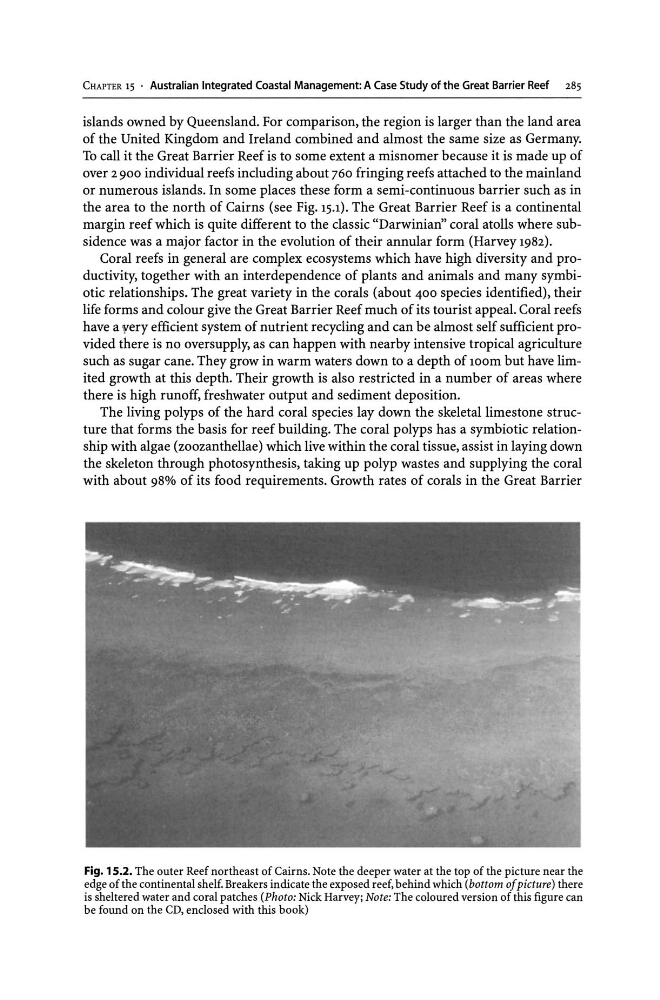
Fig. 15.2. The outer Reef northeast of Cairns. Note the deeper water at the top of the picture near the
edge of the continental shelf. Breakers indicate the exposed reef, behind which (bottom of picture) there
is sheltered water and coral patches (Photo: Nick Harvey; Note: The coloured version of this figure can
be found on the CD, enclosed with this book)
285
islands owned by Queensland. For comparison, the region is larger than the land area
of the United Kingdom and Ireland combined and almost the same size as Germany.
To call it the Great Barrier Reef is to some extent a misnomer because it is made up of
over 2900 individual reefs including about 760 fringing reefs attached to the mainland
or numerous islands. In some places these form a semi-continuous barrier such as in
the area to the north of Cairns (see Fig. 15.1). The Great Barrier Reef is a continental
margin reef which is quite different to the classic "Darwinian" coral atolls where subsidence was a major factor in the evolution of their annular form (Harvey 1982).
Coral reefs in general are complex ecosystems which have high diversity and productivity, together with an interdependence of plants and animals and many symbiotic relationships. The great variety in the corals (about 400 species identified), their
life forms and colour give the Great Barrier Reef much of its tourist appeal. Coral reefs
have a yery efficient system of nutrient recycling and can be almost self sufficient provided there is no oversupply, as can happen with nearby intensive tropical agriculture
such as sugar cane. They grow in warm waters down to a depth of 100m but have limited growth at this depth. Their growth is also restricted in a number of areas where
there is high runoff, freshwater output and sediment deposition.
The living polyps of the hard coral species lay down the skeletal limestone structure that forms the basis for reef building. The coral polyps has a symbiotic relationship with algae (zoozanthellae) which live within the coral tissue, assist in laying down
the skeleton through photosynthesis, taking up polyp wastes and supplying the coral
with about 98% of its food requirements. Growth rates of corals in the Great Barrier
Fig. 15.2. The outer Reef northeast of Cairns. Note the deeper water at the top of the picture near the
edge of the continental shelf. Breakers indicate the exposed reef, behind which (bottom of picture) there
is sheltered water and coral patches (Photo: Nick Harvey; Note: The coloured version of this figure can
be found on the CD, enclosed with this book)