

CHAPTER 14 • Tourist Development in the Costa Brava (Girona, Spain)
100%
80%
60%
40%
20%
0%
1956
BLANES
LLORET DE MAR
TOSSADEMAR
1981 1995
1956 1981
1995
1956 1981 1995
• FOREST • FARMING
D DEGRADED LAND
D TOWN
• INDUSTRIAL D URBANIZED LAND
271
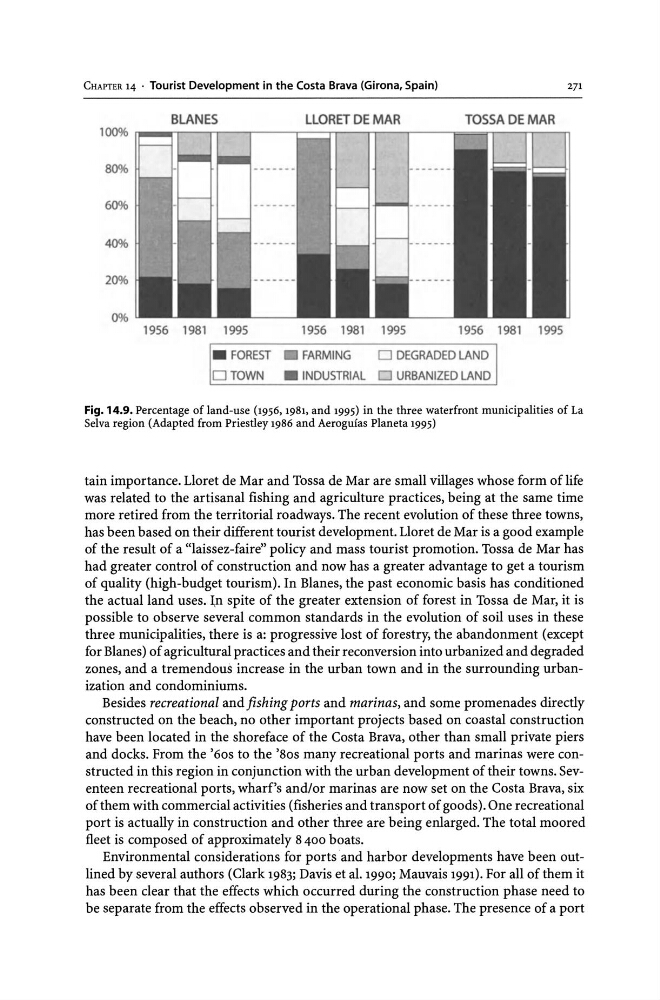
Fig. 14.9. Percentage of land-use (1956, 1981, and 1995) in the three waterfront municipalities of La
Selva region (Adapted from Priestley 1986 and Aeroguias Pianeta 1995)
tain importance. Lloret de Mar and Tossa de Mar are small villages whose form of life
was related to the artisanal fishing and agriculture practices, being at the same time
more retired from the territorial roadways. The recent evolution of these three towns,
has been based on their different tourist development. Lloret de Mar is a good example
of the result of a "laissez-faire" policy and mass tourist promotion. Tossa de Mar has
had greater control of construction and now has a greater advantage to get a tourism
of quality (high-budget tourism). In Blanes, the past economic basis has conditioned
the actual land uses. I,n spite of the greater extension of forest in Tossa de Mar, it is
possible to observe several common standards in the evolution of soil uses in these
three municipalities, there is a: progressive lost of forestry, the abandonment (except
for Blanes) of agricultural practices and their reconversion into urbanized and degraded
zones, and a tremendous increase in the urban town and in the surrounding urbanization and condominiums.
Besides recreational and fishing ports and marinas, and some promenades directly
constructed on the beach, no other important projects based on coastal construction
have been located in the shoreface of the Costa Brava, other than small private piers
and docks. From the '60S to the '80S many recreational ports and marinas were constructed in this region in conjunction with the urban development of their towns. Seventeen recreational ports, wharf's and/or marinas are now set on the Costa Brava, six
of them with commercial activities (fisheries and transport of goods). One recreational
port is actually in construction and other three are being enlarged. The total moored
fleet is composed of approximately 8400 boats.
Environmental considerations for ports and harbor developments have been outlined by several authors (Clark 1983; Davis et al. 1990; Mauvais 1991). For all of them it
has been clear that the effects which occurred during the construction phase need to
be separate from the effects observed in the operational phase. The presence of a port
100%
80%
60%
40%
20%
0%
1956
BLANES
LLORET DE MAR
TOSSADEMAR
1981 1995
1956 1981
1995
1956 1981 1995
• FOREST • FARMING
D DEGRADED LAND
D TOWN
• INDUSTRIAL D URBANIZED LAND
271
Fig. 14.9. Percentage of land-use (1956, 1981, and 1995) in the three waterfront municipalities of La
Selva region (Adapted from Priestley 1986 and Aeroguias Pianeta 1995)
tain importance. Lloret de Mar and Tossa de Mar are small villages whose form of life
was related to the artisanal fishing and agriculture practices, being at the same time
more retired from the territorial roadways. The recent evolution of these three towns,
has been based on their different tourist development. Lloret de Mar is a good example
of the result of a "laissez-faire" policy and mass tourist promotion. Tossa de Mar has
had greater control of construction and now has a greater advantage to get a tourism
of quality (high-budget tourism). In Blanes, the past economic basis has conditioned
the actual land uses. I,n spite of the greater extension of forest in Tossa de Mar, it is
possible to observe several common standards in the evolution of soil uses in these
three municipalities, there is a: progressive lost of forestry, the abandonment (except
for Blanes) of agricultural practices and their reconversion into urbanized and degraded
zones, and a tremendous increase in the urban town and in the surrounding urbanization and condominiums.
Besides recreational and fishing ports and marinas, and some promenades directly
constructed on the beach, no other important projects based on coastal construction
have been located in the shoreface of the Costa Brava, other than small private piers
and docks. From the '60S to the '80S many recreational ports and marinas were constructed in this region in conjunction with the urban development of their towns. Seventeen recreational ports, wharf's and/or marinas are now set on the Costa Brava, six
of them with commercial activities (fisheries and transport of goods). One recreational
port is actually in construction and other three are being enlarged. The total moored
fleet is composed of approximately 8400 boats.
Environmental considerations for ports and harbor developments have been outlined by several authors (Clark 1983; Davis et al. 1990; Mauvais 1991). For all of them it
has been clear that the effects which occurred during the construction phase need to
be separate from the effects observed in the operational phase. The presence of a port