

CHAPTER 13 • Coastal Zone Management: Issues and Initiatives in Small South Asian Nations 247
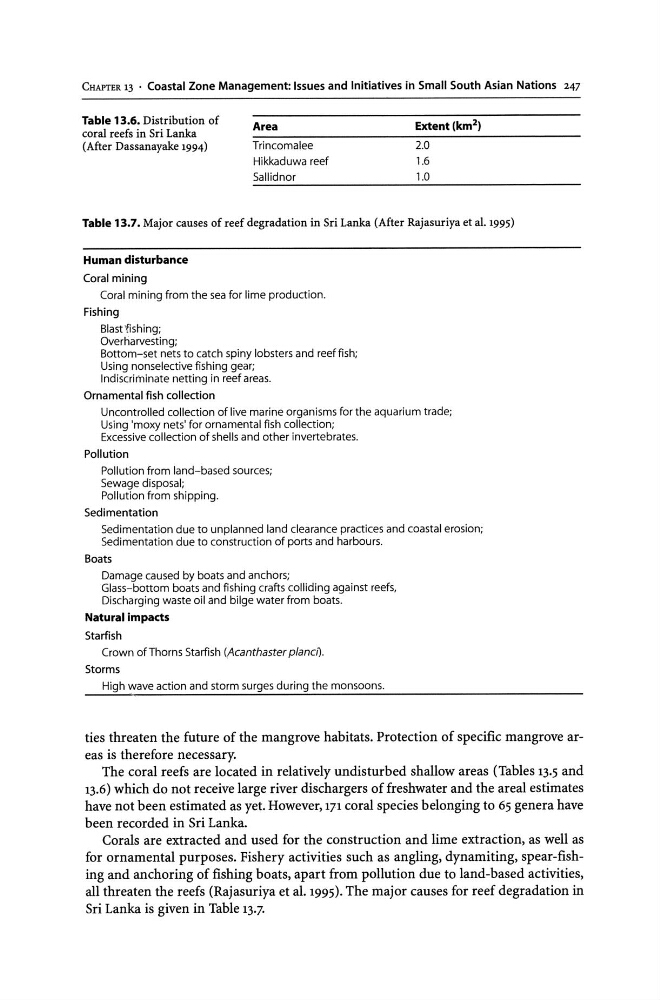
Table 13.6. Distribution of
coral reefs in Sri Lanka
(After Dassanayake 1994)
Area
Trincomalee
Hikkaduwa reef
Sallidnor
2.0
1.6
1.0
Table 13.7. Major causes of reef degradation in Sri Lanka (After Rajasuriya et al. 1995)
Human disturbance
Coral mining
Coral mining from the sea for lime production.
Fishing
Blast fishing;
Overharvesting;
Bottom-set nets to catch spiny lobsters and reef fish;
Using nonselective fishing gear;
Indiscriminate netting in reef areas.
Ornamental fish collection
Uncontrolled collection of live marine organisms for the aquarium trade;
Using 'moxy nets' for ornamental fish collection;
Excessive collection of shells and other invertebrates.
Pollution
Pollution from land-based sources;
Sewage disposal;
Pollution from shipping.
Sedimentation
Sedimentation due to unplanned land clearance practices and coastal erosion;
Sedimentation due to construction of ports and harbours.
Boats
Damage caused by boats and anchors;
Glass-bottom boats and fishing crafts colliding against reefs,
Discharging waste oil and bilge water from boats.
Natural impacts
Starfish
Crown ofThoms Starfish (Acanthaster planCl).
Storms
High wave action and storm surges during the monsoons.
ties threaten the future of the mangrove habitats. Protection of specific mangrove areas is therefore necessary.
The coral reefs are located in relatively undisturbed shallow areas (Tables 13.5 and
13.6) which do not receive large river dischargers of freshwater and the areal estimates
have not been estimated as yet. However, 171 coral species belonging to 65 genera have
been recorded in Sri Lanka.
Corals are extracted and used for the construction and lime extraction, as well as
for ornamental purposes. Fishery activities such as angling, dynamiting, spear-fishing and anchoring of fishing boats, apart from pollution due to land-based activities,
all threaten the reefs (Rajasuriya et al. 1995). The major causes for reef degradation in
Sri Lanka is given in Table 13.7.
Table 13.6. Distribution of
coral reefs in Sri Lanka
(After Dassanayake 1994)
Area
Trincomalee
Hikkaduwa reef
Sallidnor
2.0
1.6
1.0
Table 13.7. Major causes of reef degradation in Sri Lanka (After Rajasuriya et al. 1995)
Human disturbance
Coral mining
Coral mining from the sea for lime production.
Fishing
Blast fishing;
Overharvesting;
Bottom-set nets to catch spiny lobsters and reef fish;
Using nonselective fishing gear;
Indiscriminate netting in reef areas.
Ornamental fish collection
Uncontrolled collection of live marine organisms for the aquarium trade;
Using 'moxy nets' for ornamental fish collection;
Excessive collection of shells and other invertebrates.
Pollution
Pollution from land-based sources;
Sewage disposal;
Pollution from shipping.
Sedimentation
Sedimentation due to unplanned land clearance practices and coastal erosion;
Sedimentation due to construction of ports and harbours.
Boats
Damage caused by boats and anchors;
Glass-bottom boats and fishing crafts colliding against reefs,
Discharging waste oil and bilge water from boats.
Natural impacts
Starfish
Crown ofThoms Starfish (Acanthaster planCl).
Storms
High wave action and storm surges during the monsoons.
ties threaten the future of the mangrove habitats. Protection of specific mangrove areas is therefore necessary.
The coral reefs are located in relatively undisturbed shallow areas (Tables 13.5 and
13.6) which do not receive large river dischargers of freshwater and the areal estimates
have not been estimated as yet. However, 171 coral species belonging to 65 genera have
been recorded in Sri Lanka.
Corals are extracted and used for the construction and lime extraction, as well as
for ornamental purposes. Fishery activities such as angling, dynamiting, spear-fishing and anchoring of fishing boats, apart from pollution due to land-based activities,
all threaten the reefs (Rajasuriya et al. 1995). The major causes for reef degradation in
Sri Lanka is given in Table 13.7.