

Chapter 12
Integrated Coastal Zone Management (lCZM)
in Indonesia
S. Sukardjo
12.1
Introduction
Indon~ia is an archipelago country with 17085 islands and has more than 81 000 km
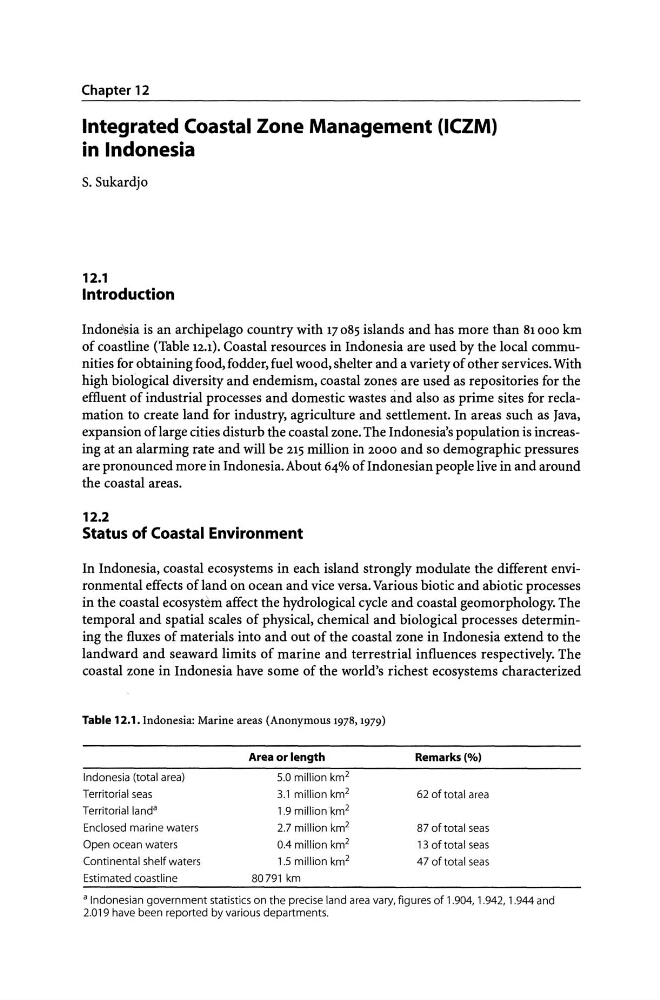
of coastline (Table 12.1). Coastal resources in Indonesia are used by the local communities for obtaining food, fodder, fuel wood, shelter and a variety of other services. With
high biological diversity and endemism, coastal zones are used as repositories for the
effluent of industrial processes and domestic wastes and also as prime sites for reclamation to create land for industry, agriculture and settlement. In areas such as Java,
expansion oflarge cities disturb the coastal zone. The Indonesia's population is increasing at an alarming rate and will be 215 million in 2000 and so demographic pressures
are pronounced more in Indonesia. About 64% ofIndonesian people live in and around
the coastal areas.
12.2
Status of Coastal Environment
In Indonesia, coastal ecosystems in each island strongly modulate the different environmental effects of land on ocean and vice versa. Various biotic and abiotic processes
in the coastal ecosystem affect the hydrological cycle and coastal geomorphology. The
temporal and spatial scales of physical, chemical and biological processes determining the fluxes of materials into and out of the coastal zone in Indonesia extend to the
landward and seaward limits of marine and terrestrial influences respectively. The
coastal zone in Indonesia have some of the world's richest ecosystems characterized
Table 12.1. Indonesia: Marine areas (Anonymous 1978, 1979)
Indonesia (total area)
Territorial seas
Territorialland a
Enclosed marine waters
Open ocean waters
Continental shelf waters
Estimated coastline
Area or length
5.0 million km 2
3.1 million km 2
1.9 million ·~m2
2.7 million km 2
0.4 million km 2
1.5 million km 2
80791 km
Remarks(%)
62 of total area
87 of total seas
13 oftota I seas
47 of total seas
a Indonesian government statistics on the precise land area vary, figures of 1.904, 1.942, 1.944 and
2.019 have been reported by various departments.
Integrated Coastal Zone Management (lCZM)
in Indonesia
S. Sukardjo
12.1
Introduction
Indon~ia is an archipelago country with 17085 islands and has more than 81 000 km
of coastline (Table 12.1). Coastal resources in Indonesia are used by the local communities for obtaining food, fodder, fuel wood, shelter and a variety of other services. With
high biological diversity and endemism, coastal zones are used as repositories for the
effluent of industrial processes and domestic wastes and also as prime sites for reclamation to create land for industry, agriculture and settlement. In areas such as Java,
expansion oflarge cities disturb the coastal zone. The Indonesia's population is increasing at an alarming rate and will be 215 million in 2000 and so demographic pressures
are pronounced more in Indonesia. About 64% ofIndonesian people live in and around
the coastal areas.
12.2
Status of Coastal Environment
In Indonesia, coastal ecosystems in each island strongly modulate the different environmental effects of land on ocean and vice versa. Various biotic and abiotic processes
in the coastal ecosystem affect the hydrological cycle and coastal geomorphology. The
temporal and spatial scales of physical, chemical and biological processes determining the fluxes of materials into and out of the coastal zone in Indonesia extend to the
landward and seaward limits of marine and terrestrial influences respectively. The
coastal zone in Indonesia have some of the world's richest ecosystems characterized
Table 12.1. Indonesia: Marine areas (Anonymous 1978, 1979)
Indonesia (total area)
Territorial seas
Territorialland a
Enclosed marine waters
Open ocean waters
Continental shelf waters
Estimated coastline
Area or length
5.0 million km 2
3.1 million km 2
1.9 million ·~m2
2.7 million km 2
0.4 million km 2
1.5 million km 2
80791 km
Remarks(%)
62 of total area
87 of total seas
13 oftota I seas
47 of total seas
a Indonesian government statistics on the precise land area vary, figures of 1.904, 1.942, 1.944 and
2.019 have been reported by various departments.