

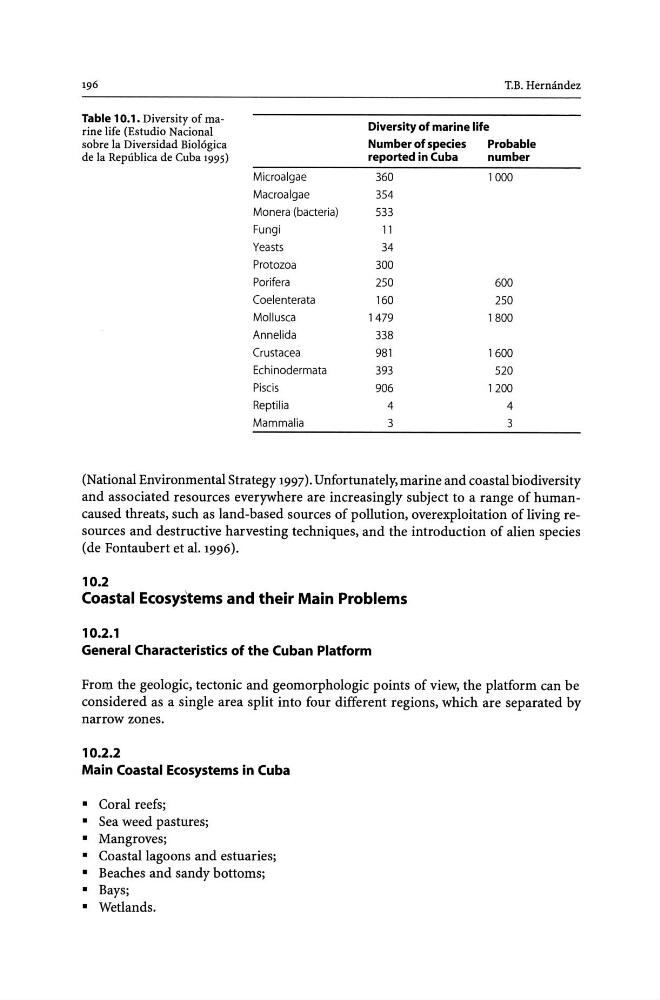
Table 10.1. Diversity of marine life (Estudio Nacional
sobre la Diversidad Biologica
de la Republica de Cuba 1995)
Microalgae
Macroalgae
Monera (bacteria)
Fungi
Yeasts
Protozoa
Porifera
Coelenterata
Mollusca
Annelida
Crustacea
Echinodermata
Piscis
Reptilia
Mammalia
T.B. Hernandez
Diversity of marine life
Number ofspecies
Probable
reported in Cuba
number
360
354
533
11
34
300
250
160
1479
338
981
393
906
4
3
1000
600
250
1800
1600
520
1200
4
3
(National Environmental Strategy 1997). Unfortunately, marine and coastal biodiversity
and associated resources everywhere are increasingly subject to a range of humancaused threats, such as land-based sources of pollution, overexploitation of living resources and destructive harvesting techniques, and the introduction of alien species
(de Fontaubert et al. 1996).
10.2
Coastal Ecosystems and their Main Problems
10.2.1
General Characteristics of the Cuban Platform
From the geologic, tectonic and geomorphologic points of view, the platform can be
considered as a single area split into four different regions, which are separated by
narrow zones.
10.2.2
Main Coastal Ecosystems in Cuba
• Coral reefs;
• Sea weed pastures;
• Mangroves;
• Coastal lagoons and estuaries;
• Beaches and sandy bottoms;
• Bays;
• Wetlands.
sobre la Diversidad Biologica
de la Republica de Cuba 1995)
Microalgae
Macroalgae
Monera (bacteria)
Fungi
Yeasts
Protozoa
Porifera
Coelenterata
Mollusca
Annelida
Crustacea
Echinodermata
Piscis
Reptilia
Mammalia
T.B. Hernandez
Diversity of marine life
Number ofspecies
Probable
reported in Cuba
number
360
354
533
11
34
300
250
160
1479
338
981
393
906
4
3
1000
600
250
1800
1600
520
1200
4
3
(National Environmental Strategy 1997). Unfortunately, marine and coastal biodiversity
and associated resources everywhere are increasingly subject to a range of humancaused threats, such as land-based sources of pollution, overexploitation of living resources and destructive harvesting techniques, and the introduction of alien species
(de Fontaubert et al. 1996).
10.2
Coastal Ecosystems and their Main Problems
10.2.1
General Characteristics of the Cuban Platform
From the geologic, tectonic and geomorphologic points of view, the platform can be
considered as a single area split into four different regions, which are separated by
narrow zones.
10.2.2
Main Coastal Ecosystems in Cuba
• Coral reefs;
• Sea weed pastures;
• Mangroves;
• Coastal lagoons and estuaries;
• Beaches and sandy bottoms;
• Bays;
• Wetlands.