

176
LOW
25
STRESS
20
15
SfG
(J/g/hr)
10
MODERATE
STRESS
5
o
SEVERE
• Musselburgh
: l~~W~~~fon
Vaxler vdI. Trow rocks
• Orkney
• Berwick
• GlussVoe
I Cresswell
Coquet
• Montrose
COASTAL
Teesmout
• Whitby
• Filey Brigg
• Humber
A.R.D. Stebbing . R.I. Willows
OFFSHORE
• Dudgeon
• Dowsing
S.Goodwin
Sunk * E. Goodwin
• Sandettie
• Falls
• Walberswick
Creeksea
Hunstanton
• Whitstable
• Harwich
• Cleethorpes
• Southend
• Ythan
ESTUARINE
• Swale
STRESS -5 1-----11-----+-----+-----+-----+---'
o
50
100
150
200
250
Approximate water age (days)
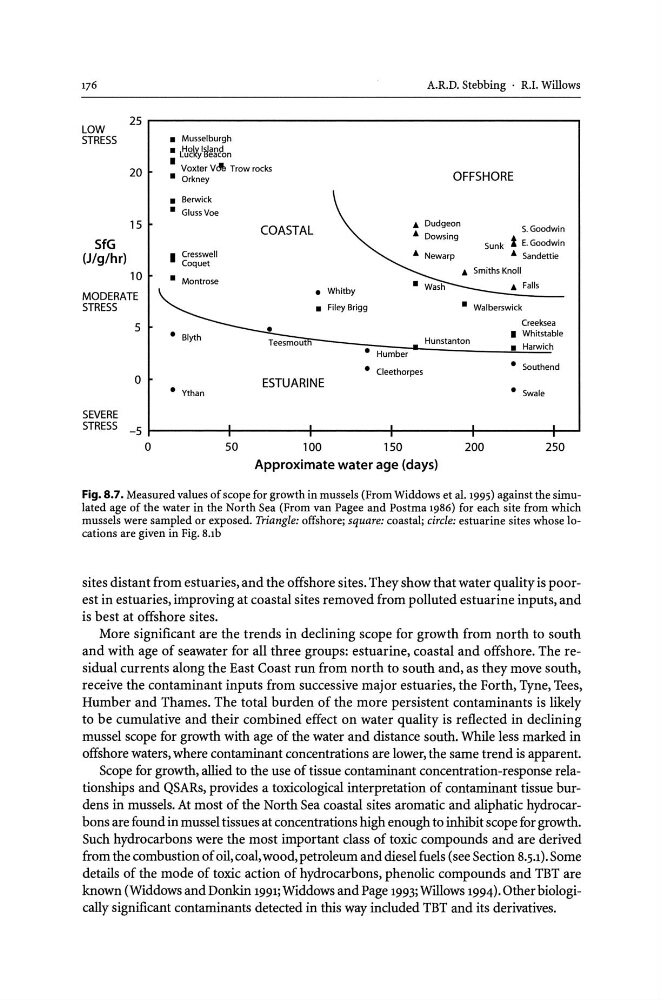
Fig. 8.7. Measured values of scope for growth in mussels (From Widdows et al. 1995) against the simulated age of the water in the North Sea (From van Pagee and Postma 1986) for each site from which
mussels were sampled or exposed. Triangle: offshore; square: coastal; circle: estuarine sites whose locations are given in Fig. 8.1b
sites distant from estuaries, and the offshore sites. They show that water quality is poorest in estuaries, improving at coastal sites removed from polluted estuarine inputs, and
is best at offshore sites.
More significant are the trends in declining scope for growth from north to south
and with age of seawater for all three groups: estuarine, coastal and offshore. The residual currents along the East Coast run from north to south and, as they move south,
receive the contaminant inputs from successive major estuaries, the Forth, Tyne, Tees,
Humber and Thames. The total burden of the more persistent contaminants is likely
to be cumulative and their combined effect on water quality is reflected in declining
mussel scope for growth with age of the water and distance south. While less marked in
offshore waters, where contaminant concentrations are lower, the same trend is apparent.
Scope for growth, allied to the use of tissue contaminant concentration-response relationships and QSARs, provides a toxicological interpretation of contaminant tissue burdens in mussels. At most of the North Sea coastal sites aromatic and aliphatic hydrocarbons are found in mussel tissues at concentrations high enough to inhibit scope for growth.
Such hydrocarbons were the most important class of toxic compounds and are derived
from the combustion of oil, coal, wood, petroleum and diesel fuels (see Section 8.5.1). Some
details of the mode of toxic action of hydrocarbons, phenolic compounds and TBT are
known (Widdows and Donkin 1991; Widdows and Page 1993; Willows 1994). Other biologically significant contaminants detected in this way included TBT and its derivatives.
LOW
25
STRESS
20
15
SfG
(J/g/hr)
10
MODERATE
STRESS
5
o
SEVERE
• Musselburgh
: l~~W~~~fon
Vaxler vdI. Trow rocks
• Orkney
• Berwick
• GlussVoe
I Cresswell
Coquet
• Montrose
COASTAL
Teesmout
• Whitby
• Filey Brigg
• Humber
A.R.D. Stebbing . R.I. Willows
OFFSHORE
• Dudgeon
• Dowsing
S.Goodwin
Sunk * E. Goodwin
• Sandettie
• Falls
• Walberswick
Creeksea
Hunstanton
• Whitstable
• Harwich
• Cleethorpes
• Southend
• Ythan
ESTUARINE
• Swale
STRESS -5 1-----11-----+-----+-----+-----+---'
o
50
100
150
200
250
Approximate water age (days)
Fig. 8.7. Measured values of scope for growth in mussels (From Widdows et al. 1995) against the simulated age of the water in the North Sea (From van Pagee and Postma 1986) for each site from which
mussels were sampled or exposed. Triangle: offshore; square: coastal; circle: estuarine sites whose locations are given in Fig. 8.1b
sites distant from estuaries, and the offshore sites. They show that water quality is poorest in estuaries, improving at coastal sites removed from polluted estuarine inputs, and
is best at offshore sites.
More significant are the trends in declining scope for growth from north to south
and with age of seawater for all three groups: estuarine, coastal and offshore. The residual currents along the East Coast run from north to south and, as they move south,
receive the contaminant inputs from successive major estuaries, the Forth, Tyne, Tees,
Humber and Thames. The total burden of the more persistent contaminants is likely
to be cumulative and their combined effect on water quality is reflected in declining
mussel scope for growth with age of the water and distance south. While less marked in
offshore waters, where contaminant concentrations are lower, the same trend is apparent.
Scope for growth, allied to the use of tissue contaminant concentration-response relationships and QSARs, provides a toxicological interpretation of contaminant tissue burdens in mussels. At most of the North Sea coastal sites aromatic and aliphatic hydrocarbons are found in mussel tissues at concentrations high enough to inhibit scope for growth.
Such hydrocarbons were the most important class of toxic compounds and are derived
from the combustion of oil, coal, wood, petroleum and diesel fuels (see Section 8.5.1). Some
details of the mode of toxic action of hydrocarbons, phenolic compounds and TBT are
known (Widdows and Donkin 1991; Widdows and Page 1993; Willows 1994). Other biologically significant contaminants detected in this way included TBT and its derivatives.