

CHAPTER 8 • Quality Status, Appropriate Monitoring and Legislation of the North Sea
163
the biological impact of pollution, and the criteria for environmental quality are biological, the compelling logic is to use biological indices of pollution. The advantages
of such an approach are outlined below.
Detection of new and unsuspected pollutants. To depend on a chemically-orientated approach presumes that it is known which chemical contaminants are likely to
be important, but repeatedly the detection of environmentally significant, new contaminants has depended upon research that recognized their biological impact. Numerous
examples could be cited, such egg shell thinning in birds due to organochlorine pesticides, but the best marine example is probably that of TBT (tributyl tin), a biocide used
in antifouling paints (see Champ and Seligman 1996). It was first detected due to the
failure of oyster larvae to metamorphose and the shell-thickening of adult oysters
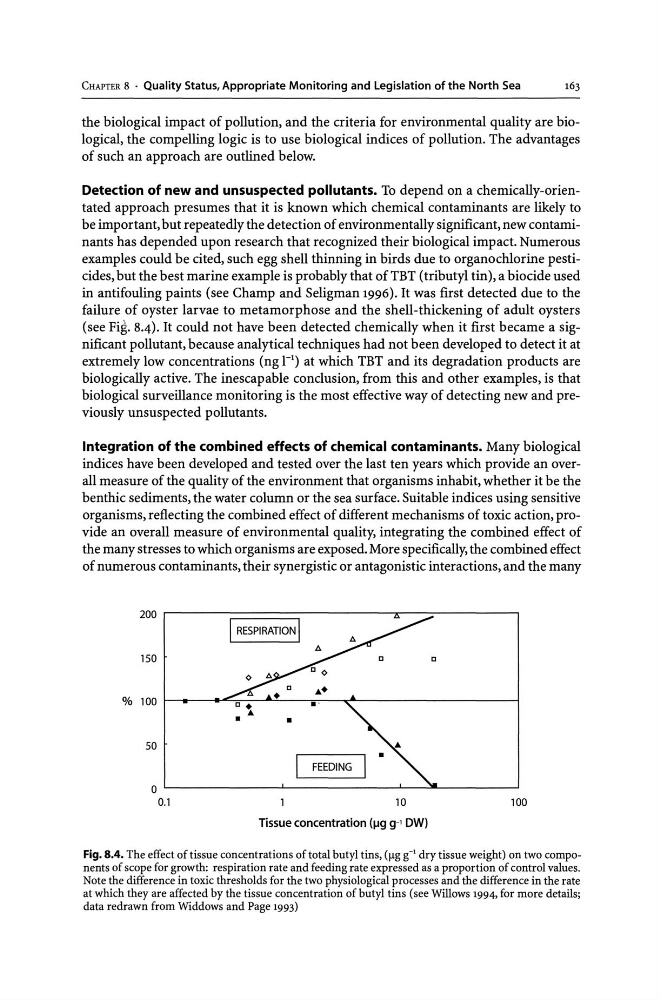
(see Fig. 8.4). It could not have been detected chemically when it first became a significant pollutant, because analytical techniques had not been developed to detect it at
extremely low concentrations (ng 1-1) at which TBT and its degradation products are
biologically active. The inescapable conclusion, from this and other examples, is that
biological surveillance monitoring is the most effective way of detecting new and previously unsuspected pollutants.
Integration of the combined effects of chemical contaminants. Many biological
indices have been developed and tested over the last ten years which provide an overall measure of the quality of the environment that organisms inhabit, whether it be the
benthic sediments, the water column or the sea surface. Suitable indices using sensitive
organisms, reflecting the combined effect of different mechanisms of toxic action, provide an overall measure of environmental quality, integrating the combined effect of
the many stresses to which organisms are exposed. More specifically, the combined effect
of numerous contaminants, their synergistic or antagonistic interactions, and the many
200,-----~======~--------
150
"
.. +
0/0 100 r-~--~~07~~---..~ . . --~L--------------------1
•
•
50
o ~------------~------------~--~--------~
0.1
10
Tissue concentration (lJg g-1 OW)
100
Fig. 8.4. The effect of tissue concentrations of total butyl tins, (Ilg g-l dry tissue weight) on two components of scope for growth: respiration rate and feeding rate expressed as a proportion of control values.
Note the difference in toxic thresholds for the two physiological processes and the difference in the rate
at which they are affected by the tissue concentration of butyl tins (see Willows 1994, for more details;
data redrawn from Widdows and Page 1993)
163
the biological impact of pollution, and the criteria for environmental quality are biological, the compelling logic is to use biological indices of pollution. The advantages
of such an approach are outlined below.
Detection of new and unsuspected pollutants. To depend on a chemically-orientated approach presumes that it is known which chemical contaminants are likely to
be important, but repeatedly the detection of environmentally significant, new contaminants has depended upon research that recognized their biological impact. Numerous
examples could be cited, such egg shell thinning in birds due to organochlorine pesticides, but the best marine example is probably that of TBT (tributyl tin), a biocide used
in antifouling paints (see Champ and Seligman 1996). It was first detected due to the
failure of oyster larvae to metamorphose and the shell-thickening of adult oysters
(see Fig. 8.4). It could not have been detected chemically when it first became a significant pollutant, because analytical techniques had not been developed to detect it at
extremely low concentrations (ng 1-1) at which TBT and its degradation products are
biologically active. The inescapable conclusion, from this and other examples, is that
biological surveillance monitoring is the most effective way of detecting new and previously unsuspected pollutants.
Integration of the combined effects of chemical contaminants. Many biological
indices have been developed and tested over the last ten years which provide an overall measure of the quality of the environment that organisms inhabit, whether it be the
benthic sediments, the water column or the sea surface. Suitable indices using sensitive
organisms, reflecting the combined effect of different mechanisms of toxic action, provide an overall measure of environmental quality, integrating the combined effect of
the many stresses to which organisms are exposed. More specifically, the combined effect
of numerous contaminants, their synergistic or antagonistic interactions, and the many
200,-----~======~--------
150
"
.. +
0/0 100 r-~--~~07~~---..~ . . --~L--------------------1
•
•
50
o ~------------~------------~--~--------~
0.1
10
Tissue concentration (lJg g-1 OW)
100
Fig. 8.4. The effect of tissue concentrations of total butyl tins, (Ilg g-l dry tissue weight) on two components of scope for growth: respiration rate and feeding rate expressed as a proportion of control values.
Note the difference in toxic thresholds for the two physiological processes and the difference in the rate
at which they are affected by the tissue concentration of butyl tins (see Willows 1994, for more details;
data redrawn from Widdows and Page 1993)