

CHAPTER 8 . Quality Status, Appropriate Monitoring and Legislation of the North Sea
159
Loading of
assimilative
capacity
Value to
society of
environment
Economic benefits
- assimilation of wastes
- sewage and wastes
- recycling organic inputs from
land and industry
- detoxication of organics
- energy subsidy to ecosystem
1
Ecological
response
Toxic
effect
!
f per unit of
assimilative
capacity
I Conta~ir:'ant inputs I
to receiving waters
i
Environmental capacity
LOAD
OVERLOAD
Degradable organics a
.!J
Non-degradable toxic inputs
I
b
Financial efficiency I C
_~ "OC
_AS--I>Inpuls _ _
Overloading
of assimilative
capacity
Assimilative
capacity
Loss of value to
Assimilative
society of
capacity
environment
Economic costs
-loss of water quality - fisheries.
aquaculture, bathing water
-loss of capacity to assimilate
and detoxify inputs
-loss of biodiversity
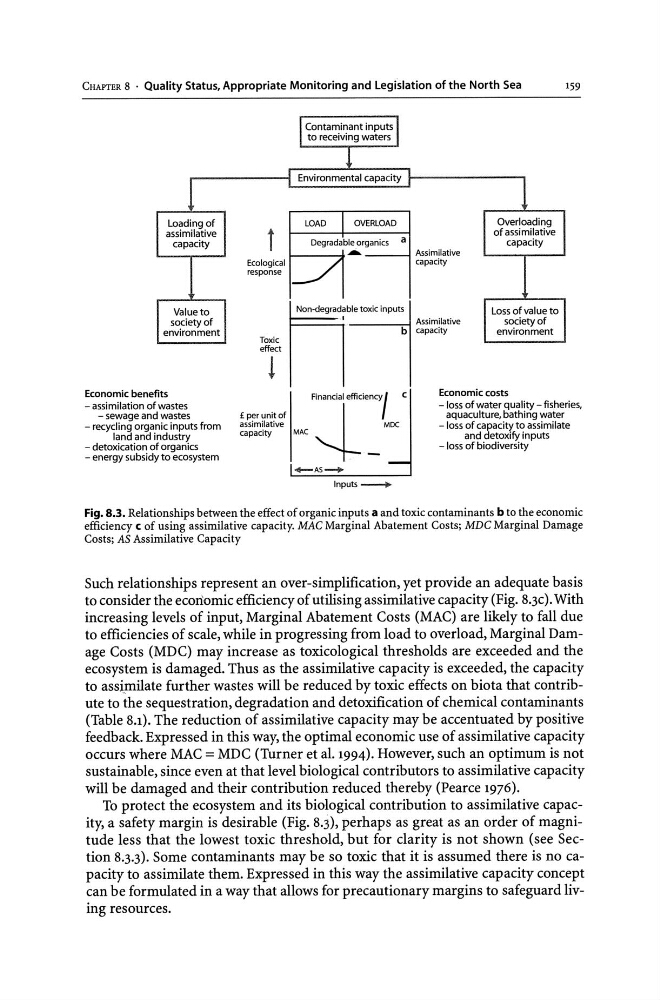
Fig. 8.3. Relationships between the effect of organic inputs a and toxic contaminants b to the economic
efficiency c of using assimilative capacity. MAC Marginal Abatement Costs; MDe Marginal Damage
Costs; AS Assimilative Capacity
Such relationships represent an over-simplification, yet provide an adequate basis
to consider the economic efficiency of utilising assimilative capacity (Fig. 8.3c). With
increasing levels of input, Marginal Abatement Costs (MAC) are likely to fall due
to efficiencies of scale, while in progressing from load to overload, Marginal Damage Costs (MDC) may increase as toxicological thresholds are exceeded and the
ecosystem is damaged. Thus as the assimilative capacity is exceeded, the capacity
to assimilate further wastes will be reduced by toxic effects on biota that contribute to the sequestration, degradation and detoxification of chemical contaminants
(Table 8.1). The reduction of assimilative capacity may be accentuated by positive
feedback. Expressed in this way, the optimal economic use of assimilative capacity
occurs where MAC = MDC (Turner et al. 1994). However, such an optimum is not
sustainable, since even at that level biological contributors to assimilative capacity
will be damaged and their contribution reduced thereby (Pearce 1976).
To protect the ecosystem and its biological contribution to assimilative capacity, a safety margin is desirable (Fig. 8.3), perhaps as great as an order of magnitude less that the lowest toxic threshold, but for clarity is not shown (see Section 8.3.3). Some contaminants may be so toxic that it is assumed there is no capacity to assimilate them. Expressed in this way the assimilative capacity concept
can be formulated in a way that allows for precautionary margins to safeguard living resources.
159
Loading of
assimilative
capacity
Value to
society of
environment
Economic benefits
- assimilation of wastes
- sewage and wastes
- recycling organic inputs from
land and industry
- detoxication of organics
- energy subsidy to ecosystem
1
Ecological
response
Toxic
effect
!
f per unit of
assimilative
capacity
I Conta~ir:'ant inputs I
to receiving waters
i
Environmental capacity
LOAD
OVERLOAD
Degradable organics a
.!J
Non-degradable toxic inputs
I
b
Financial efficiency I C
_~ "OC
_AS--I>Inpuls _ _
Overloading
of assimilative
capacity
Assimilative
capacity
Loss of value to
Assimilative
society of
capacity
environment
Economic costs
-loss of water quality - fisheries.
aquaculture, bathing water
-loss of capacity to assimilate
and detoxify inputs
-loss of biodiversity
Fig. 8.3. Relationships between the effect of organic inputs a and toxic contaminants b to the economic
efficiency c of using assimilative capacity. MAC Marginal Abatement Costs; MDe Marginal Damage
Costs; AS Assimilative Capacity
Such relationships represent an over-simplification, yet provide an adequate basis
to consider the economic efficiency of utilising assimilative capacity (Fig. 8.3c). With
increasing levels of input, Marginal Abatement Costs (MAC) are likely to fall due
to efficiencies of scale, while in progressing from load to overload, Marginal Damage Costs (MDC) may increase as toxicological thresholds are exceeded and the
ecosystem is damaged. Thus as the assimilative capacity is exceeded, the capacity
to assimilate further wastes will be reduced by toxic effects on biota that contribute to the sequestration, degradation and detoxification of chemical contaminants
(Table 8.1). The reduction of assimilative capacity may be accentuated by positive
feedback. Expressed in this way, the optimal economic use of assimilative capacity
occurs where MAC = MDC (Turner et al. 1994). However, such an optimum is not
sustainable, since even at that level biological contributors to assimilative capacity
will be damaged and their contribution reduced thereby (Pearce 1976).
To protect the ecosystem and its biological contribution to assimilative capacity, a safety margin is desirable (Fig. 8.3), perhaps as great as an order of magnitude less that the lowest toxic threshold, but for clarity is not shown (see Section 8.3.3). Some contaminants may be so toxic that it is assumed there is no capacity to assimilate them. Expressed in this way the assimilative capacity concept
can be formulated in a way that allows for precautionary margins to safeguard living resources.