

CHAPTER 8 . Quality Status, Appropriate Monitoring and Legislation of the North Sea
157
Environmental
Quality Standard
Assim!lative {
capaCity
Toxic exposure
r
f'>"lro,>
Chemical
'>1_'>t"l
contaminant
cO'>t" .
concentration
Limit of legal use of A C
'>1''>'''>t co.::"'-""""-------''------1
'/)ce/Jtri/fj'
70,>
Tolerable exposure
L -__________________________________ L -__ ~
Distance from contaminant source -------i~~
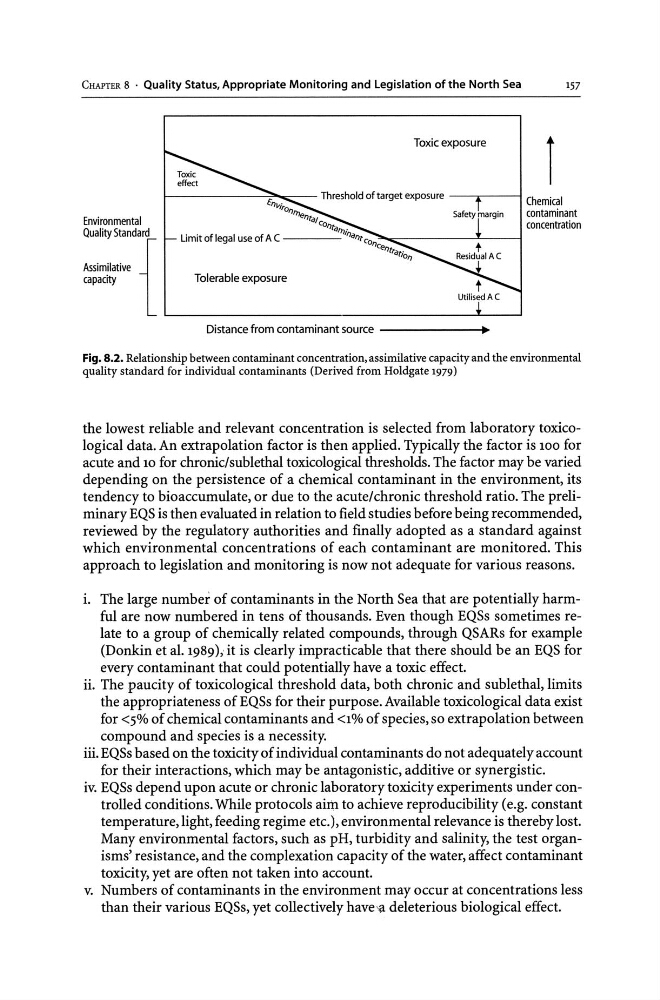
Fig. 8.2. Relationship between contaminant concentration, assimilative capacity and the environmental
quality standard for individual contaminants (Derived from Holdgate 1979)
the lowest reliable and relevant concentration is selected from laboratory toxicological data. An extrapolation factor is then applied. Typically the factor is 100 for
acute and 10 for chronic/sublethal toxicological thresholds. The factor may be varied
depending on the persistence of a chemical contaminant in the environment, its
tendency to bioaccumulate, or due to the acute/chronic threshold ratio. The preliminary EQS is then evaluated in relation to field studies before being recommended,
reviewed by the regulatory authorities and finally adopted as a standard against
which environmental concentrations of each contaminant are monitored. This
approach to legislation and monitoring is now not adequate for various reasons.
i. The large number of contaminants in the North Sea that are potentially harmful are now numbered in tens of thousands. Even though EQSs sometimes relate to a group of chemically related compounds, through QSARs for example
(Donkin et al. 1989), it is clearly impracticable that there should be an EQS for
every contaminant that could potentially have a toxic effect.
ii. The paucity of toxicological threshold data, both chronic and sublethal, limits
the appropriateness of EQSs for their purpose. Available toxicological data exist
for <5% of chemical contaminants and <1% of species, so extrapolation between
compound and species is a necessity.
iii. EQSs based on the toxicity of individual contaminants do not adequately account
for their interactions, which may be antagonistic, additive or synergistic.
iv. EQSs depend upon acute or chronic laboratory toxicity experiments under controlled conditions. While protocols aim to achieve reproducibility (e.g. constant
temperature, light, feeding regime etc.), environmental relevance is thereby lost.
Many environmental factors, such as pH, turbidity and salinity, the test organisms' resistance, and the complexation capacity of the water, affect contaminant
toxicity, yet are often not taken into account.
v. Numbers of contaminants in the environment may occur at concentrations less
than their various EQSs, yet collectively have \Ii deleterious biological effect.
157
Environmental
Quality Standard
Assim!lative {
capaCity
Toxic exposure
r
f'>"lro,>
Chemical
'>1_'>t"l
contaminant
cO'>t" .
concentration
Limit of legal use of A C
'>1''>'''>t co.::"'-""""-------''------1
'/)ce/Jtri/fj'
70,>
Tolerable exposure
L -__________________________________ L -__ ~
Distance from contaminant source -------i~~
Fig. 8.2. Relationship between contaminant concentration, assimilative capacity and the environmental
quality standard for individual contaminants (Derived from Holdgate 1979)
the lowest reliable and relevant concentration is selected from laboratory toxicological data. An extrapolation factor is then applied. Typically the factor is 100 for
acute and 10 for chronic/sublethal toxicological thresholds. The factor may be varied
depending on the persistence of a chemical contaminant in the environment, its
tendency to bioaccumulate, or due to the acute/chronic threshold ratio. The preliminary EQS is then evaluated in relation to field studies before being recommended,
reviewed by the regulatory authorities and finally adopted as a standard against
which environmental concentrations of each contaminant are monitored. This
approach to legislation and monitoring is now not adequate for various reasons.
i. The large number of contaminants in the North Sea that are potentially harmful are now numbered in tens of thousands. Even though EQSs sometimes relate to a group of chemically related compounds, through QSARs for example
(Donkin et al. 1989), it is clearly impracticable that there should be an EQS for
every contaminant that could potentially have a toxic effect.
ii. The paucity of toxicological threshold data, both chronic and sublethal, limits
the appropriateness of EQSs for their purpose. Available toxicological data exist
for <5% of chemical contaminants and <1% of species, so extrapolation between
compound and species is a necessity.
iii. EQSs based on the toxicity of individual contaminants do not adequately account
for their interactions, which may be antagonistic, additive or synergistic.
iv. EQSs depend upon acute or chronic laboratory toxicity experiments under controlled conditions. While protocols aim to achieve reproducibility (e.g. constant
temperature, light, feeding regime etc.), environmental relevance is thereby lost.
Many environmental factors, such as pH, turbidity and salinity, the test organisms' resistance, and the complexation capacity of the water, affect contaminant
toxicity, yet are often not taken into account.
v. Numbers of contaminants in the environment may occur at concentrations less
than their various EQSs, yet collectively have \Ii deleterious biological effect.