

112
A.J. Underwood . M.G. Chapman
Therefore, any previous condition is not necessarily appropriate at the time a particular proposal is made to begin restoration.
Second, even if we could reach a decision about the previous conditions that restoration is attempting to achieve, it is unlikely that there are adequate data to describe
these quantitatively (except perhaps for certain large plants and/or a few species of
vertebrates). Most species are not only characterized by average changes in abundances
from place to place and time to time. Abundances also vary at an hierarchy of small
and large spatial and temporal scales and patterns of variance across these scales may
be extremely important in
i. quantifying natural patterns of abundance and
ii. identifying responses of assemblages to disturbances or restoration (Underwood
1992, 1994a; Warkwick and Clarke 1995).
These findings are relatively recent and it is extremely unlikely that the relevant data
about spatial and temporal variability are available for historic or past conditions for
most habitats being restored.
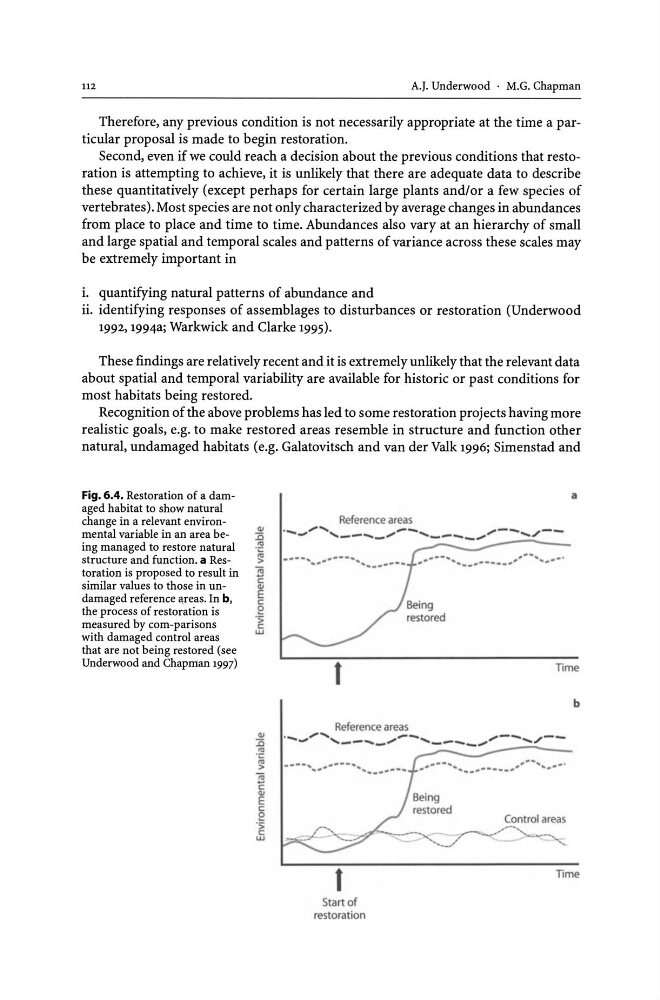
Recognition of the above problems has led to some restoration projects having more
realistic goals, e.g. to make restored areas resemble in structure and function other
natural, undamaged habitats (e.g. Galatovitsch and van der Valk 1996; Simenstad and
Fig. 6.4. Restoration of a damaged habitat to show natural
change in a relevant environmental variable in an area being managed to restore natural
structure and function. a Restoration is proposed to result in
similar values to those in undamaged reference ' 1reas. In b,
the process of restoration is
measured by com-parisons
with damaged control areas
that are not being restored (see
Underwood and Chapman 1997)
'"
:0
.!!!
~
-;;;
C 0/
E c
e
.::;
c
w
a
Reference areas
' ~~"'--~-;~~'--~-~/-~'/-t
Time
b
Reference areas
' ~~", - -~-~~~,--~-~~-~,/-t
Start of
restoration
Control areas
~~~
Time
A.J. Underwood . M.G. Chapman
Therefore, any previous condition is not necessarily appropriate at the time a particular proposal is made to begin restoration.
Second, even if we could reach a decision about the previous conditions that restoration is attempting to achieve, it is unlikely that there are adequate data to describe
these quantitatively (except perhaps for certain large plants and/or a few species of
vertebrates). Most species are not only characterized by average changes in abundances
from place to place and time to time. Abundances also vary at an hierarchy of small
and large spatial and temporal scales and patterns of variance across these scales may
be extremely important in
i. quantifying natural patterns of abundance and
ii. identifying responses of assemblages to disturbances or restoration (Underwood
1992, 1994a; Warkwick and Clarke 1995).
These findings are relatively recent and it is extremely unlikely that the relevant data
about spatial and temporal variability are available for historic or past conditions for
most habitats being restored.
Recognition of the above problems has led to some restoration projects having more
realistic goals, e.g. to make restored areas resemble in structure and function other
natural, undamaged habitats (e.g. Galatovitsch and van der Valk 1996; Simenstad and
Fig. 6.4. Restoration of a damaged habitat to show natural
change in a relevant environmental variable in an area being managed to restore natural
structure and function. a Restoration is proposed to result in
similar values to those in undamaged reference ' 1reas. In b,
the process of restoration is
measured by com-parisons
with damaged control areas
that are not being restored (see
Underwood and Chapman 1997)
'"
:0
.!!!
~
-;;;
C 0/
E c
e
.::;
c
w
a
Reference areas
' ~~"'--~-;~~'--~-~/-~'/-t
Time
b
Reference areas
' ~~", - -~-~~~,--~-~~-~,/-t
Start of
restoration
Control areas
~~~
Time