

CHAPTER 5 • Chances for Nature - A Matter of Substitution
93
sidered valuable regardless of human use. Active human intervention is considered
necessary since nature cannot defend itself against the threats from society. Nature is
isolated from the economy since substitution within the natural capital stock and substitution between nature and other capital stocks are rejected. As such this view corresponds with the concept of strong sustain ability. All forms of substitution are rejected,
since the consequences from substitution are not known. From a conservation perspective, a "no regret strategy" is chosen by rejecting substitutions. To prevent the occurrence of irreversibilities, economic opportunities are passed by. Chances for nature are
maximized while accepting risks for the economy. The substitution ratio within the
natural capital stock is zero as illustrated by the L-shaped isoquant in Fig. 5.l.
The basic rationale of the conservation approach is that substitution has caused degradation of the natural environment. The influence of the conservation approach in public
policy, can be seen in the segregation of economic policies and policies for nature.
5.4.2
Functionality
According to the functional view nature derives its value from the functions it performs
for society. Utilisation of nature in order to generate income, is the main objective of
this view. This does not necessarily mean that nature cannot have an intrinsic value
according to this view, but it will only have one if humans find it important for some
reason; if they are willing to pay for its mere existence (investing in the mere existence
of nature, is regarded as a form of saving according to the functional view). Well functioning markets are supposed to account for the welfare generating capacity of nature,
ensuring that producers will not destroy their source of income. Since income
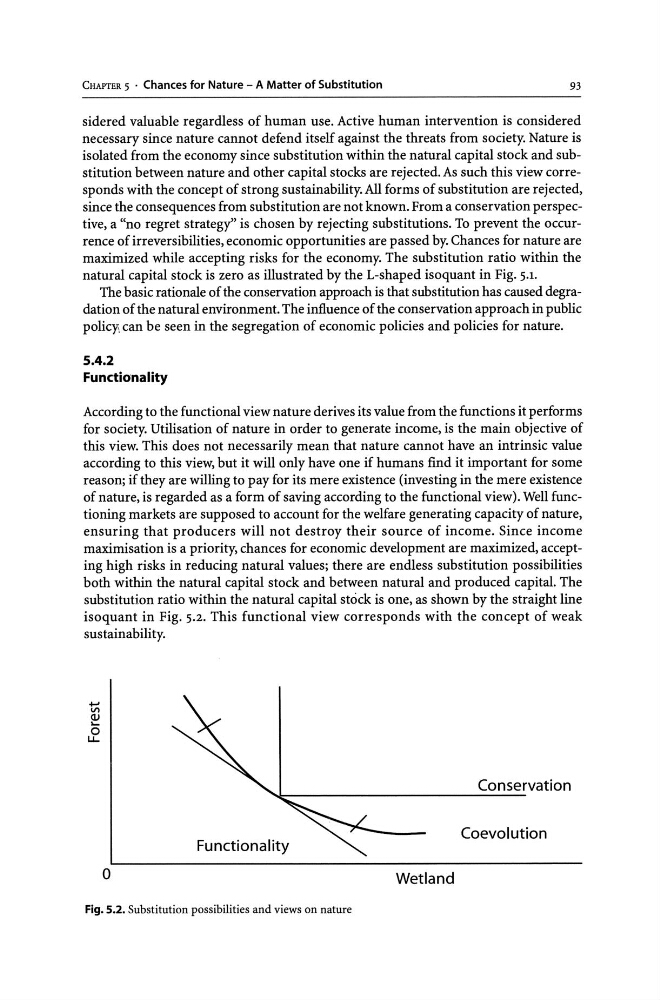
maximisation is a priority, chances for economic development are maximized, accepting high risks in reducing natural values; there are endless substitution possibilities
both within the natural capital stock and between natural and produced capital. The
substitution ratio within the natural capital stock is one, as shown by the straight line
isoquant in Fig. 5.2. This functional view corresponds with the concept of weak
sustainability.
Conservation
Functionality
Coevolution
o
Wetland
Fig. 5.2. Substitution possibilities and views on nature
93
sidered valuable regardless of human use. Active human intervention is considered
necessary since nature cannot defend itself against the threats from society. Nature is
isolated from the economy since substitution within the natural capital stock and substitution between nature and other capital stocks are rejected. As such this view corresponds with the concept of strong sustain ability. All forms of substitution are rejected,
since the consequences from substitution are not known. From a conservation perspective, a "no regret strategy" is chosen by rejecting substitutions. To prevent the occurrence of irreversibilities, economic opportunities are passed by. Chances for nature are
maximized while accepting risks for the economy. The substitution ratio within the
natural capital stock is zero as illustrated by the L-shaped isoquant in Fig. 5.l.
The basic rationale of the conservation approach is that substitution has caused degradation of the natural environment. The influence of the conservation approach in public
policy, can be seen in the segregation of economic policies and policies for nature.
5.4.2
Functionality
According to the functional view nature derives its value from the functions it performs
for society. Utilisation of nature in order to generate income, is the main objective of
this view. This does not necessarily mean that nature cannot have an intrinsic value
according to this view, but it will only have one if humans find it important for some
reason; if they are willing to pay for its mere existence (investing in the mere existence
of nature, is regarded as a form of saving according to the functional view). Well functioning markets are supposed to account for the welfare generating capacity of nature,
ensuring that producers will not destroy their source of income. Since income
maximisation is a priority, chances for economic development are maximized, accepting high risks in reducing natural values; there are endless substitution possibilities
both within the natural capital stock and between natural and produced capital. The
substitution ratio within the natural capital stock is one, as shown by the straight line
isoquant in Fig. 5.2. This functional view corresponds with the concept of weak
sustainability.
Conservation
Functionality
Coevolution
o
Wetland
Fig. 5.2. Substitution possibilities and views on nature