

90
E.C.M. Ruijgrok . P. Vellinga
• It is diffuse. It is not homogeneous in quality and it performs different functions at
different places. E.g. the water in a river may differ in quality at different locations,
because it is used for different purposes at different places.
• There are indivisibilities, which means that the welfare generated by one unit cannot
be calculated. The welfare generated by 1 m 2 of a lake of a size of 100 m 2 , is not equal
to 1% of the total value of the lake. In fact a lake of one square cannot function properly and may not generate anything at all. There are minimum scale requirements.
• There may be thresholds, leading to a sudden huge change in the welfare generating
capacity, when the stock is reduced by one extra unit.
• There can be complementarities between various environmental goods (e.g. food
chains), but also between natural capital and other forms of capital (e.g. source and
sink relations).
These characteristics determine the physical substitution possibilities. They also make
natural capital hard to both quantify and qualify. If one wants to make sure that our present
substitution behaviour is optimal (that is maximum welfare generation, without reducing the welfare potential), one should identify substitution possibilities. Substitution
possibilities depend on physical restrictions whereas actual substitution behaviour
depends on economic values. Restrained by physical conditions, the economic values of
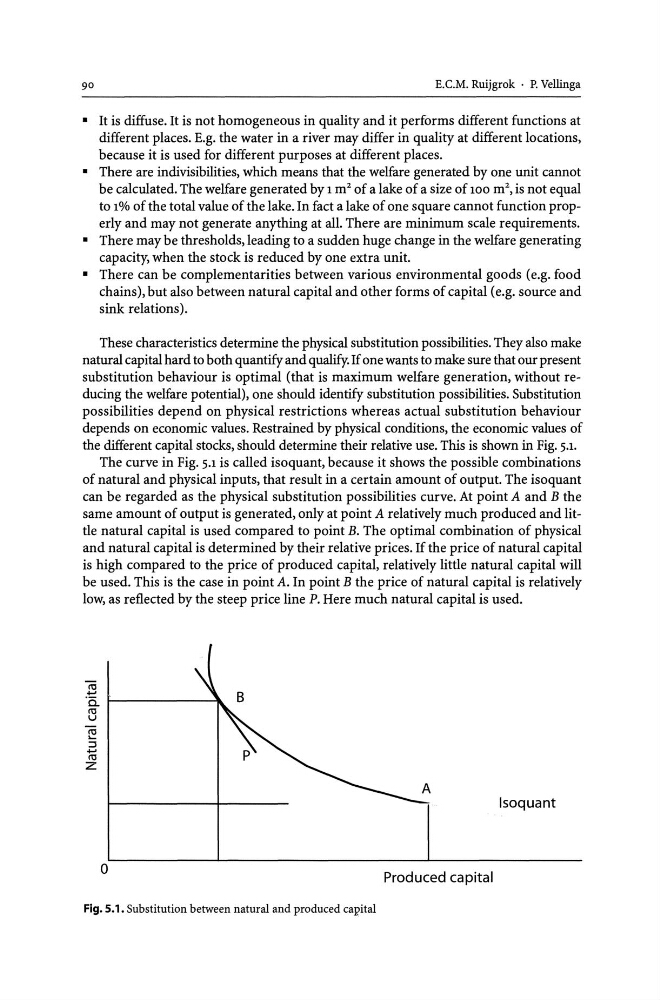
the different capital stocks, should determine their relative use. This is shown in Fig. 5.l.
The curve in Fig. 5.1 is called isoquant, because it shows the possible combinations
of natural and physical inputs, that result in a certain amount of output. The isoquant
can be regarded as the physical substitution possibilities curve. At point A and B the
same amount of output is generated, only at point A relatively much produced and little natural capital is used compared to point B. The optimal combination of physical
and natural capital is determined by their relative prices. If the price of natural capital
is high compared to the price of produced capital, relatively little natural capital will
be used. This is the case in point A. In point B the price of natural capital is relatively
low, as reflected by the steep price line P. Here much natural capital is used.
~
.~ ~----------~
"' u
~
:::l
.....
"'
Z
o
Fig. 5.1. Substitution between natural and produced capital
Isoquant
Produced capital
E.C.M. Ruijgrok . P. Vellinga
• It is diffuse. It is not homogeneous in quality and it performs different functions at
different places. E.g. the water in a river may differ in quality at different locations,
because it is used for different purposes at different places.
• There are indivisibilities, which means that the welfare generated by one unit cannot
be calculated. The welfare generated by 1 m 2 of a lake of a size of 100 m 2 , is not equal
to 1% of the total value of the lake. In fact a lake of one square cannot function properly and may not generate anything at all. There are minimum scale requirements.
• There may be thresholds, leading to a sudden huge change in the welfare generating
capacity, when the stock is reduced by one extra unit.
• There can be complementarities between various environmental goods (e.g. food
chains), but also between natural capital and other forms of capital (e.g. source and
sink relations).
These characteristics determine the physical substitution possibilities. They also make
natural capital hard to both quantify and qualify. If one wants to make sure that our present
substitution behaviour is optimal (that is maximum welfare generation, without reducing the welfare potential), one should identify substitution possibilities. Substitution
possibilities depend on physical restrictions whereas actual substitution behaviour
depends on economic values. Restrained by physical conditions, the economic values of
the different capital stocks, should determine their relative use. This is shown in Fig. 5.l.
The curve in Fig. 5.1 is called isoquant, because it shows the possible combinations
of natural and physical inputs, that result in a certain amount of output. The isoquant
can be regarded as the physical substitution possibilities curve. At point A and B the
same amount of output is generated, only at point A relatively much produced and little natural capital is used compared to point B. The optimal combination of physical
and natural capital is determined by their relative prices. If the price of natural capital
is high compared to the price of produced capital, relatively little natural capital will
be used. This is the case in point A. In point B the price of natural capital is relatively
low, as reflected by the steep price line P. Here much natural capital is used.
~
.~ ~----------~
"' u
~
:::l
.....
"'
Z
o
Fig. 5.1. Substitution between natural and produced capital
Isoquant
Produced capital