

5.5 Post-Restoration and the Future
In the case of the Oakura restoration, by 2008, the dune had been scarped by waves
on numerous occasions (as expected given the very limited or negative sediment
budget), but had also lost around 8 m in width. The dune had also been seriously
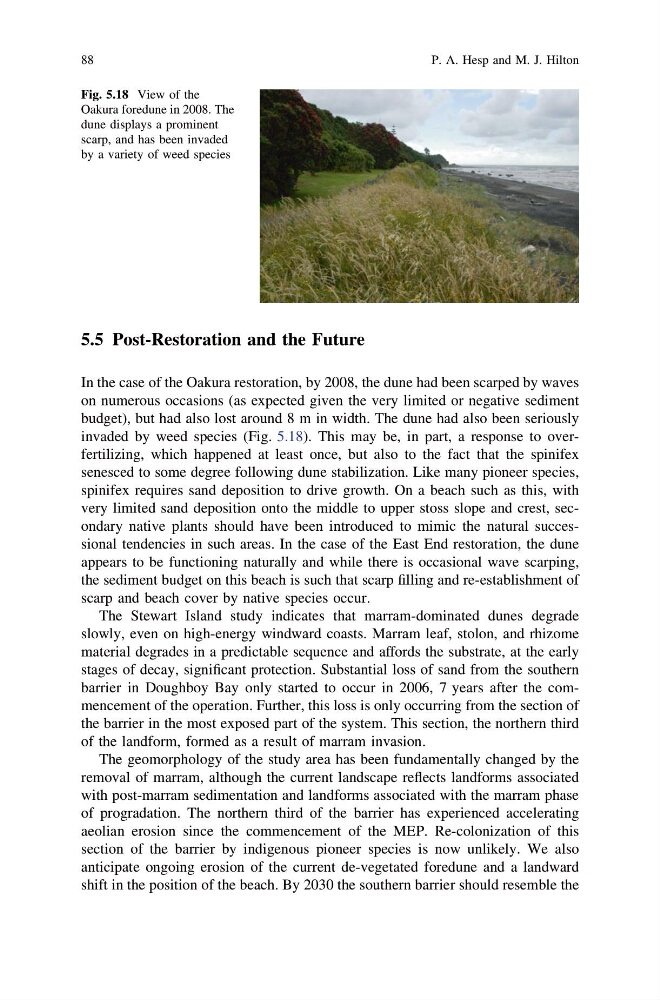
invaded by weed species (Fig. 5.18). This may be, in part, a response to overfertilizing, which happened at least once, but also to the fact that the spinifex
senesced to some degree following dune stabilization. Like many pioneer species,
spinifex requires sand deposition to drive growth. On a beach such as this, with
very limited sand deposition onto the middle to upper stoss slope and crest, secondary native plants should have been introduced to mimic the natural successional tendencies in such areas. In the case of the East End restoration, the dune
appears to be functioning naturally and while there is occasional wave scarping,
the sediment budget on this beach is such that scarp filling and re-establishment of
scarp and beach cover by native species occur.
The Stewart Island study indicates that marram-dominated dunes degrade
slowly, even on high-energy windward coasts. Marram leaf, stolon, and rhizome
material degrades in a predictable sequence and affords the substrate, at the early
stages of decay, significant protection. Substantial loss of sand from the southern
barrier in Doughboy Bay only started to occur in 2006, 7 years after the commencement of the operation. Further, this loss is only occurring from the section of
the barrier in the most exposed part of the system. This section, the northern third
of the landform, formed as a result of marram invasion.
The geomorphology of the study area has been fundamentally changed by the
removal of marram, although the current landscape reflects landforms associated
with post-marram sedimentation and landforms associated with the marram phase
of progradation. The northern third of the barrier has experienced accelerating
aeolian erosion since the commencement of the MEP. Re-colonization of this
section of the barrier by indigenous pioneer species is now unlikely. We also
anticipate ongoing erosion of the current de-vegetated foredune and a landward
shift in the position of the beach. By 2030 the southern barrier should resemble the
Fig. 5.18 View of the
Oakura foredune in 2008. The
dune displays a prominent
scarp, and has been invaded
by a variety of weed species
88
P. A. Hesp and M. J. Hilton
In the case of the Oakura restoration, by 2008, the dune had been scarped by waves
on numerous occasions (as expected given the very limited or negative sediment
budget), but had also lost around 8 m in width. The dune had also been seriously
invaded by weed species (Fig. 5.18). This may be, in part, a response to overfertilizing, which happened at least once, but also to the fact that the spinifex
senesced to some degree following dune stabilization. Like many pioneer species,
spinifex requires sand deposition to drive growth. On a beach such as this, with
very limited sand deposition onto the middle to upper stoss slope and crest, secondary native plants should have been introduced to mimic the natural successional tendencies in such areas. In the case of the East End restoration, the dune
appears to be functioning naturally and while there is occasional wave scarping,
the sediment budget on this beach is such that scarp filling and re-establishment of
scarp and beach cover by native species occur.
The Stewart Island study indicates that marram-dominated dunes degrade
slowly, even on high-energy windward coasts. Marram leaf, stolon, and rhizome
material degrades in a predictable sequence and affords the substrate, at the early
stages of decay, significant protection. Substantial loss of sand from the southern
barrier in Doughboy Bay only started to occur in 2006, 7 years after the commencement of the operation. Further, this loss is only occurring from the section of
the barrier in the most exposed part of the system. This section, the northern third
of the landform, formed as a result of marram invasion.
The geomorphology of the study area has been fundamentally changed by the
removal of marram, although the current landscape reflects landforms associated
with post-marram sedimentation and landforms associated with the marram phase
of progradation. The northern third of the barrier has experienced accelerating
aeolian erosion since the commencement of the MEP. Re-colonization of this
section of the barrier by indigenous pioneer species is now unlikely. We also
anticipate ongoing erosion of the current de-vegetated foredune and a landward
shift in the position of the beach. By 2030 the southern barrier should resemble the
Fig. 5.18 View of the
Oakura foredune in 2008. The
dune displays a prominent
scarp, and has been invaded
by a variety of weed species
88
P. A. Hesp and M. J. Hilton