

of marram adjacent to the Doughboy River had been left unsprayed, because of the
proximity of a colony of G. hamiltonii to blowout, while alternative management
options for the site were being considered. Two storm events, in 2005 and 2008,
resulted in large quantities of marram rhizome being washed into Doughboy Bay.
This rhizome was deposited above the spring high tide level on the beach fronting
the three barriers. Vigorous marram growth and incipient foredune development
resulted within 12 months on both occasions. This growth was subsequently
sprayed, but not before some flowering occurred.
The presence of a marram seed bank has been more problematic (Konlechner
and Hilton 2010). The biological literature provided little guidance as to the
longevity of marram seeds, which are trapped in foredunes as they prograde and
accrete. The monitoring program referred to above has involved precise annual
mapping of seedlings across a DTM using a Leica total station. Seedlings started to
emerge in 2004 after the decay of the marram grass leaf material and erosion of the
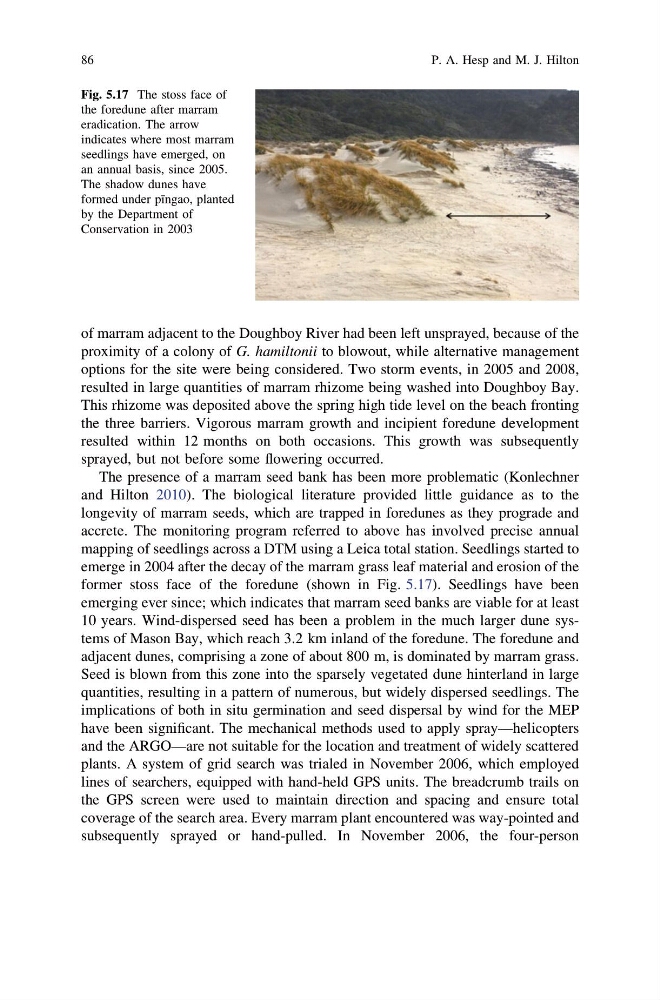
former stoss face of the foredune (shown in Fig. 5.17). Seedlings have been
emerging ever since; which indicates that marram seed banks are viable for at least
10 years. Wind-dispersed seed has been a problem in the much larger dune systems of Mason Bay, which reach 3.2 km inland of the foredune. The foredune and
adjacent dunes, comprising a zone of about 800 m, is dominated by marram grass.
Seed is blown from this zone into the sparsely vegetated dune hinterland in large
quantities, resulting in a pattern of numerous, but widely dispersed seedlings. The
implications of both in situ germination and seed dispersal by wind for the MEP
have been significant. The mechanical methods used to apply spray—helicopters
and the ARGO—are not suitable for the location and treatment of widely scattered
plants. A system of grid search was trialed in November 2006, which employed
lines of searchers, equipped with hand-held GPS units. The breadcrumb trails on
the GPS screen were used to maintain direction and spacing and ensure total
coverage of the search area. Every marram plant encountered was way-pointed and
subsequently sprayed or hand-pulled. In November 2006, the four-person
Fig. 5.17 The stoss face of
the foredune after marram
eradication. The arrow
indicates where most marram
seedlings have emerged, on
an annual basis, since 2005.
The shadow dunes have
formed under pı ¯ngao, planted
by the Department of
Conservation in 2003
86
P. A. Hesp and M. J. Hilton
proximity of a colony of G. hamiltonii to blowout, while alternative management
options for the site were being considered. Two storm events, in 2005 and 2008,
resulted in large quantities of marram rhizome being washed into Doughboy Bay.
This rhizome was deposited above the spring high tide level on the beach fronting
the three barriers. Vigorous marram growth and incipient foredune development
resulted within 12 months on both occasions. This growth was subsequently
sprayed, but not before some flowering occurred.
The presence of a marram seed bank has been more problematic (Konlechner
and Hilton 2010). The biological literature provided little guidance as to the
longevity of marram seeds, which are trapped in foredunes as they prograde and
accrete. The monitoring program referred to above has involved precise annual
mapping of seedlings across a DTM using a Leica total station. Seedlings started to
emerge in 2004 after the decay of the marram grass leaf material and erosion of the
former stoss face of the foredune (shown in Fig. 5.17). Seedlings have been
emerging ever since; which indicates that marram seed banks are viable for at least
10 years. Wind-dispersed seed has been a problem in the much larger dune systems of Mason Bay, which reach 3.2 km inland of the foredune. The foredune and
adjacent dunes, comprising a zone of about 800 m, is dominated by marram grass.
Seed is blown from this zone into the sparsely vegetated dune hinterland in large
quantities, resulting in a pattern of numerous, but widely dispersed seedlings. The
implications of both in situ germination and seed dispersal by wind for the MEP
have been significant. The mechanical methods used to apply spray—helicopters
and the ARGO—are not suitable for the location and treatment of widely scattered
plants. A system of grid search was trialed in November 2006, which employed
lines of searchers, equipped with hand-held GPS units. The breadcrumb trails on
the GPS screen were used to maintain direction and spacing and ensure total
coverage of the search area. Every marram plant encountered was way-pointed and
subsequently sprayed or hand-pulled. In November 2006, the four-person
Fig. 5.17 The stoss face of
the foredune after marram
eradication. The arrow
indicates where most marram
seedlings have emerged, on
an annual basis, since 2005.
The shadow dunes have
formed under pı ¯ngao, planted
by the Department of
Conservation in 2003
86
P. A. Hesp and M. J. Hilton