

because of initial concern that marram was adversely affecting three of the surviving six populations of Gunnera hamiltonii in the Bay, an endangered coastal
herb. The impact was twofold. Marram was overgrowing and shading the herb,
which has a low growth form. Second, marram was growing in the most exposed
central section of the Bay, on the distal tip of the southern barrier. This development was forcing the mouth of the Doughboy River to the north, with the result
that the northern bank of the river was eroding, with the imminent loss of the only
wild female colony of Gunnera hamiltonii. Were it not for the conservation status
of this species (nationally critical), the Marram Eradication Program (MEP) on
Stewart Island might not have commenced. In 1999 there was no national overview of dune conservation in New Zealand or national program of dune restoration. Such a program has still to emerge, although the Department of Conservation
is engaged in a process of national ecosystem and site prioritization.
5.4.2 Methods of Eradication
Marram grass has primarily been controlled using herbicides in New Zealand.
Mechanical methods of control—excavation, burial, solarization, salt treatment—
have been trialed by local authorities and conservation groups. However, unlike
some jurisdictions (e.g., California and Oregon; Pickart 1997; Wiedemann and
Pickart 2004), there is general acceptance that herbicides are the most effective
treatment option. Some early treatments in Fiordland National Park employed
Roundup
TM
, but this caused general necrosis of nearby native species and
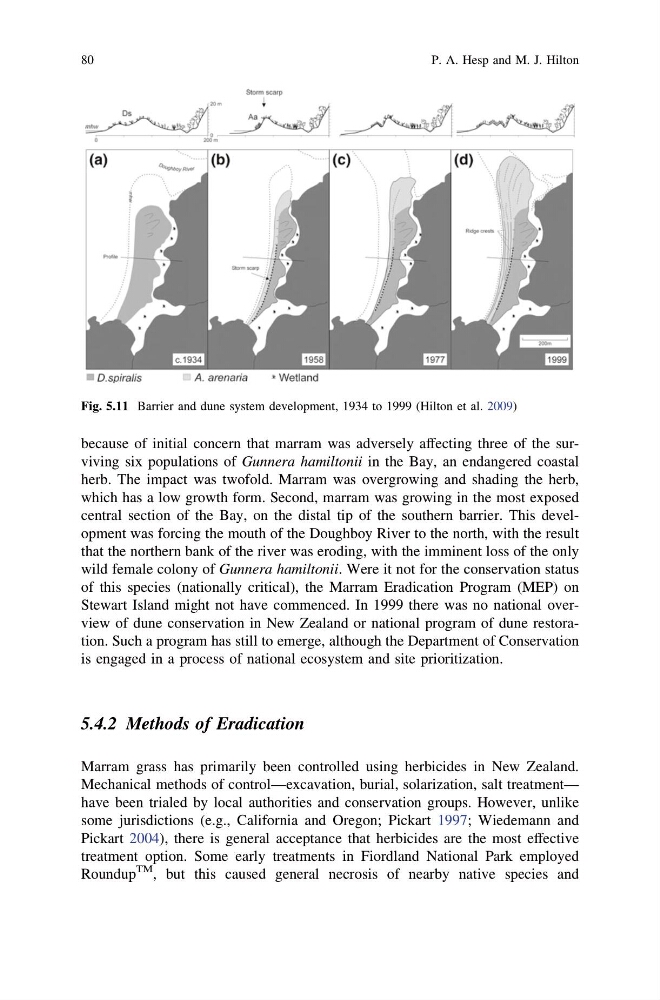
Fig. 5.11 Barrier and dune system development, 1934 to 1999 (Hilton et al. 2009)
80
P. A. Hesp and M. J. Hilton
herb. The impact was twofold. Marram was overgrowing and shading the herb,
which has a low growth form. Second, marram was growing in the most exposed
central section of the Bay, on the distal tip of the southern barrier. This development was forcing the mouth of the Doughboy River to the north, with the result
that the northern bank of the river was eroding, with the imminent loss of the only
wild female colony of Gunnera hamiltonii. Were it not for the conservation status
of this species (nationally critical), the Marram Eradication Program (MEP) on
Stewart Island might not have commenced. In 1999 there was no national overview of dune conservation in New Zealand or national program of dune restoration. Such a program has still to emerge, although the Department of Conservation
is engaged in a process of national ecosystem and site prioritization.
5.4.2 Methods of Eradication
Marram grass has primarily been controlled using herbicides in New Zealand.
Mechanical methods of control—excavation, burial, solarization, salt treatment—
have been trialed by local authorities and conservation groups. However, unlike
some jurisdictions (e.g., California and Oregon; Pickart 1997; Wiedemann and
Pickart 2004), there is general acceptance that herbicides are the most effective
treatment option. Some early treatments in Fiordland National Park employed
Roundup
TM
, but this caused general necrosis of nearby native species and
Fig. 5.11 Barrier and dune system development, 1934 to 1999 (Hilton et al. 2009)
80
P. A. Hesp and M. J. Hilton