

with Spinifex sericeus (primarily raised from seed) at a spacing of 50–70 cm. This
close spacing was desirable because the operation of high-energy, west-coast,
‘‘roaring forties’’’ winds in this region means that there is a considerable chance of
aeolian erosion occurring following planting. Some limited planting of Carex
pumila plants was also undertaken as a trial to examine how well this native plant
might survive in this environment (Bergin et al. 2000). The surface was fertilized
with two slow-release NPK fertilizers at planting. A three-wire fence was erected
along the front and back of the dune to restrict pedestrian access, and signs were
erected to inform the public of the works. The plants grew rapidly and the dune
displayed a high percentage of cover after 6 months (Fig. 5.5).
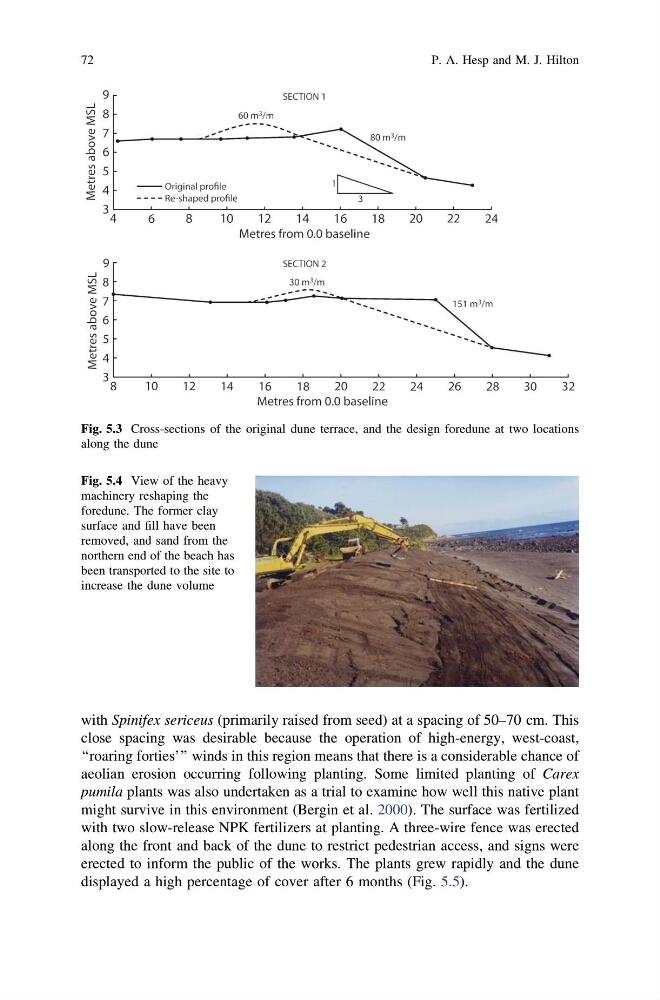
Fig. 5.3 Cross-sections of the original dune terrace, and the design foredune at two locations
along the dune
Fig. 5.4 View of the heavy
machinery reshaping the
foredune. The former clay
surface and fill have been
removed, and sand from the
northern end of the beach has
been transported to the site to
increase the dune volume
72
P. A. Hesp and M. J. Hilton
close spacing was desirable because the operation of high-energy, west-coast,
‘‘roaring forties’’’ winds in this region means that there is a considerable chance of
aeolian erosion occurring following planting. Some limited planting of Carex
pumila plants was also undertaken as a trial to examine how well this native plant
might survive in this environment (Bergin et al. 2000). The surface was fertilized
with two slow-release NPK fertilizers at planting. A three-wire fence was erected
along the front and back of the dune to restrict pedestrian access, and signs were
erected to inform the public of the works. The plants grew rapidly and the dune
displayed a high percentage of cover after 6 months (Fig. 5.5).
Fig. 5.3 Cross-sections of the original dune terrace, and the design foredune at two locations
along the dune
Fig. 5.4 View of the heavy
machinery reshaping the
foredune. The former clay
surface and fill have been
removed, and sand from the
northern end of the beach has
been transported to the site to
increase the dune volume
72
P. A. Hesp and M. J. Hilton