

3.5.2 Restoration: Dynamic Spatial Displacement (No Human
Intervention)
Another type of natural restoration occurs where the general displacement of the
beach and dune cause a translocation of the site of sediment accumulation and
foredune development. An example of this dynamic restoration of a foredune
occurred at Talisman, a part of the island under the jurisdiction of the National
Park Service and where the foredune is functioning in a mainly natural state. In
1994, a large circulation cell caused major erosion of the beach and the existing
foredune (Psuty et al. 2005). The foredune crest was lowered by about 50 % and
the volume of sand above the beach surface lost about 35 % of its original mass.
Following 1994, natural restoration of the foredune ensued to recreate a foredune
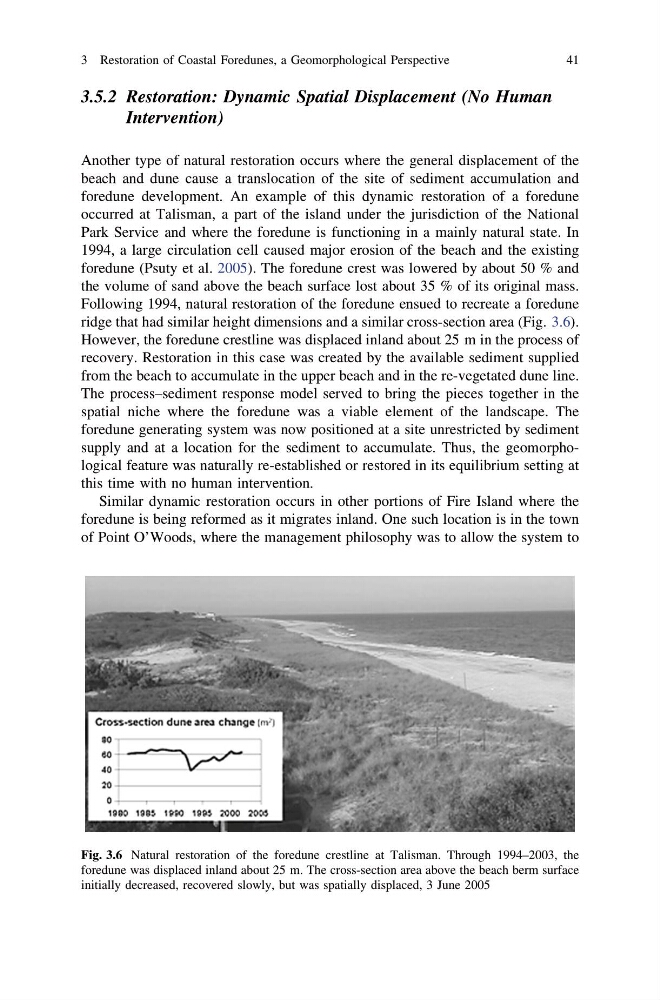
ridge that had similar height dimensions and a similar cross-section area (Fig. 3.6).
However, the foredune crestline was displaced inland about 25 m in the process of
recovery. Restoration in this case was created by the available sediment supplied
from the beach to accumulate in the upper beach and in the re-vegetated dune line.
The process–sediment response model served to bring the pieces together in the
spatial niche where the foredune was a viable element of the landscape. The
foredune generating system was now positioned at a site unrestricted by sediment
supply and at a location for the sediment to accumulate. Thus, the geomorphological feature was naturally re-established or restored in its equilibrium setting at
this time with no human intervention.
Similar dynamic restoration occurs in other portions of Fire Island where the
foredune is being reformed as it migrates inland. One such location is in the town
of Point O’Woods, where the management philosophy was to allow the system to
Fig. 3.6 Natural restoration of the foredune crestline at Talisman. Through 1994–2003, the
foredune was displaced inland about 25 m. The cross-section area above the beach berm surface
initially decreased, recovered slowly, but was spatially displaced, 3 June 2005
3 Restoration of Coastal Foredunes, a Geomorphological Perspective
41
Intervention)
Another type of natural restoration occurs where the general displacement of the
beach and dune cause a translocation of the site of sediment accumulation and
foredune development. An example of this dynamic restoration of a foredune
occurred at Talisman, a part of the island under the jurisdiction of the National
Park Service and where the foredune is functioning in a mainly natural state. In
1994, a large circulation cell caused major erosion of the beach and the existing
foredune (Psuty et al. 2005). The foredune crest was lowered by about 50 % and
the volume of sand above the beach surface lost about 35 % of its original mass.
Following 1994, natural restoration of the foredune ensued to recreate a foredune
ridge that had similar height dimensions and a similar cross-section area (Fig. 3.6).
However, the foredune crestline was displaced inland about 25 m in the process of
recovery. Restoration in this case was created by the available sediment supplied
from the beach to accumulate in the upper beach and in the re-vegetated dune line.
The process–sediment response model served to bring the pieces together in the
spatial niche where the foredune was a viable element of the landscape. The
foredune generating system was now positioned at a site unrestricted by sediment
supply and at a location for the sediment to accumulate. Thus, the geomorphological feature was naturally re-established or restored in its equilibrium setting at
this time with no human intervention.
Similar dynamic restoration occurs in other portions of Fire Island where the
foredune is being reformed as it migrates inland. One such location is in the town
of Point O’Woods, where the management philosophy was to allow the system to
Fig. 3.6 Natural restoration of the foredune crestline at Talisman. Through 1994–2003, the
foredune was displaced inland about 25 m. The cross-section area above the beach berm surface
initially decreased, recovered slowly, but was spatially displaced, 3 June 2005
3 Restoration of Coastal Foredunes, a Geomorphological Perspective
41