

under some constraints imposed by the impacts of the jetties and the existing morphologies. Yet, there is an opportunity to consider the responses of the foredune
features amongst the variety of conditions and to put the morphological outcomes in a
restoration/rehabilitation/construction perspective.
In general, the US National Park Service has a policy of supporting continuity
of the natural system, natural processes, and the resulting landscape. In the coastal
areas, this is usually translated into a reluctance to use hard structures to stabilize
the shoreline, a minimum of artificial emplacement of sediment to balance the
sediment budget, and an acceptance of coastal erosion and inland displacement of
the beach–dune profile. In the coastal parks, restoration is viewed as restoring the
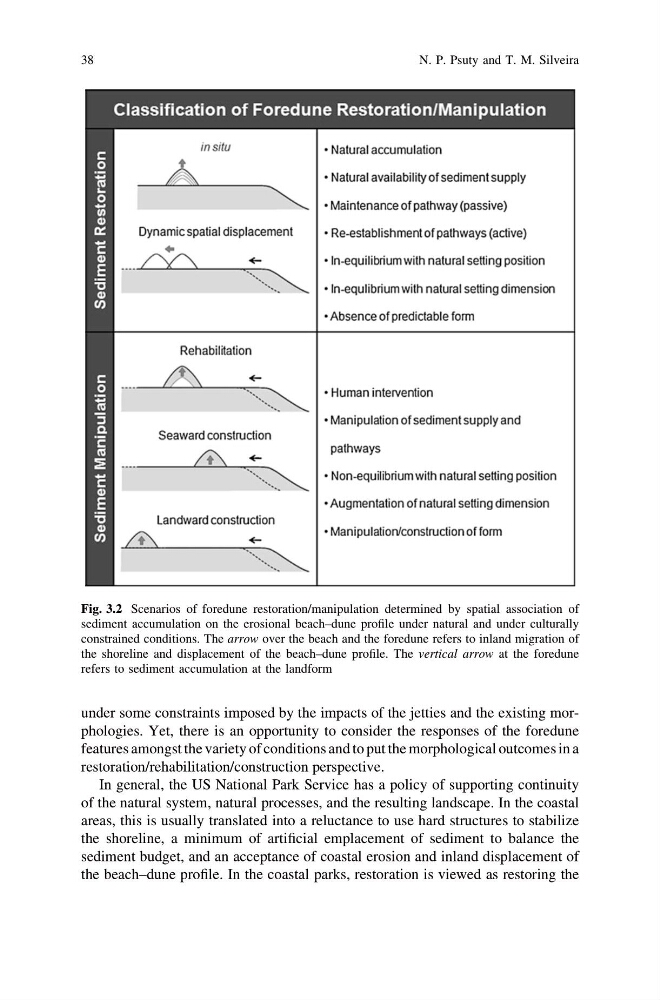
Fig. 3.2 Scenarios of foredune restoration/manipulation determined by spatial association of
sediment accumulation on the erosional beach–dune profile under natural and under culturally
constrained conditions. The arrow over the beach and the foredune refers to inland migration of
the shoreline and displacement of the beach–dune profile. The vertical arrow at the foredune
refers to sediment accumulation at the landform
38
N. P. Psuty and T. M. Silveira
features amongst the variety of conditions and to put the morphological outcomes in a
restoration/rehabilitation/construction perspective.
In general, the US National Park Service has a policy of supporting continuity
of the natural system, natural processes, and the resulting landscape. In the coastal
areas, this is usually translated into a reluctance to use hard structures to stabilize
the shoreline, a minimum of artificial emplacement of sediment to balance the
sediment budget, and an acceptance of coastal erosion and inland displacement of
the beach–dune profile. In the coastal parks, restoration is viewed as restoring the
Fig. 3.2 Scenarios of foredune restoration/manipulation determined by spatial association of
sediment accumulation on the erosional beach–dune profile under natural and under culturally
constrained conditions. The arrow over the beach and the foredune refers to inland migration of
the shoreline and displacement of the beach–dune profile. The vertical arrow at the foredune
refers to sediment accumulation at the landform
38
N. P. Psuty and T. M. Silveira