

These other forms may or may not be actively exchanging sediment with the
beach. Although these dune forms may be the subject of restoration, they are not
the focus of this paper.
3.2 Traces in the Literature
In coastal geomorphology, the issue of coastal dune restoration is at least as old as
the classic publication by Marsh (1864) on the interaction of people with physical
geography. Marsh described programs to re-create coastal dunes where they would
have a positive effect on the land use of the hinterland. A number of decades ago,
in the extensive review tome on Man’s role in changing the face of the earth
(Thomas 1956), Davis (1956) produced a seminal paper that described a variety of
situations where humans had either altered the existing coastal topography or
influenced the processes to produce change. He suggested that humans should play
a more active role in re-establishing some of the natural features. More recently,
Nordstrom (2008) has reviewed a range of actions that humans have taken to alter,
to modify, as well as to re-create beach and dune topography. The product of these
and many other publications on a similar theme is the description of a modified
landscape and an earth-science system that is not always functioning to produce
the natural outcomes of physical processes operating on sediment supply to create
morphological responses. The thrust of this literature is that many features on the
earth’s surface are altered in some of their characteristics because of human
influence and that a reduction of human influence would generate geomorphological features that would be more consistent with the natural system. Or, from a
restoration perspective, a reduction of the human influence would serve to rebuild
the products of the natural system to some degree.
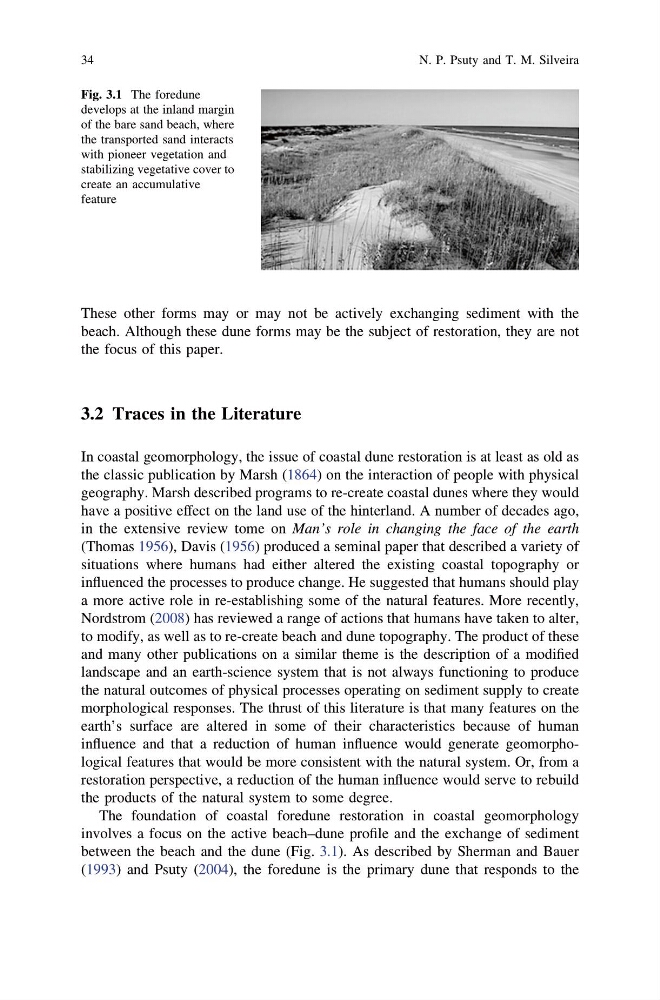
The foundation of coastal foredune restoration in coastal geomorphology
involves a focus on the active beach–dune profile and the exchange of sediment
between the beach and the dune (Fig. 3.1). As described by Sherman and Bauer
(1993) and Psuty (2004), the foredune is the primary dune that responds to the
Fig. 3.1 The foredune
develops at the inland margin
of the bare sand beach, where
the transported sand interacts
with pioneer vegetation and
stabilizing vegetative cover to
create an accumulative
feature
34
N. P. Psuty and T. M. Silveira
beach. Although these dune forms may be the subject of restoration, they are not
the focus of this paper.
3.2 Traces in the Literature
In coastal geomorphology, the issue of coastal dune restoration is at least as old as
the classic publication by Marsh (1864) on the interaction of people with physical
geography. Marsh described programs to re-create coastal dunes where they would
have a positive effect on the land use of the hinterland. A number of decades ago,
in the extensive review tome on Man’s role in changing the face of the earth
(Thomas 1956), Davis (1956) produced a seminal paper that described a variety of
situations where humans had either altered the existing coastal topography or
influenced the processes to produce change. He suggested that humans should play
a more active role in re-establishing some of the natural features. More recently,
Nordstrom (2008) has reviewed a range of actions that humans have taken to alter,
to modify, as well as to re-create beach and dune topography. The product of these
and many other publications on a similar theme is the description of a modified
landscape and an earth-science system that is not always functioning to produce
the natural outcomes of physical processes operating on sediment supply to create
morphological responses. The thrust of this literature is that many features on the
earth’s surface are altered in some of their characteristics because of human
influence and that a reduction of human influence would generate geomorphological features that would be more consistent with the natural system. Or, from a
restoration perspective, a reduction of the human influence would serve to rebuild
the products of the natural system to some degree.
The foundation of coastal foredune restoration in coastal geomorphology
involves a focus on the active beach–dune profile and the exchange of sediment
between the beach and the dune (Fig. 3.1). As described by Sherman and Bauer
(1993) and Psuty (2004), the foredune is the primary dune that responds to the
Fig. 3.1 The foredune
develops at the inland margin
of the bare sand beach, where
the transported sand interacts
with pioneer vegetation and
stabilizing vegetative cover to
create an accumulative
feature
34
N. P. Psuty and T. M. Silveira