

project can provide the necessary sand volume and space for dunes to form
(Fig. 2.1), but time is required for backdune species to colonize, and maintenance
nourishment of the beach is required to retain dune integrity, given subsequent
wave-induced erosion.
The characteristics of beach fill and the design elevation of the berm crest
influence the likelihood of aeolian transport and delivery of sand to the dune. The
removal of finer sands from poorly sorted fill sediment can leave a coarser shell or
gravel lag surface that resists subsequent aeolian transport (Psuty and Moreira
1992; van der Wal 1998). Storm reworking of the backshore can replenish the finer
sand and initiate new cycles of increased aeolian transport, but the elevation of the
nourished beach must be low enough to allow storm wave run-up to occur on the
backshore. The common practice of building a beach higher than a natural beach to
provide protection to human infrastructure against run-up should be avoided if
natural aeolian transfers are to be favored (Jackson et al. 2010).
Under natural conditions, restoration of the morphology and vegetation
assemblages of foredunes can take up to 10 years (Woodhouse et al. 1977; Maun
2004). Accordingly, it may be desirable to use earth-moving equipment, sand
fences or vegetation planting to create a dune ridge for initial protection and allow
a more natural dune to gradually evolve toward the sea. Creation of this initial
barrier will eliminate the need for an overly nourished beach to provide flood
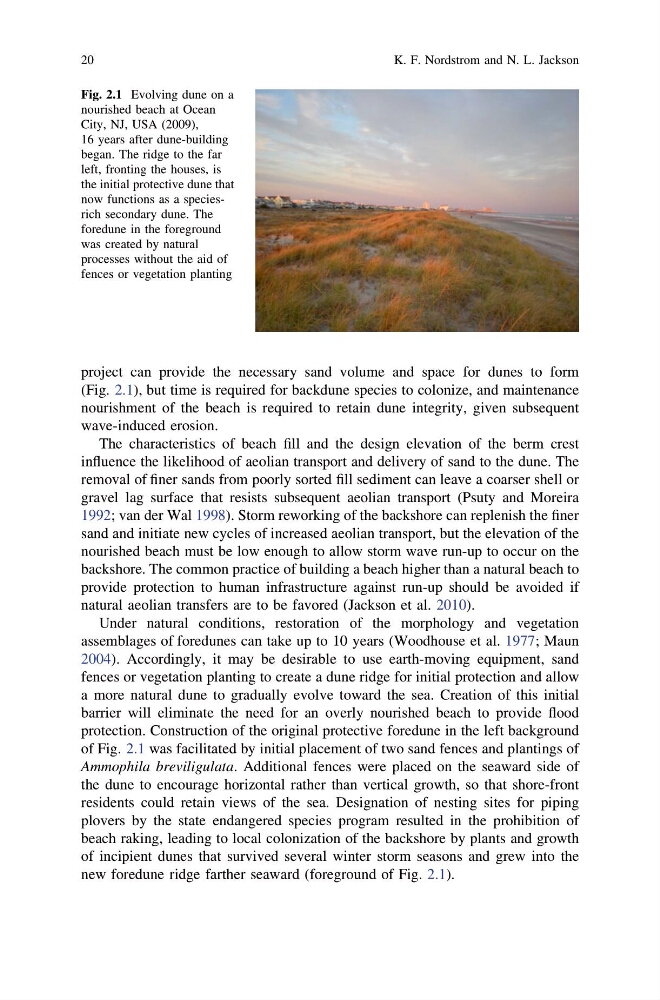
protection. Construction of the original protective foredune in the left background
of Fig. 2.1 was facilitated by initial placement of two sand fences and plantings of
Ammophila breviligulata. Additional fences were placed on the seaward side of
the dune to encourage horizontal rather than vertical growth, so that shore-front
residents could retain views of the sea. Designation of nesting sites for piping
plovers by the state endangered species program resulted in the prohibition of
beach raking, leading to local colonization of the backshore by plants and growth
of incipient dunes that survived several winter storm seasons and grew into the
new foredune ridge farther seaward (foreground of Fig. 2.1).
Fig. 2.1 Evolving dune on a
nourished beach at Ocean
City, NJ, USA (2009),
16 years after dune-building
began. The ridge to the far
left, fronting the houses, is
the initial protective dune that
now functions as a speciesrich secondary dune. The
foredune in the foreground
was created by natural
processes without the aid of
fences or vegetation planting
20
K. F. Nordstrom and N. L. Jackson
(Fig. 2.1), but time is required for backdune species to colonize, and maintenance
nourishment of the beach is required to retain dune integrity, given subsequent
wave-induced erosion.
The characteristics of beach fill and the design elevation of the berm crest
influence the likelihood of aeolian transport and delivery of sand to the dune. The
removal of finer sands from poorly sorted fill sediment can leave a coarser shell or
gravel lag surface that resists subsequent aeolian transport (Psuty and Moreira
1992; van der Wal 1998). Storm reworking of the backshore can replenish the finer
sand and initiate new cycles of increased aeolian transport, but the elevation of the
nourished beach must be low enough to allow storm wave run-up to occur on the
backshore. The common practice of building a beach higher than a natural beach to
provide protection to human infrastructure against run-up should be avoided if
natural aeolian transfers are to be favored (Jackson et al. 2010).
Under natural conditions, restoration of the morphology and vegetation
assemblages of foredunes can take up to 10 years (Woodhouse et al. 1977; Maun
2004). Accordingly, it may be desirable to use earth-moving equipment, sand
fences or vegetation planting to create a dune ridge for initial protection and allow
a more natural dune to gradually evolve toward the sea. Creation of this initial
barrier will eliminate the need for an overly nourished beach to provide flood
protection. Construction of the original protective foredune in the left background
of Fig. 2.1 was facilitated by initial placement of two sand fences and plantings of
Ammophila breviligulata. Additional fences were placed on the seaward side of
the dune to encourage horizontal rather than vertical growth, so that shore-front
residents could retain views of the sea. Designation of nesting sites for piping
plovers by the state endangered species program resulted in the prohibition of
beach raking, leading to local colonization of the backshore by plants and growth
of incipient dunes that survived several winter storm seasons and grew into the
new foredune ridge farther seaward (foreground of Fig. 2.1).
Fig. 2.1 Evolving dune on a
nourished beach at Ocean
City, NJ, USA (2009),
16 years after dune-building
began. The ridge to the far
left, fronting the houses, is
the initial protective dune that
now functions as a speciesrich secondary dune. The
foredune in the foreground
was created by natural
processes without the aid of
fences or vegetation planting
20
K. F. Nordstrom and N. L. Jackson