

(Grootjans et al. 2002). The vegetation of the slack consists of acidic heathland
and small willows with very low species diversity. Commonly encountered species
are Oxycoccus macrocarpa, S. repens, and Calamagrostis epigejos. Various
attempts to restore younger vegetation stages with typical dune slack species have
been carried out. The oldest experiment is from 1954, the youngest is from 1995.
In 1986 and 1991 parts of the slack have also undergone sod cutting. The activities
of dune managers thus produced a chronosequence of five stages over a period of
almost 100 years. However, we will only discuss an experiment in which the
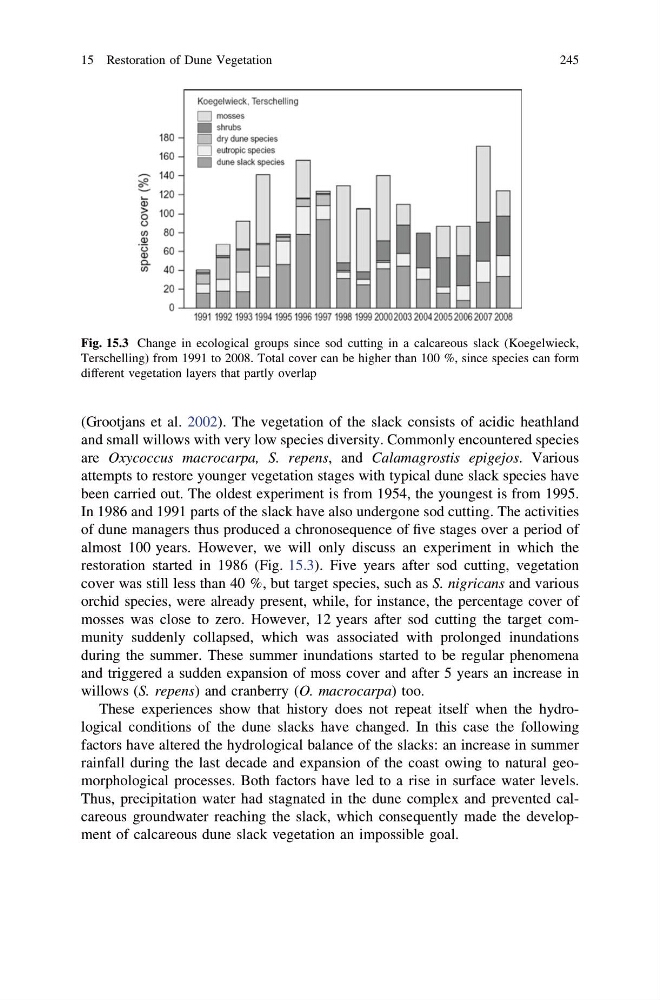
restoration started in 1986 (Fig. 15.3). Five years after sod cutting, vegetation
cover was still less than 40 %, but target species, such as S. nigricans and various
orchid species, were already present, while, for instance, the percentage cover of
mosses was close to zero. However, 12 years after sod cutting the target community suddenly collapsed, which was associated with prolonged inundations
during the summer. These summer inundations started to be regular phenomena
and triggered a sudden expansion of moss cover and after 5 years an increase in
willows (S. repens) and cranberry (O. macrocarpa) too.
These experiences show that history does not repeat itself when the hydrological conditions of the dune slacks have changed. In this case the following
factors have altered the hydrological balance of the slacks: an increase in summer
rainfall during the last decade and expansion of the coast owing to natural geomorphological processes. Both factors have led to a rise in surface water levels.
Thus, precipitation water had stagnated in the dune complex and prevented calcareous groundwater reaching the slack, which consequently made the development of calcareous dune slack vegetation an impossible goal.
Fig. 15.3 Change in ecological groups since sod cutting in a calcareous slack (Koegelwieck,
Terschelling) from 1991 to 2008. Total cover can be higher than 100 %, since species can form
different vegetation layers that partly overlap
15 Restoration of Dune Vegetation
245
and small willows with very low species diversity. Commonly encountered species
are Oxycoccus macrocarpa, S. repens, and Calamagrostis epigejos. Various
attempts to restore younger vegetation stages with typical dune slack species have
been carried out. The oldest experiment is from 1954, the youngest is from 1995.
In 1986 and 1991 parts of the slack have also undergone sod cutting. The activities
of dune managers thus produced a chronosequence of five stages over a period of
almost 100 years. However, we will only discuss an experiment in which the
restoration started in 1986 (Fig. 15.3). Five years after sod cutting, vegetation
cover was still less than 40 %, but target species, such as S. nigricans and various
orchid species, were already present, while, for instance, the percentage cover of
mosses was close to zero. However, 12 years after sod cutting the target community suddenly collapsed, which was associated with prolonged inundations
during the summer. These summer inundations started to be regular phenomena
and triggered a sudden expansion of moss cover and after 5 years an increase in
willows (S. repens) and cranberry (O. macrocarpa) too.
These experiences show that history does not repeat itself when the hydrological conditions of the dune slacks have changed. In this case the following
factors have altered the hydrological balance of the slacks: an increase in summer
rainfall during the last decade and expansion of the coast owing to natural geomorphological processes. Both factors have led to a rise in surface water levels.
Thus, precipitation water had stagnated in the dune complex and prevented calcareous groundwater reaching the slack, which consequently made the development of calcareous dune slack vegetation an impossible goal.
Fig. 15.3 Change in ecological groups since sod cutting in a calcareous slack (Koegelwieck,
Terschelling) from 1991 to 2008. Total cover can be higher than 100 %, since species can form
different vegetation layers that partly overlap
15 Restoration of Dune Vegetation
245