

(Kooijman et al. 2009). Calcareous dune grasslands can supposedly stand critical
loads of 20 kg N ha
-1 year
-1 , but acid dune grasslands only 10 kg N ha
-1 year
-1 . For
acid dune grasslands, even this may be too high, because in the Baltic Sea area grass
encroachment in acidic soils already seemed to occur at 5–8 kg N ha
-1 year
-1
(Remke et al. 2009). In calcareous dunes, high microbial N demand may lead to
relatively high storage of N in the soil, but in acid dunes, low microbial N demand
may lead to relatively high allocation of N to the vegetation and thus to grass
encroachment (Kooijman and Besse 2002; Kooijman et al. 2009). The Wadden sea
area is therefore more sensitive to atmospheric nitrogen deposition.
15.1.4 Crucial Role of the Hydrology in Dune Slacks
In most dune slacks high water tables prevail during winter and spring, while
summer water tables may drop 50–100 cm below the surface, depending on the
weather conditions. Dune slacks are usually influenced by groundwater, which is
usually calcareous, and by precipitation, which is mostly acidic.
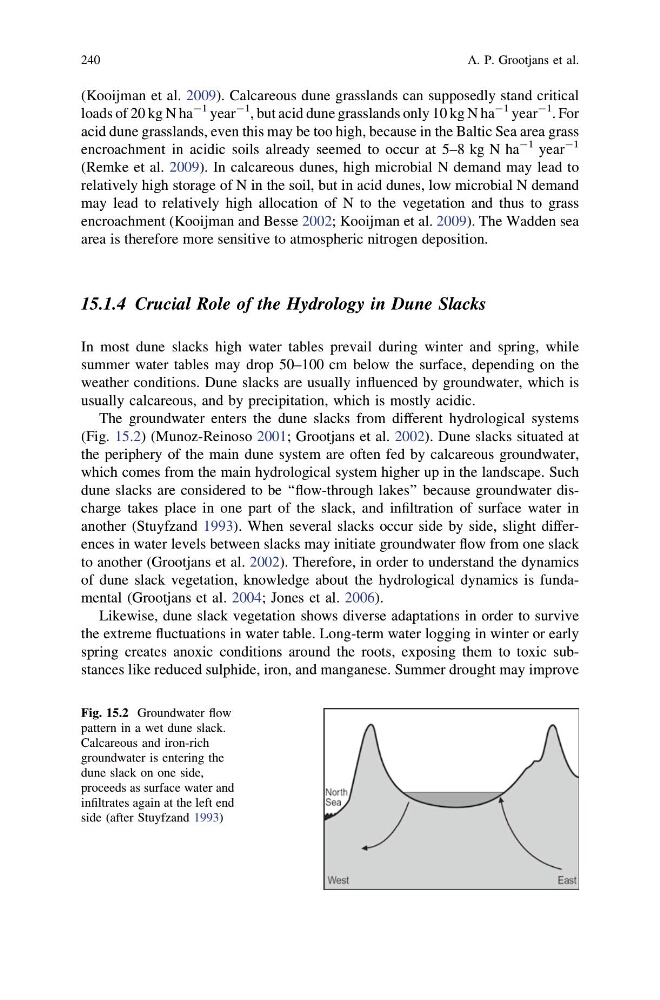
The groundwater enters the dune slacks from different hydrological systems
(Fig. 15.2) (Munoz-Reinoso 2001; Grootjans et al. 2002). Dune slacks situated at
the periphery of the main dune system are often fed by calcareous groundwater,
which comes from the main hydrological system higher up in the landscape. Such
dune slacks are considered to be ‘‘flow-through lakes’’ because groundwater discharge takes place in one part of the slack, and infiltration of surface water in
another (Stuyfzand 1993). When several slacks occur side by side, slight differences in water levels between slacks may initiate groundwater flow from one slack
to another (Grootjans et al. 2002). Therefore, in order to understand the dynamics
of dune slack vegetation, knowledge about the hydrological dynamics is fundamental (Grootjans et al. 2004; Jones et al. 2006).
Likewise, dune slack vegetation shows diverse adaptations in order to survive
the extreme fluctuations in water table. Long-term water logging in winter or early
spring creates anoxic conditions around the roots, exposing them to toxic substances like reduced sulphide, iron, and manganese. Summer drought may improve
Fig. 15.2 Groundwater flow
pattern in a wet dune slack.
Calcareous and iron-rich
groundwater is entering the
dune slack on one side,
proceeds as surface water and
infiltrates again at the left end
side (after Stuyfzand 1993)
240
A. P. Grootjans et al.
loads of 20 kg N ha
-1 year
-1 , but acid dune grasslands only 10 kg N ha
-1 year
-1 . For
acid dune grasslands, even this may be too high, because in the Baltic Sea area grass
encroachment in acidic soils already seemed to occur at 5–8 kg N ha
-1 year
-1
(Remke et al. 2009). In calcareous dunes, high microbial N demand may lead to
relatively high storage of N in the soil, but in acid dunes, low microbial N demand
may lead to relatively high allocation of N to the vegetation and thus to grass
encroachment (Kooijman and Besse 2002; Kooijman et al. 2009). The Wadden sea
area is therefore more sensitive to atmospheric nitrogen deposition.
15.1.4 Crucial Role of the Hydrology in Dune Slacks
In most dune slacks high water tables prevail during winter and spring, while
summer water tables may drop 50–100 cm below the surface, depending on the
weather conditions. Dune slacks are usually influenced by groundwater, which is
usually calcareous, and by precipitation, which is mostly acidic.
The groundwater enters the dune slacks from different hydrological systems
(Fig. 15.2) (Munoz-Reinoso 2001; Grootjans et al. 2002). Dune slacks situated at
the periphery of the main dune system are often fed by calcareous groundwater,
which comes from the main hydrological system higher up in the landscape. Such
dune slacks are considered to be ‘‘flow-through lakes’’ because groundwater discharge takes place in one part of the slack, and infiltration of surface water in
another (Stuyfzand 1993). When several slacks occur side by side, slight differences in water levels between slacks may initiate groundwater flow from one slack
to another (Grootjans et al. 2002). Therefore, in order to understand the dynamics
of dune slack vegetation, knowledge about the hydrological dynamics is fundamental (Grootjans et al. 2004; Jones et al. 2006).
Likewise, dune slack vegetation shows diverse adaptations in order to survive
the extreme fluctuations in water table. Long-term water logging in winter or early
spring creates anoxic conditions around the roots, exposing them to toxic substances like reduced sulphide, iron, and manganese. Summer drought may improve
Fig. 15.2 Groundwater flow
pattern in a wet dune slack.
Calcareous and iron-rich
groundwater is entering the
dune slack on one side,
proceeds as surface water and
infiltrates again at the left end
side (after Stuyfzand 1993)
240
A. P. Grootjans et al.