

13.2.2 Rehabilitation Following Diamond Mining in the Pocket
Beach Areas, Sperrgebiet, Namibia
13.2.2.1 Vegetation
Indigenous vegetation in the Sperrgebiet region of the Succulent Karoo can be
summarized as follows: 1,038 flowering plants, 13 ferns and 22 moss and liverwort
species, representing a total of 21.5 % of the flowering plant diversity in the entire
Succulent Karoo Biome (Burke and Mannheimer 2004); 184 endemic plants have
been recorded, 17.5 % of which are endemic to Namibia (Burke 2004). Only 12
species, however, were recorded in the study area by van der Merwe (2005).
Vegetation in this region—categorized as ‘‘Outer Namib Fog Desert’’—is sparse,
consisting of herbs and grasses and scattered cushions of succulent shrubs such as
Salsola nollothensis. Perennials survive in microhabitats within rocky outcrops
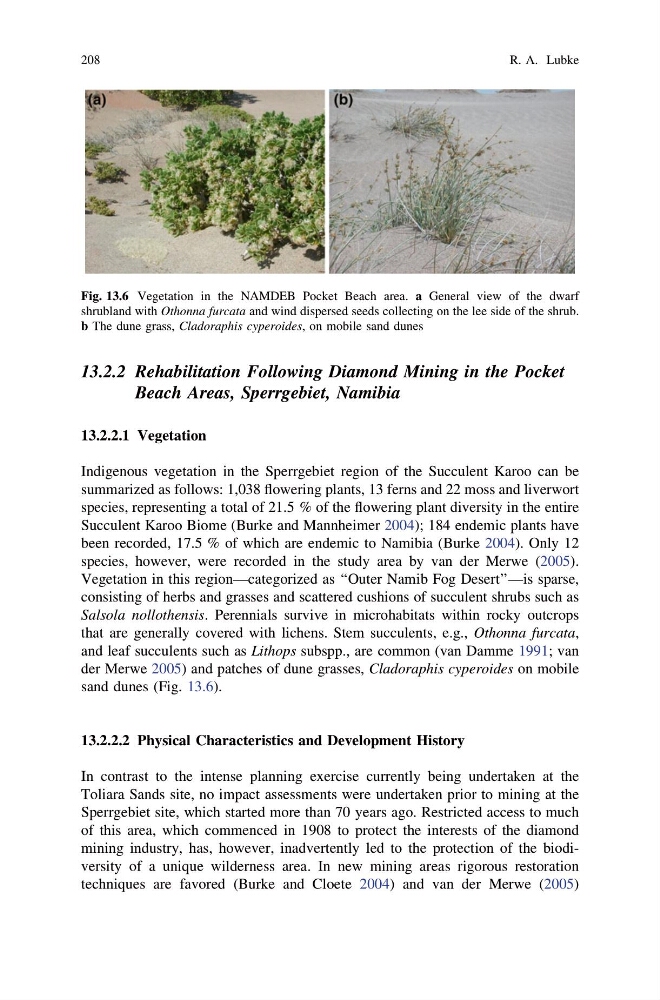
that are generally covered with lichens. Stem succulents, e.g., Othonna furcata,
and leaf succulents such as Lithops subspp., are common (van Damme 1991; van
der Merwe 2005) and patches of dune grasses, Cladoraphis cyperoides on mobile
sand dunes (Fig. 13.6).
13.2.2.2 Physical Characteristics and Development History
In contrast to the intense planning exercise currently being undertaken at the
Toliara Sands site, no impact assessments were undertaken prior to mining at the
Sperrgebiet site, which started more than 70 years ago. Restricted access to much
of this area, which commenced in 1908 to protect the interests of the diamond
mining industry, has, however, inadvertently led to the protection of the biodiversity of a unique wilderness area. In new mining areas rigorous restoration
techniques are favored (Burke and Cloete 2004) and van der Merwe (2005)
Fig. 13.6 Vegetation in the NAMDEB Pocket Beach area. a General view of the dwarf
shrubland with Othonna furcata and wind dispersed seeds collecting on the lee side of the shrub.
b The dune grass, Cladoraphis cyperoides, on mobile sand dunes
208
R. A. Lubke
Beach Areas, Sperrgebiet, Namibia
13.2.2.1 Vegetation
Indigenous vegetation in the Sperrgebiet region of the Succulent Karoo can be
summarized as follows: 1,038 flowering plants, 13 ferns and 22 moss and liverwort
species, representing a total of 21.5 % of the flowering plant diversity in the entire
Succulent Karoo Biome (Burke and Mannheimer 2004); 184 endemic plants have
been recorded, 17.5 % of which are endemic to Namibia (Burke 2004). Only 12
species, however, were recorded in the study area by van der Merwe (2005).
Vegetation in this region—categorized as ‘‘Outer Namib Fog Desert’’—is sparse,
consisting of herbs and grasses and scattered cushions of succulent shrubs such as
Salsola nollothensis. Perennials survive in microhabitats within rocky outcrops
that are generally covered with lichens. Stem succulents, e.g., Othonna furcata,
and leaf succulents such as Lithops subspp., are common (van Damme 1991; van
der Merwe 2005) and patches of dune grasses, Cladoraphis cyperoides on mobile
sand dunes (Fig. 13.6).
13.2.2.2 Physical Characteristics and Development History
In contrast to the intense planning exercise currently being undertaken at the
Toliara Sands site, no impact assessments were undertaken prior to mining at the
Sperrgebiet site, which started more than 70 years ago. Restricted access to much
of this area, which commenced in 1908 to protect the interests of the diamond
mining industry, has, however, inadvertently led to the protection of the biodiversity of a unique wilderness area. In new mining areas rigorous restoration
techniques are favored (Burke and Cloete 2004) and van der Merwe (2005)
Fig. 13.6 Vegetation in the NAMDEB Pocket Beach area. a General view of the dwarf
shrubland with Othonna furcata and wind dispersed seeds collecting on the lee side of the shrub.
b The dune grass, Cladoraphis cyperoides, on mobile sand dunes
208
R. A. Lubke