

1. Variation in terms of physical features, such as temperature, rainfall, and sand
movement, and how this affects restoration processes.
2. Ecosystems in the two regions; determining the formulation of restoration
objectives.
3. The role of local communities and other interested and affected parties (IAPs)
(or lack thereof) in terms of influencing restoration processes.
4. Contrasting the types of restoration projects suitable for the two sites.
13.1.1 The Two Study Sites
The two study sites are in the West Malagasy (Madagascar) and the Sperrgebiet in
the Namib Desert, southwestern Namibia (Pallett 1995). The latter site lies within
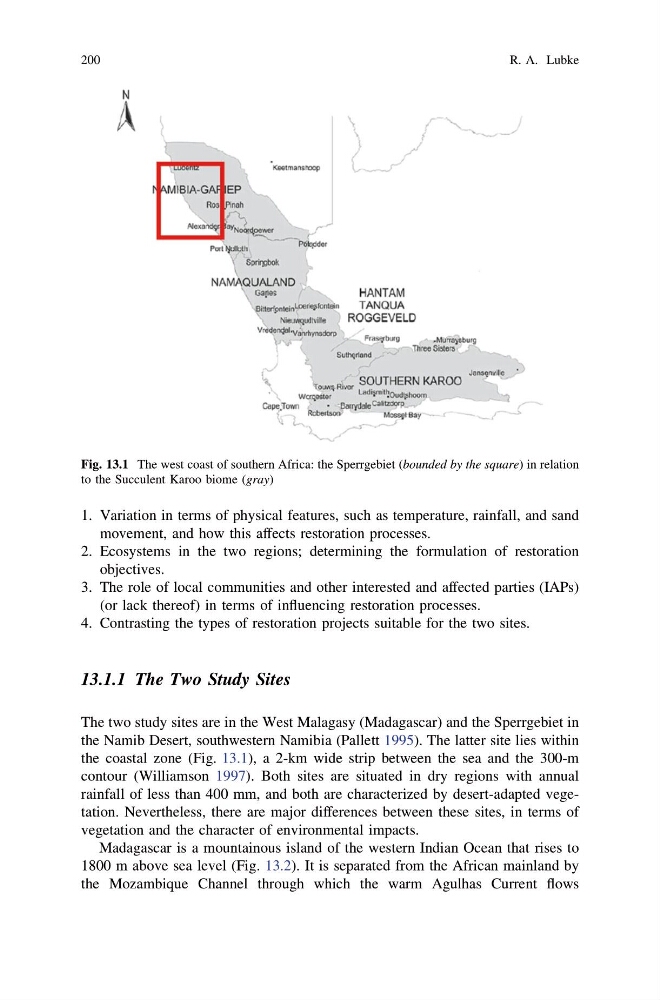
the coastal zone (Fig. 13.1), a 2-km wide strip between the sea and the 300-m
contour (Williamson 1997). Both sites are situated in dry regions with annual
rainfall of less than 400 mm, and both are characterized by desert-adapted vegetation. Nevertheless, there are major differences between these sites, in terms of
vegetation and the character of environmental impacts.
Madagascar is a mountainous island of the western Indian Ocean that rises to
1800 m above sea level (Fig. 13.2). It is separated from the African mainland by
the Mozambique Channel through which the warm Agulhas Current flows
Fig. 13.1 The west coast of southern Africa: the Sperrgebiet (bounded by the square) in relation
to the Succulent Karoo biome (gray)
200
R. A. Lubke
movement, and how this affects restoration processes.
2. Ecosystems in the two regions; determining the formulation of restoration
objectives.
3. The role of local communities and other interested and affected parties (IAPs)
(or lack thereof) in terms of influencing restoration processes.
4. Contrasting the types of restoration projects suitable for the two sites.
13.1.1 The Two Study Sites
The two study sites are in the West Malagasy (Madagascar) and the Sperrgebiet in
the Namib Desert, southwestern Namibia (Pallett 1995). The latter site lies within
the coastal zone (Fig. 13.1), a 2-km wide strip between the sea and the 300-m
contour (Williamson 1997). Both sites are situated in dry regions with annual
rainfall of less than 400 mm, and both are characterized by desert-adapted vegetation. Nevertheless, there are major differences between these sites, in terms of
vegetation and the character of environmental impacts.
Madagascar is a mountainous island of the western Indian Ocean that rises to
1800 m above sea level (Fig. 13.2). It is separated from the African mainland by
the Mozambique Channel through which the warm Agulhas Current flows
Fig. 13.1 The west coast of southern Africa: the Sperrgebiet (bounded by the square) in relation
to the Succulent Karoo biome (gray)
200
R. A. Lubke