

fragmented and presented a patchy distribution interlaid into a matrix of bare sand.
Therefore, sparse, degraded, and relatively homogeneous dune vegetation was
observed in the field.
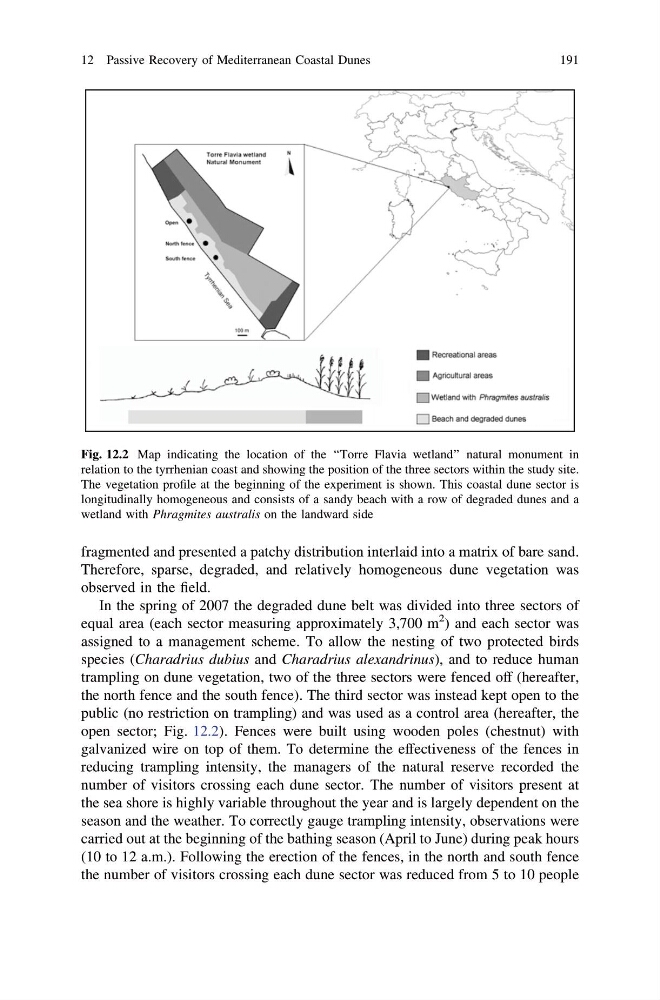
In the spring of 2007 the degraded dune belt was divided into three sectors of
equal area (each sector measuring approximately 3,700 m
2 ) and each sector was
assigned to a management scheme. To allow the nesting of two protected birds
species (Charadrius dubius and Charadrius alexandrinus), and to reduce human
trampling on dune vegetation, two of the three sectors were fenced off (hereafter,
the north fence and the south fence). The third sector was instead kept open to the
public (no restriction on trampling) and was used as a control area (hereafter, the
open sector; Fig. 12.2). Fences were built using wooden poles (chestnut) with
galvanized wire on top of them. To determine the effectiveness of the fences in
reducing trampling intensity, the managers of the natural reserve recorded the
number of visitors crossing each dune sector. The number of visitors present at
the sea shore is highly variable throughout the year and is largely dependent on the
season and the weather. To correctly gauge trampling intensity, observations were
carried out at the beginning of the bathing season (April to June) during peak hours
(10 to 12 a.m.). Following the erection of the fences, in the north and south fence
the number of visitors crossing each dune sector was reduced from 5 to 10 people
Fig. 12.2 Map indicating the location of the ‘‘Torre Flavia wetland’’ natural monument in
relation to the tyrrhenian coast and showing the position of the three sectors within the study site.
The vegetation profile at the beginning of the experiment is shown. This coastal dune sector is
longitudinally homogeneous and consists of a sandy beach with a row of degraded dunes and a
wetland with Phragmites australis on the landward side
12 Passive Recovery of Mediterranean Coastal Dunes
191
Therefore, sparse, degraded, and relatively homogeneous dune vegetation was
observed in the field.
In the spring of 2007 the degraded dune belt was divided into three sectors of
equal area (each sector measuring approximately 3,700 m
2 ) and each sector was
assigned to a management scheme. To allow the nesting of two protected birds
species (Charadrius dubius and Charadrius alexandrinus), and to reduce human
trampling on dune vegetation, two of the three sectors were fenced off (hereafter,
the north fence and the south fence). The third sector was instead kept open to the
public (no restriction on trampling) and was used as a control area (hereafter, the
open sector; Fig. 12.2). Fences were built using wooden poles (chestnut) with
galvanized wire on top of them. To determine the effectiveness of the fences in
reducing trampling intensity, the managers of the natural reserve recorded the
number of visitors crossing each dune sector. The number of visitors present at
the sea shore is highly variable throughout the year and is largely dependent on the
season and the weather. To correctly gauge trampling intensity, observations were
carried out at the beginning of the bathing season (April to June) during peak hours
(10 to 12 a.m.). Following the erection of the fences, in the north and south fence
the number of visitors crossing each dune sector was reduced from 5 to 10 people
Fig. 12.2 Map indicating the location of the ‘‘Torre Flavia wetland’’ natural monument in
relation to the tyrrhenian coast and showing the position of the three sectors within the study site.
The vegetation profile at the beginning of the experiment is shown. This coastal dune sector is
longitudinally homogeneous and consists of a sandy beach with a row of degraded dunes and a
wetland with Phragmites australis on the landward side
12 Passive Recovery of Mediterranean Coastal Dunes
191