

(Brown and McLachlan 2002), even if in Europe a few well-preserved dune
systems still exist.
The European Directive 92/43/EEC, also known as the ‘‘Habitats Directive,’’
provides a list of habitats and species of conservation interest in Europe, aiming
to facilitate and improve conservation efforts and management strategies. At
present, the Habitats Directive constitutes the most important legal instrument for
biodiversity and nature conservation at the European level (Wätzold and
Schwerdtner 2005). Habitats of conservation interest can be identified on the basis
of the presence of characteristic and diagnostic plant species (European Commission 2007), a list of which has been standardized across Europe. About 20
coastal dune plant assemblages have been included among these habitats and most
of them can be found in Italy (Biondi et al. 2009). An example of a well-preserved
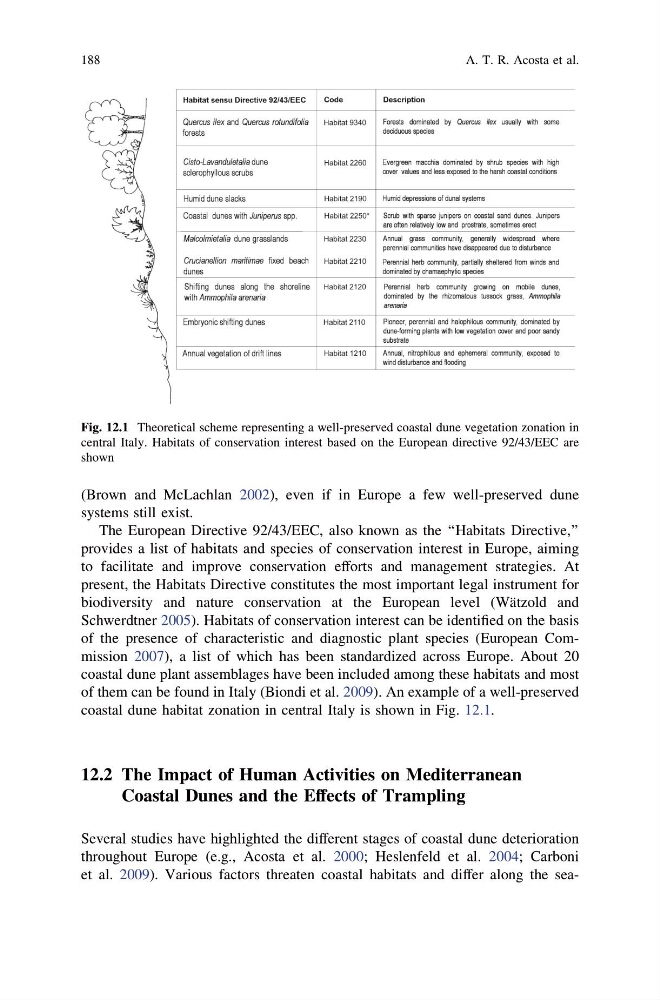
coastal dune habitat zonation in central Italy is shown in Fig. 12.1.
12.2 The Impact of Human Activities on Mediterranean
Coastal Dunes and the Effects of Trampling
Several studies have highlighted the different stages of coastal dune deterioration
throughout Europe (e.g., Acosta et al. 2000; Heslenfeld et al. 2004; Carboni
et al. 2009). Various factors threaten coastal habitats and differ along the seaFig. 12.1 Theoretical scheme representing a well-preserved coastal dune vegetation zonation in
central Italy. Habitats of conservation interest based on the European directive 92/43/EEC are
shown
188
A. T. R. Acosta et al.
systems still exist.
The European Directive 92/43/EEC, also known as the ‘‘Habitats Directive,’’
provides a list of habitats and species of conservation interest in Europe, aiming
to facilitate and improve conservation efforts and management strategies. At
present, the Habitats Directive constitutes the most important legal instrument for
biodiversity and nature conservation at the European level (Wätzold and
Schwerdtner 2005). Habitats of conservation interest can be identified on the basis
of the presence of characteristic and diagnostic plant species (European Commission 2007), a list of which has been standardized across Europe. About 20
coastal dune plant assemblages have been included among these habitats and most
of them can be found in Italy (Biondi et al. 2009). An example of a well-preserved
coastal dune habitat zonation in central Italy is shown in Fig. 12.1.
12.2 The Impact of Human Activities on Mediterranean
Coastal Dunes and the Effects of Trampling
Several studies have highlighted the different stages of coastal dune deterioration
throughout Europe (e.g., Acosta et al. 2000; Heslenfeld et al. 2004; Carboni
et al. 2009). Various factors threaten coastal habitats and differ along the seaFig. 12.1 Theoretical scheme representing a well-preserved coastal dune vegetation zonation in
central Italy. Habitats of conservation interest based on the European directive 92/43/EEC are
shown
188
A. T. R. Acosta et al.