

11.4 Restoration of Coastal Sand Dunes: Motivation,
Initiatives, and Primary Results
The term restoration has many definitions (Jackson et al. 2006) and in some cases
is confused with ‘‘recovery’’ and ‘‘rehabilitation’’. In our case, we refer to restoration as the attempt to conserve the high biodiversity of the coastal dunes that
include various dune types in various states of stabilization. In order to apply this
attempt there is a need to revive the stabilized dunes to the state they were in
before the stabilization process. In a way it sounds paradoxical as we intend to
prevent the natural process of stabilization and apply a ‘‘desertification’’ process
on the dunes. However, this attempt imitates the ‘‘cutting and grazing policy’’ that
existed within the coastal dunes for hundreds of years before the protection policy
of the State of Israel, which stimulated the co-evolution of psammophilic species,
particularly those that are considered endemic to the region, as described above. In
other words, simple conservation of dune areas, which removes the cutting and
grazing, will actually decrease their biodiversity values by turning all the dunes
into stabilized ones. Thus, a more complex and dynamic type of management is
required. The plan is to apply the re-activation management strategy to a certain
percentage of the stabilized and semi-stabilized dunes in order to conserve the
entire biodiversity of the coastal dunes, which includes the various types of dune
stabilization levels.
The first study to examine the impact of the removal of woody plants on annual
plants and rodents was conducted in 1995 at the Alexander Stream National Park
located on the northern part of the coastal dunes strip (Kutiel et al. 2000a).
The shrubs with 80 % coverage were completely removed manually (with the aid
of saws and pruning hooks) in order to minimize damage to the soil. Three years of
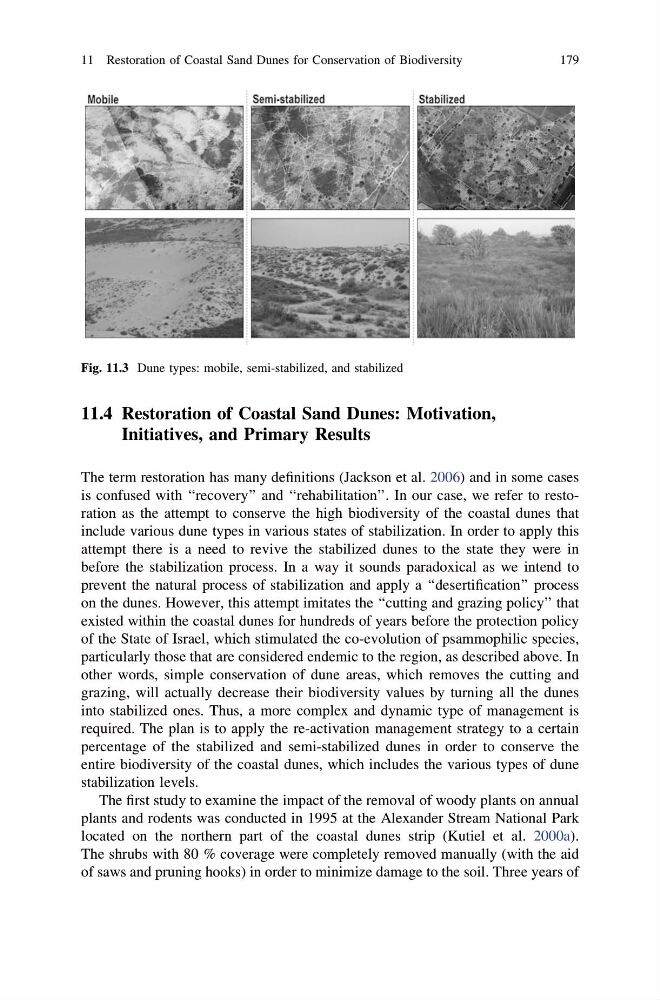
Fig. 11.3 Dune types: mobile, semi-stabilized, and stabilized
11 Restoration of Coastal Sand Dunes for Conservation of Biodiversity
179
Initiatives, and Primary Results
The term restoration has many definitions (Jackson et al. 2006) and in some cases
is confused with ‘‘recovery’’ and ‘‘rehabilitation’’. In our case, we refer to restoration as the attempt to conserve the high biodiversity of the coastal dunes that
include various dune types in various states of stabilization. In order to apply this
attempt there is a need to revive the stabilized dunes to the state they were in
before the stabilization process. In a way it sounds paradoxical as we intend to
prevent the natural process of stabilization and apply a ‘‘desertification’’ process
on the dunes. However, this attempt imitates the ‘‘cutting and grazing policy’’ that
existed within the coastal dunes for hundreds of years before the protection policy
of the State of Israel, which stimulated the co-evolution of psammophilic species,
particularly those that are considered endemic to the region, as described above. In
other words, simple conservation of dune areas, which removes the cutting and
grazing, will actually decrease their biodiversity values by turning all the dunes
into stabilized ones. Thus, a more complex and dynamic type of management is
required. The plan is to apply the re-activation management strategy to a certain
percentage of the stabilized and semi-stabilized dunes in order to conserve the
entire biodiversity of the coastal dunes, which includes the various types of dune
stabilization levels.
The first study to examine the impact of the removal of woody plants on annual
plants and rodents was conducted in 1995 at the Alexander Stream National Park
located on the northern part of the coastal dunes strip (Kutiel et al. 2000a).
The shrubs with 80 % coverage were completely removed manually (with the aid
of saws and pruning hooks) in order to minimize damage to the soil. Three years of
Fig. 11.3 Dune types: mobile, semi-stabilized, and stabilized
11 Restoration of Coastal Sand Dunes for Conservation of Biodiversity
179