

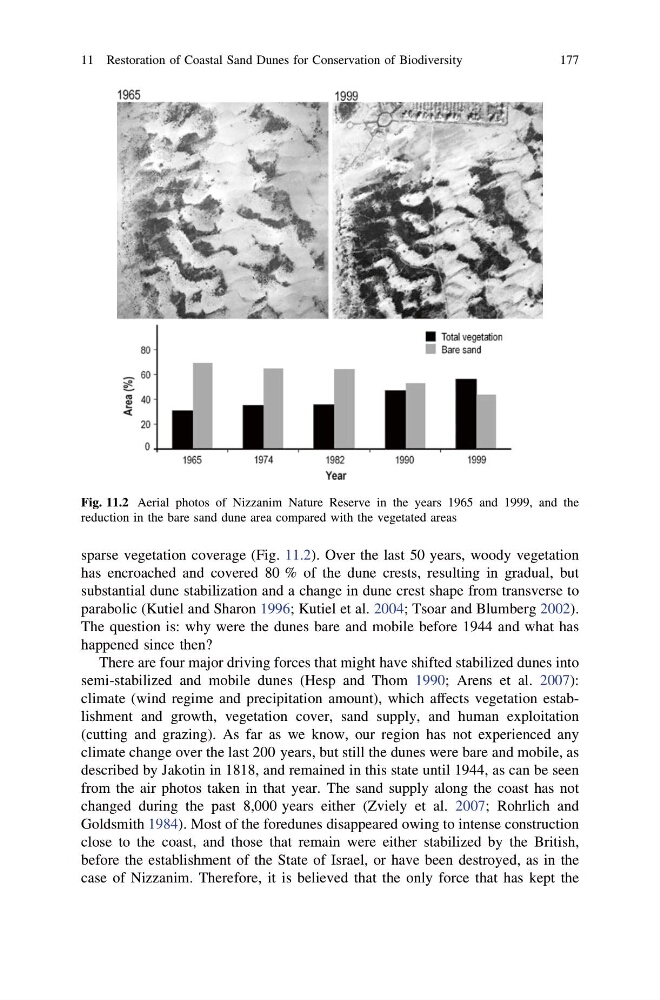
sparse vegetation coverage (Fig. 11.2). Over the last 50 years, woody vegetation
has encroached and covered 80 % of the dune crests, resulting in gradual, but
substantial dune stabilization and a change in dune crest shape from transverse to
parabolic (Kutiel and Sharon 1996; Kutiel et al. 2004; Tsoar and Blumberg 2002).
The question is: why were the dunes bare and mobile before 1944 and what has
happened since then?
There are four major driving forces that might have shifted stabilized dunes into
semi-stabilized and mobile dunes (Hesp and Thom 1990; Arens et al. 2007):
climate (wind regime and precipitation amount), which affects vegetation establishment and growth, vegetation cover, sand supply, and human exploitation
(cutting and grazing). As far as we know, our region has not experienced any
climate change over the last 200 years, but still the dunes were bare and mobile, as
described by Jakotin in 1818, and remained in this state until 1944, as can be seen
from the air photos taken in that year. The sand supply along the coast has not
changed during the past 8,000 years either (Zviely et al. 2007; Rohrlich and
Goldsmith 1984). Most of the foredunes disappeared owing to intense construction
close to the coast, and those that remain were either stabilized by the British,
before the establishment of the State of Israel, or have been destroyed, as in the
case of Nizzanim. Therefore, it is believed that the only force that has kept the
Fig. 11.2 Aerial photos of Nizzanim Nature Reserve in the years 1965 and 1999, and the
reduction in the bare sand dune area compared with the vegetated areas
11 Restoration of Coastal Sand Dunes for Conservation of Biodiversity
177
has encroached and covered 80 % of the dune crests, resulting in gradual, but
substantial dune stabilization and a change in dune crest shape from transverse to
parabolic (Kutiel and Sharon 1996; Kutiel et al. 2004; Tsoar and Blumberg 2002).
The question is: why were the dunes bare and mobile before 1944 and what has
happened since then?
There are four major driving forces that might have shifted stabilized dunes into
semi-stabilized and mobile dunes (Hesp and Thom 1990; Arens et al. 2007):
climate (wind regime and precipitation amount), which affects vegetation establishment and growth, vegetation cover, sand supply, and human exploitation
(cutting and grazing). As far as we know, our region has not experienced any
climate change over the last 200 years, but still the dunes were bare and mobile, as
described by Jakotin in 1818, and remained in this state until 1944, as can be seen
from the air photos taken in that year. The sand supply along the coast has not
changed during the past 8,000 years either (Zviely et al. 2007; Rohrlich and
Goldsmith 1984). Most of the foredunes disappeared owing to intense construction
close to the coast, and those that remain were either stabilized by the British,
before the establishment of the State of Israel, or have been destroyed, as in the
case of Nizzanim. Therefore, it is believed that the only force that has kept the
Fig. 11.2 Aerial photos of Nizzanim Nature Reserve in the years 1965 and 1999, and the
reduction in the bare sand dune area compared with the vegetated areas
11 Restoration of Coastal Sand Dunes for Conservation of Biodiversity
177