

Salt spray deposition was estimated by washing in de-ionized water three twigs
(10 cm long) per juniper out of the individuals located in different situations (six
junipers per location) and measuring the electrical conductivity of the water. Data
were presented as percentages in relation to the highest conductivity (MuñozReinoso 2003). Because installed poles were stolen or pulled out, sand mobility
was estimated subjectively through the presence of deposits of sand or evidence of
erosion. Radiation was measured at noon with a LICOR LI-189 radiometer in the
center of the plots in spring (18 recordings per situation).
At the end of the summer of 2003, prior to the clearing experiments, cone
production was estimated by counting the fleshy cones present in juniper branches
of individuals located in the three desired pine tree cover situations (dense canopy,
light clearing, clearing). Samples were taken to estimate the number of seeds per
cone (30–50 cones per juniper). In 2006, the sampling was repeated. Only 32
juniper trees that remained in the same situation during the studied period were
considered (5 in clearings, 12 in light clearings, 15 in dense canopy).
The growth of branches and density of pollen in the air were estimated in the
clearings and dense canopy plots. The growth of branches was estimated every
3 months in five individuals per treatment by measuring the increase in length of
five twigs per individual between May 2004 and February 2005. Pollen traps
consisted of Melinex tapes, fixed onto a wire mesh, and covered with transparent
silicone. The traps were hung on the juniper branches (three traps per situation).
They were hung during seven clear days in December 2004. Pollen counts were
carried out with a microscope (940) on a surface of 907.2 mm
2 per tape.
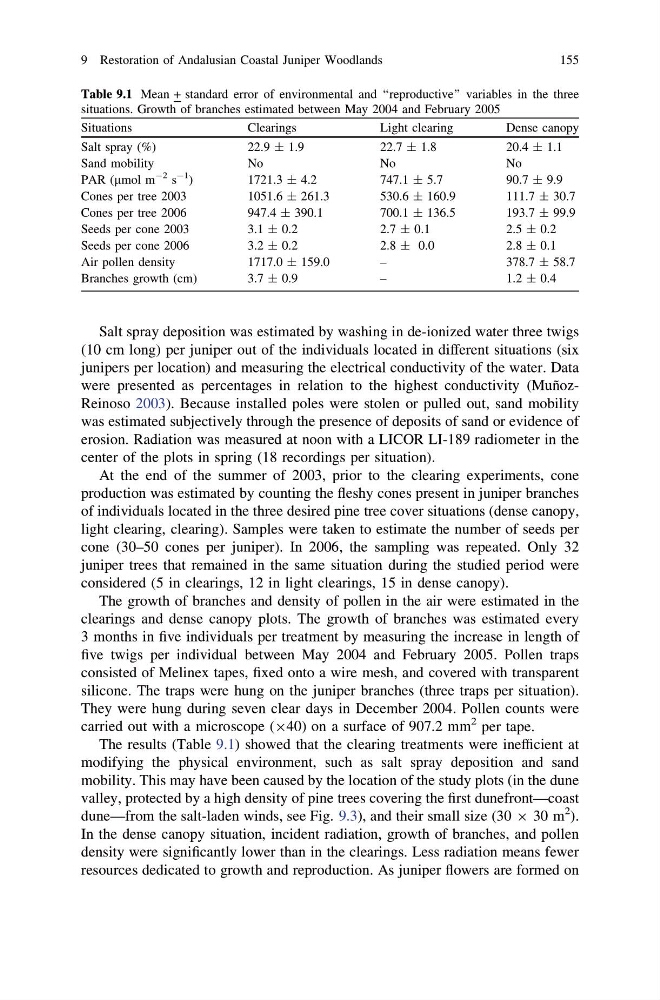
The results (Table 9.1) showed that the clearing treatments were inefficient at
modifying the physical environment, such as salt spray deposition and sand
mobility. This may have been caused by the location of the study plots (in the dune
valley, protected by a high density of pine trees covering the first dunefront—coast
dune—from the salt-laden winds, see Fig. 9.3), and their small size (30 9 30 m
2 ).
In the dense canopy situation, incident radiation, growth of branches, and pollen
density were significantly lower than in the clearings. Less radiation means fewer
resources dedicated to growth and reproduction. As juniper flowers are formed on
Table 9.1 Mean + standard error of environmental and ‘‘reproductive’’ variables in the three
situations. Growth of branches estimated between May 2004 and February 2005
Situations
Clearings
Light clearing
Dense canopy
Salt spray (%)
22.9 ± 1.9
22.7 ± 1.8
20.4 ± 1.1
Sand mobility
No
No
No
PAR (lmol m
-2 s
-1
)
1721.3 ± 4.2
747.1 ± 5.7
90.7 ± 9.9
Cones per tree 2003
1051.6 ± 261.3
530.6 ± 160.9
111.7 ± 30.7
Cones per tree 2006
947.4 ± 390.1
700.1 ± 136.5
193.7 ± 99.9
Seeds per cone 2003
3.1 ± 0.2
2.7 ± 0.1
2.5 ± 0.2
Seeds per cone 2006
3.2 ± 0.2
2.8 ± 0.0
2.8 ± 0.1
Air pollen density
1717.0 ± 159.0
–
378.7 ± 58.7
Branches growth (cm)
3.7 ± 0.9
–
1.2 ± 0.4
9 Restoration of Andalusian Coastal Juniper Woodlands
155
(10 cm long) per juniper out of the individuals located in different situations (six
junipers per location) and measuring the electrical conductivity of the water. Data
were presented as percentages in relation to the highest conductivity (MuñozReinoso 2003). Because installed poles were stolen or pulled out, sand mobility
was estimated subjectively through the presence of deposits of sand or evidence of
erosion. Radiation was measured at noon with a LICOR LI-189 radiometer in the
center of the plots in spring (18 recordings per situation).
At the end of the summer of 2003, prior to the clearing experiments, cone
production was estimated by counting the fleshy cones present in juniper branches
of individuals located in the three desired pine tree cover situations (dense canopy,
light clearing, clearing). Samples were taken to estimate the number of seeds per
cone (30–50 cones per juniper). In 2006, the sampling was repeated. Only 32
juniper trees that remained in the same situation during the studied period were
considered (5 in clearings, 12 in light clearings, 15 in dense canopy).
The growth of branches and density of pollen in the air were estimated in the
clearings and dense canopy plots. The growth of branches was estimated every
3 months in five individuals per treatment by measuring the increase in length of
five twigs per individual between May 2004 and February 2005. Pollen traps
consisted of Melinex tapes, fixed onto a wire mesh, and covered with transparent
silicone. The traps were hung on the juniper branches (three traps per situation).
They were hung during seven clear days in December 2004. Pollen counts were
carried out with a microscope (940) on a surface of 907.2 mm
2 per tape.
The results (Table 9.1) showed that the clearing treatments were inefficient at
modifying the physical environment, such as salt spray deposition and sand
mobility. This may have been caused by the location of the study plots (in the dune
valley, protected by a high density of pine trees covering the first dunefront—coast
dune—from the salt-laden winds, see Fig. 9.3), and their small size (30 9 30 m
2 ).
In the dense canopy situation, incident radiation, growth of branches, and pollen
density were significantly lower than in the clearings. Less radiation means fewer
resources dedicated to growth and reproduction. As juniper flowers are formed on
Table 9.1 Mean + standard error of environmental and ‘‘reproductive’’ variables in the three
situations. Growth of branches estimated between May 2004 and February 2005
Situations
Clearings
Light clearing
Dense canopy
Salt spray (%)
22.9 ± 1.9
22.7 ± 1.8
20.4 ± 1.1
Sand mobility
No
No
No
PAR (lmol m
-2 s
-1
)
1721.3 ± 4.2
747.1 ± 5.7
90.7 ± 9.9
Cones per tree 2003
1051.6 ± 261.3
530.6 ± 160.9
111.7 ± 30.7
Cones per tree 2006
947.4 ± 390.1
700.1 ± 136.5
193.7 ± 99.9
Seeds per cone 2003
3.1 ± 0.2
2.7 ± 0.1
2.5 ± 0.2
Seeds per cone 2006
3.2 ± 0.2
2.8 ± 0.0
2.8 ± 0.1
Air pollen density
1717.0 ± 159.0
–
378.7 ± 58.7
Branches growth (cm)
3.7 ± 0.9
–
1.2 ± 0.4
9 Restoration of Andalusian Coastal Juniper Woodlands
155