

Age–size distribution of the maritime juniper populations showed that those
located on sandy dunes, with a certain degree of mobility, a substratum rich in
calcium carbonate, and a high salt spray deposition, have high recruitment rates,
with large proportions of young individuals, especially within protected, large or
medium-sized populations (Muñoz-Reinoso 2003). Conversely, in juniper populations under a coastal pine tree plantation, especially in those from Huelva
province, there is a lack of recruitment, showing only adult individuals. Several
factors acting in a synergistic way may be responsible for that lack of natural
regeneration. Among them, the deposition of pine needles, which prevent seedling
establishment, competition with inland species (Muñoz-Reinoso 2003), and deficient pollination (Ortiz et al. 1998) have been singled out as potential inhibitors of
juniper recruitment.
Most of the juniper populations along the Gulf of Cádiz show an unbiased sex
ratio distribution. However, some populations close to the Gibraltar Strait show a
male-biased ratio. This is hypothesized to be due to a stressful environment
(Muñoz-Reinoso 2003), with strong eastern winds that may promote an increase in
evapotranspiration and high water stress, which may favor male individuals owing
to a lower cost of pollen production (Allen and Antos 1993).
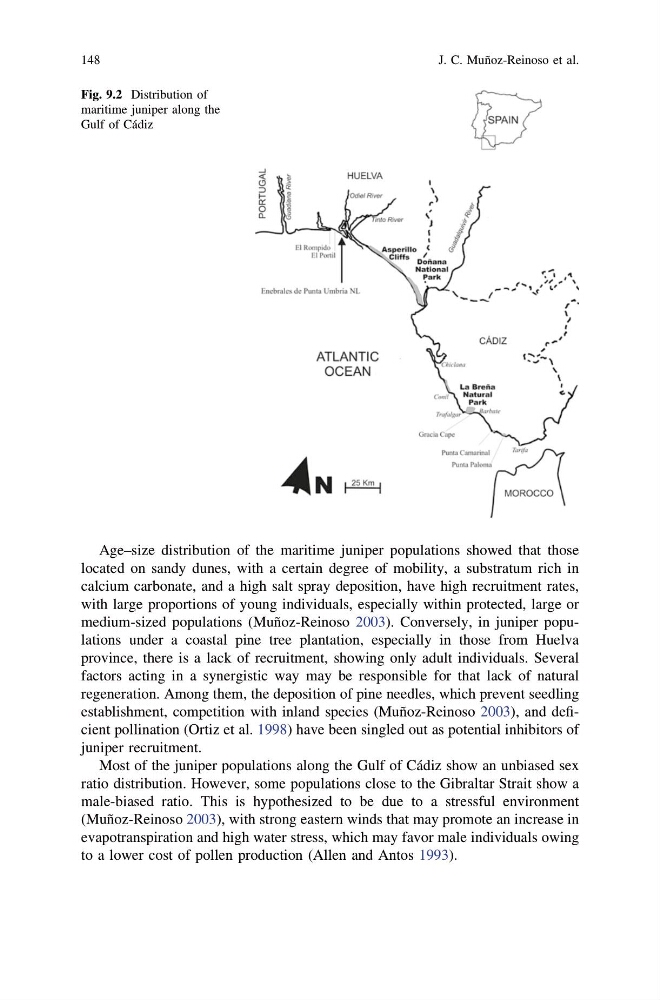
Fig. 9.2 Distribution of
maritime juniper along the
Gulf of Cádiz
148
J. C. Muñoz-Reinoso et al.
located on sandy dunes, with a certain degree of mobility, a substratum rich in
calcium carbonate, and a high salt spray deposition, have high recruitment rates,
with large proportions of young individuals, especially within protected, large or
medium-sized populations (Muñoz-Reinoso 2003). Conversely, in juniper populations under a coastal pine tree plantation, especially in those from Huelva
province, there is a lack of recruitment, showing only adult individuals. Several
factors acting in a synergistic way may be responsible for that lack of natural
regeneration. Among them, the deposition of pine needles, which prevent seedling
establishment, competition with inland species (Muñoz-Reinoso 2003), and deficient pollination (Ortiz et al. 1998) have been singled out as potential inhibitors of
juniper recruitment.
Most of the juniper populations along the Gulf of Cádiz show an unbiased sex
ratio distribution. However, some populations close to the Gibraltar Strait show a
male-biased ratio. This is hypothesized to be due to a stressful environment
(Muñoz-Reinoso 2003), with strong eastern winds that may promote an increase in
evapotranspiration and high water stress, which may favor male individuals owing
to a lower cost of pollen production (Allen and Antos 1993).
Fig. 9.2 Distribution of
maritime juniper along the
Gulf of Cádiz
148
J. C. Muñoz-Reinoso et al.