

9.2 The Maritime Juniper
From the Cupressaceae family, the maritime juniper is a dioecious, long-lived tree
around 5–9 m tall, which usually grows in pyramidal or hemi-spherical shapes in
the dunes, with branches developing from its base. Maritime juniper leaves are
triverticillate, prickly, with a hard cuticle, and show two characteristic white lines
on the face. It flowers from October to January, while fertilization takes place in
May/June, and the cones are ripe in September/October of the second year (Arista
et al. 2001). Their fleshy cones, called galbules, are relatively large (mean
15.5 mm), and give the name to that subspecies. The galbules, covered by pruina,
have a strong scent that attracts small omnivorous species such as red foxes,
badgers and wild boars that disperse lots of juniper seeds. Rabbits also eat the
galbules and may disperse juniper seeds; those have also been found in the feces of
some birds (blackbirds, thrushes).
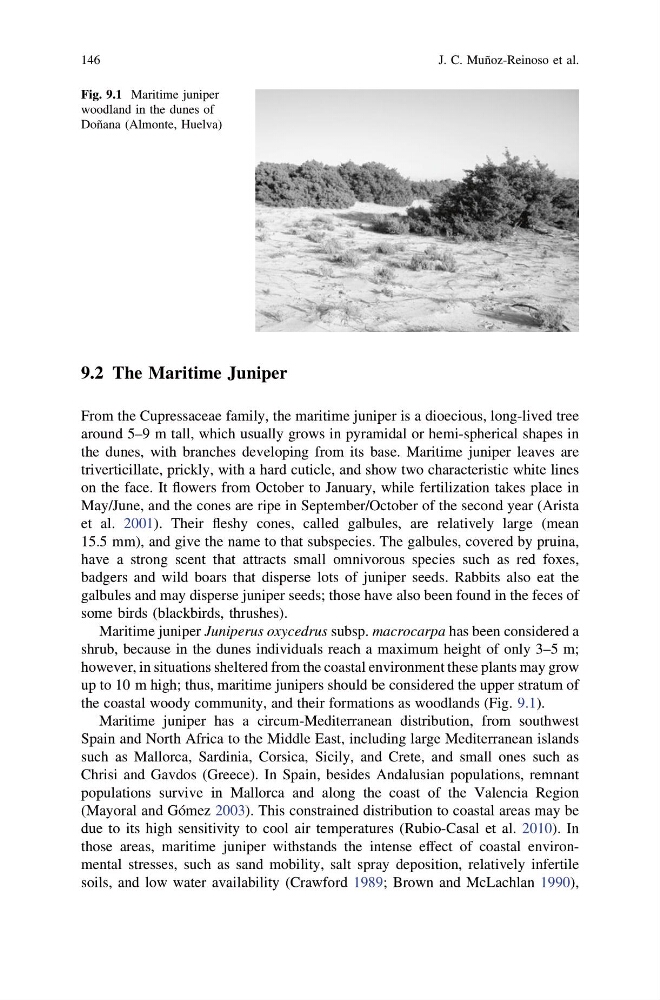
Maritime juniper Juniperus oxycedrus subsp. macrocarpa has been considered a
shrub, because in the dunes individuals reach a maximum height of only 3–5 m;
however, in situations sheltered from the coastal environment these plants may grow
up to 10 m high; thus, maritime junipers should be considered the upper stratum of
the coastal woody community, and their formations as woodlands (Fig. 9.1).
Maritime juniper has a circum-Mediterranean distribution, from southwest
Spain and North Africa to the Middle East, including large Mediterranean islands
such as Mallorca, Sardinia, Corsica, Sicily, and Crete, and small ones such as
Chrisi and Gavdos (Greece). In Spain, besides Andalusian populations, remnant
populations survive in Mallorca and along the coast of the Valencia Region
(Mayoral and Gómez 2003). This constrained distribution to coastal areas may be
due to its high sensitivity to cool air temperatures (Rubio-Casal et al. 2010). In
those areas, maritime juniper withstands the intense effect of coastal environmental stresses, such as sand mobility, salt spray deposition, relatively infertile
soils, and low water availability (Crawford 1989; Brown and McLachlan 1990),
Fig. 9.1 Maritime juniper
woodland in the dunes of
Doñana (Almonte, Huelva)
146
J. C. Muñoz-Reinoso et al.
From the Cupressaceae family, the maritime juniper is a dioecious, long-lived tree
around 5–9 m tall, which usually grows in pyramidal or hemi-spherical shapes in
the dunes, with branches developing from its base. Maritime juniper leaves are
triverticillate, prickly, with a hard cuticle, and show two characteristic white lines
on the face. It flowers from October to January, while fertilization takes place in
May/June, and the cones are ripe in September/October of the second year (Arista
et al. 2001). Their fleshy cones, called galbules, are relatively large (mean
15.5 mm), and give the name to that subspecies. The galbules, covered by pruina,
have a strong scent that attracts small omnivorous species such as red foxes,
badgers and wild boars that disperse lots of juniper seeds. Rabbits also eat the
galbules and may disperse juniper seeds; those have also been found in the feces of
some birds (blackbirds, thrushes).
Maritime juniper Juniperus oxycedrus subsp. macrocarpa has been considered a
shrub, because in the dunes individuals reach a maximum height of only 3–5 m;
however, in situations sheltered from the coastal environment these plants may grow
up to 10 m high; thus, maritime junipers should be considered the upper stratum of
the coastal woody community, and their formations as woodlands (Fig. 9.1).
Maritime juniper has a circum-Mediterranean distribution, from southwest
Spain and North Africa to the Middle East, including large Mediterranean islands
such as Mallorca, Sardinia, Corsica, Sicily, and Crete, and small ones such as
Chrisi and Gavdos (Greece). In Spain, besides Andalusian populations, remnant
populations survive in Mallorca and along the coast of the Valencia Region
(Mayoral and Gómez 2003). This constrained distribution to coastal areas may be
due to its high sensitivity to cool air temperatures (Rubio-Casal et al. 2010). In
those areas, maritime juniper withstands the intense effect of coastal environmental stresses, such as sand mobility, salt spray deposition, relatively infertile
soils, and low water availability (Crawford 1989; Brown and McLachlan 1990),
Fig. 9.1 Maritime juniper
woodland in the dunes of
Doñana (Almonte, Huelva)
146
J. C. Muñoz-Reinoso et al.