

Netherlands (Arens and Geelen 2006) have also shown, regeneration from deep
roots or rhizomes of perennials can be a problem, and winnowing of sand from the
ploughed surface brings the buried soil layers closer to the surface. Subsequent
vegetation growth has showed a dominance of Equisetum arvense and Rubus
caesius, as well as naturally recolonizing dune species such as Erodium maritimum
and Carex arenaria. Depending on the aims of restoration, it may be desirable to
immediately plant with A. arenaria (marram grass) following topsoil inversion to
stabilize the bare sand surface for vegetative colonization by early successional
species. The organization Landlife, which specializes in topsoil restoration, also
recommends spraying with herbicide 14 days prior to ploughing; then again
28 days after ploughing to control deep-rooted perennials and prevent regeneration
from root fragments or rhizomes (Landlife 2008).
Beach nourishment is another solution and, although expensive, its value has
been clearly demonstrated at Talacre Warren. Here in 2003, 150,000 m
3 of
dredged sand was pumped on to the foreshore along a section of eroding dunes.
The material was made available from navigation dredging operations in the
nearby Dee Estuary, thereby reducing the cost. New foredunes are now developing
and blowouts are now channeling the sand into hind dune areas, creating new
mobile dunes. However, the lack of sand supply per se does not appear to be the
primary reason for stabilization, since a number of sites that still have positive
sediment budgets have undergone stabilization.
Another possible technique is the use of controlled burning. This has the
advantage of potentially removing above ground biomass and its associated
nutrients without the use of heavy machinery. An accidental fire at Newborough
Warren in North Wales resulted in a marked improvement in the structure and
composition of the affected vegetation (Rhind and Sandison 1999).
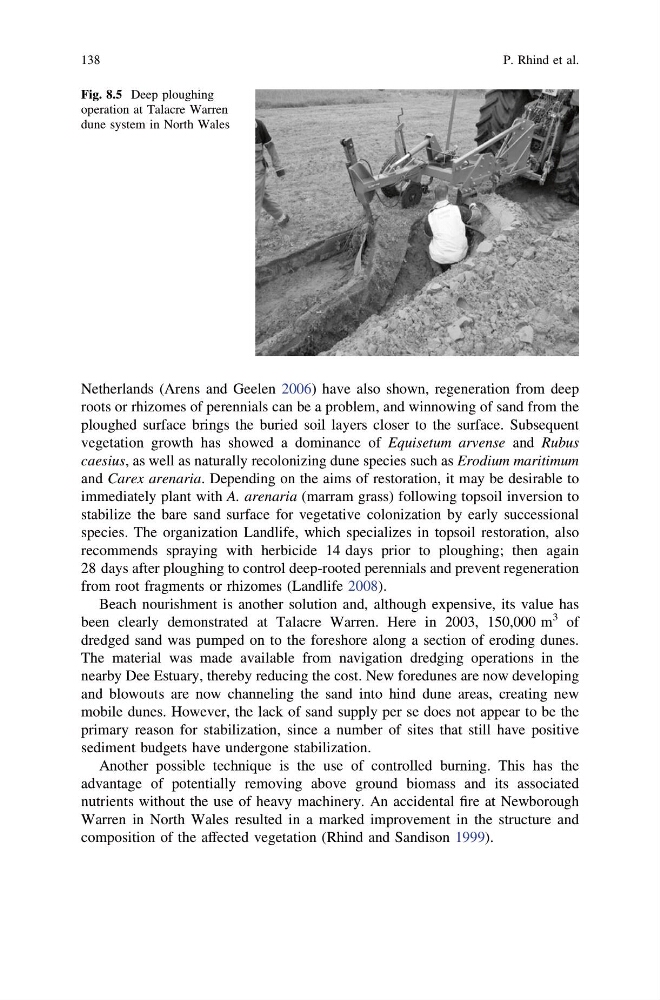
Fig. 8.5 Deep ploughing
operation at Talacre Warren
dune system in North Wales
138
P. Rhind et al.
roots or rhizomes of perennials can be a problem, and winnowing of sand from the
ploughed surface brings the buried soil layers closer to the surface. Subsequent
vegetation growth has showed a dominance of Equisetum arvense and Rubus
caesius, as well as naturally recolonizing dune species such as Erodium maritimum
and Carex arenaria. Depending on the aims of restoration, it may be desirable to
immediately plant with A. arenaria (marram grass) following topsoil inversion to
stabilize the bare sand surface for vegetative colonization by early successional
species. The organization Landlife, which specializes in topsoil restoration, also
recommends spraying with herbicide 14 days prior to ploughing; then again
28 days after ploughing to control deep-rooted perennials and prevent regeneration
from root fragments or rhizomes (Landlife 2008).
Beach nourishment is another solution and, although expensive, its value has
been clearly demonstrated at Talacre Warren. Here in 2003, 150,000 m
3 of
dredged sand was pumped on to the foreshore along a section of eroding dunes.
The material was made available from navigation dredging operations in the
nearby Dee Estuary, thereby reducing the cost. New foredunes are now developing
and blowouts are now channeling the sand into hind dune areas, creating new
mobile dunes. However, the lack of sand supply per se does not appear to be the
primary reason for stabilization, since a number of sites that still have positive
sediment budgets have undergone stabilization.
Another possible technique is the use of controlled burning. This has the
advantage of potentially removing above ground biomass and its associated
nutrients without the use of heavy machinery. An accidental fire at Newborough
Warren in North Wales resulted in a marked improvement in the structure and
composition of the affected vegetation (Rhind and Sandison 1999).
Fig. 8.5 Deep ploughing
operation at Talacre Warren
dune system in North Wales
138
P. Rhind et al.