

Classification (NVC) (Rodwell 2000). Furthermore, most of the modern mobile
dune vegetation, which is still mainly dominated by A. arenaria, is restricted to the
coastal fringe, whereas in the 1950s, mobile dune vegetation extended inland in
some areas for over 1 km.
Shortly after the onset of myxomatosis (a rabbit disease caused by the deliberate introduction of the Myxoma virus) in 1954, virtually all of the rabbits at
Newborough Warren were eliminated (Ranwell 1959, 1960b). The resulting
reduction in grazing pressure gave rise to conditions much more suitable for scrub
invasion and by 1981 scrub had spread over much of the Warren (Hodgkin 1984).
Hawthorn (Crataegus monogyna) and to a certain extent birch (Betula pendula)
were the most frequent species. No attempt to control hawthorn has been undertaken, but stands of sea buckthorn (Hippophae rhamnoides) and some birch have
been eradicated.
8.3 External Factors Influencing Stabilization
8.3.1 Sediment Supply
Much of the sand present on coastal dunes in Britain accumulated during the
Holocene, often as transgressive beaches rolling inland over Pleistocene land
surfaces as the sea level rose with the melting of the ice-sheets. However, today we
are facing reduced levels of primary accretion and growth. This has been ascribed
to the ending of a long phase of available quantities of sand-sized sediment in
shallow coastal waters at the conclusion of the post-glacial and there is evidence
that sand dune geomorphology in the UK is now entering a phase of senility
(Ritchie 2001).
Sediment today is mainly supplied from the offshore zone, but this is frequently
supplemented by longshore transport although much of this has now been disrupted by sea defense structures. The majority of dune sites in Wales have
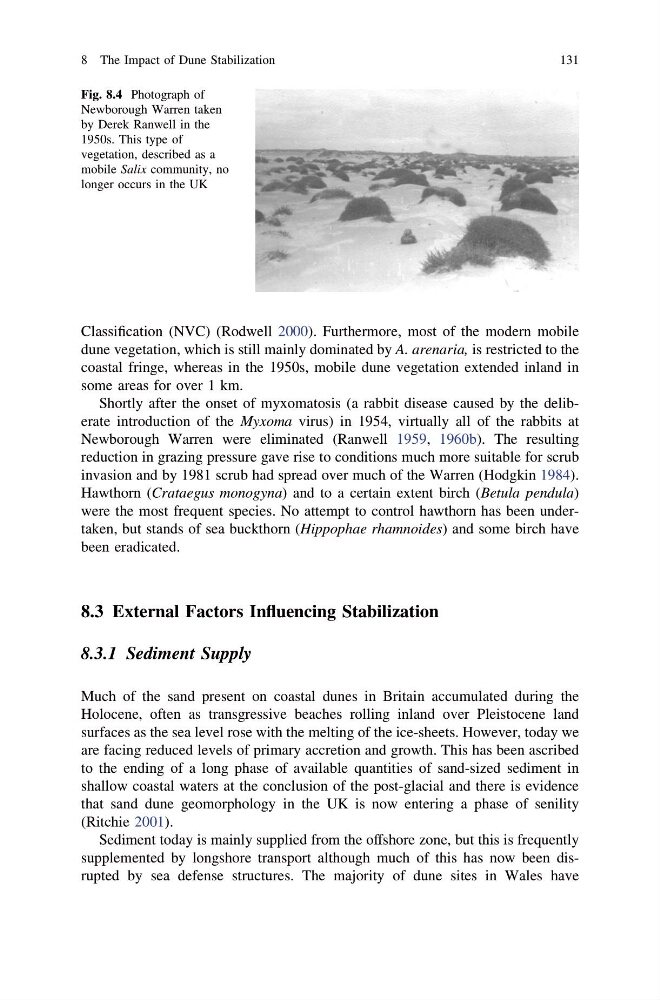
Fig. 8.4 Photograph of
Newborough Warren taken
by Derek Ranwell in the
1950s. This type of
vegetation, described as a
mobile Salix community, no
longer occurs in the UK
8 The Impact of Dune Stabilization
131
dune vegetation, which is still mainly dominated by A. arenaria, is restricted to the
coastal fringe, whereas in the 1950s, mobile dune vegetation extended inland in
some areas for over 1 km.
Shortly after the onset of myxomatosis (a rabbit disease caused by the deliberate introduction of the Myxoma virus) in 1954, virtually all of the rabbits at
Newborough Warren were eliminated (Ranwell 1959, 1960b). The resulting
reduction in grazing pressure gave rise to conditions much more suitable for scrub
invasion and by 1981 scrub had spread over much of the Warren (Hodgkin 1984).
Hawthorn (Crataegus monogyna) and to a certain extent birch (Betula pendula)
were the most frequent species. No attempt to control hawthorn has been undertaken, but stands of sea buckthorn (Hippophae rhamnoides) and some birch have
been eradicated.
8.3 External Factors Influencing Stabilization
8.3.1 Sediment Supply
Much of the sand present on coastal dunes in Britain accumulated during the
Holocene, often as transgressive beaches rolling inland over Pleistocene land
surfaces as the sea level rose with the melting of the ice-sheets. However, today we
are facing reduced levels of primary accretion and growth. This has been ascribed
to the ending of a long phase of available quantities of sand-sized sediment in
shallow coastal waters at the conclusion of the post-glacial and there is evidence
that sand dune geomorphology in the UK is now entering a phase of senility
(Ritchie 2001).
Sediment today is mainly supplied from the offshore zone, but this is frequently
supplemented by longshore transport although much of this has now been disrupted by sea defense structures. The majority of dune sites in Wales have
Fig. 8.4 Photograph of
Newborough Warren taken
by Derek Ranwell in the
1950s. This type of
vegetation, described as a
mobile Salix community, no
longer occurs in the UK
8 The Impact of Dune Stabilization
131