

7.7 Restarting the Engine? Toward a New Management
Strategy
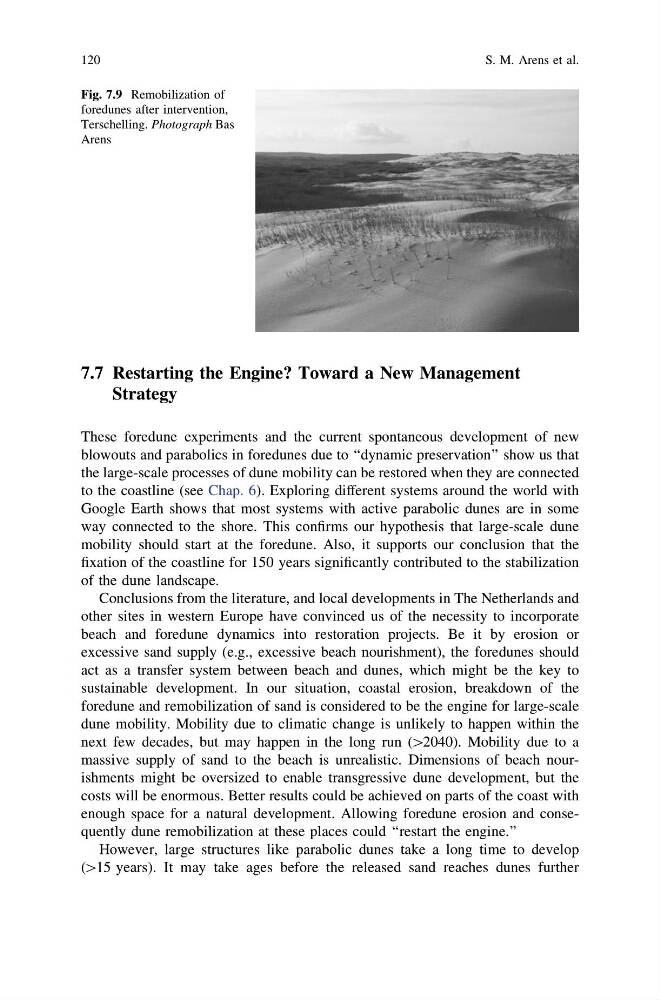
These foredune experiments and the current spontaneous development of new
blowouts and parabolics in foredunes due to ‘‘dynamic preservation’’ show us that
the large-scale processes of dune mobility can be restored when they are connected
to the coastline (see Chap. 6). Exploring different systems around the world with
Google Earth shows that most systems with active parabolic dunes are in some
way connected to the shore. This confirms our hypothesis that large-scale dune
mobility should start at the foredune. Also, it supports our conclusion that the
fixation of the coastline for 150 years significantly contributed to the stabilization
of the dune landscape.
Conclusions from the literature, and local developments in The Netherlands and
other sites in western Europe have convinced us of the necessity to incorporate
beach and foredune dynamics into restoration projects. Be it by erosion or
excessive sand supply (e.g., excessive beach nourishment), the foredunes should
act as a transfer system between beach and dunes, which might be the key to
sustainable development. In our situation, coastal erosion, breakdown of the
foredune and remobilization of sand is considered to be the engine for large-scale
dune mobility. Mobility due to climatic change is unlikely to happen within the
next few decades, but may happen in the long run ([2040). Mobility due to a
massive supply of sand to the beach is unrealistic. Dimensions of beach nourishments might be oversized to enable transgressive dune development, but the
costs will be enormous. Better results could be achieved on parts of the coast with
enough space for a natural development. Allowing foredune erosion and consequently dune remobilization at these places could ‘‘restart the engine.’’
However, large structures like parabolic dunes take a long time to develop
([15 years). It may take ages before the released sand reaches dunes further
Fig. 7.9 Remobilization of
foredunes after intervention,
Terschelling. Photograph Bas
Arens
120
S. M. Arens et al.
Strategy
These foredune experiments and the current spontaneous development of new
blowouts and parabolics in foredunes due to ‘‘dynamic preservation’’ show us that
the large-scale processes of dune mobility can be restored when they are connected
to the coastline (see Chap. 6). Exploring different systems around the world with
Google Earth shows that most systems with active parabolic dunes are in some
way connected to the shore. This confirms our hypothesis that large-scale dune
mobility should start at the foredune. Also, it supports our conclusion that the
fixation of the coastline for 150 years significantly contributed to the stabilization
of the dune landscape.
Conclusions from the literature, and local developments in The Netherlands and
other sites in western Europe have convinced us of the necessity to incorporate
beach and foredune dynamics into restoration projects. Be it by erosion or
excessive sand supply (e.g., excessive beach nourishment), the foredunes should
act as a transfer system between beach and dunes, which might be the key to
sustainable development. In our situation, coastal erosion, breakdown of the
foredune and remobilization of sand is considered to be the engine for large-scale
dune mobility. Mobility due to climatic change is unlikely to happen within the
next few decades, but may happen in the long run ([2040). Mobility due to a
massive supply of sand to the beach is unrealistic. Dimensions of beach nourishments might be oversized to enable transgressive dune development, but the
costs will be enormous. Better results could be achieved on parts of the coast with
enough space for a natural development. Allowing foredune erosion and consequently dune remobilization at these places could ‘‘restart the engine.’’
However, large structures like parabolic dunes take a long time to develop
([15 years). It may take ages before the released sand reaches dunes further
Fig. 7.9 Remobilization of
foredunes after intervention,
Terschelling. Photograph Bas
Arens
120
S. M. Arens et al.