

private land was partially due to the State’s intervention in the natural sedimentary
dynamics of the region, and that the State should extend the armoring further
westward to protect their properties as well. By 1998, however, ‘‘hard’’ shoreline
armoring was no longer allowed or approved by the State, in general. As an
alternative solution, geo-textile tubes were proposed for Pirates’ Beach.
Geo-textile tubes, or geotubes, are essentially large textile socks filled with sand.
They can be cut open and removed relatively quickly if desired.
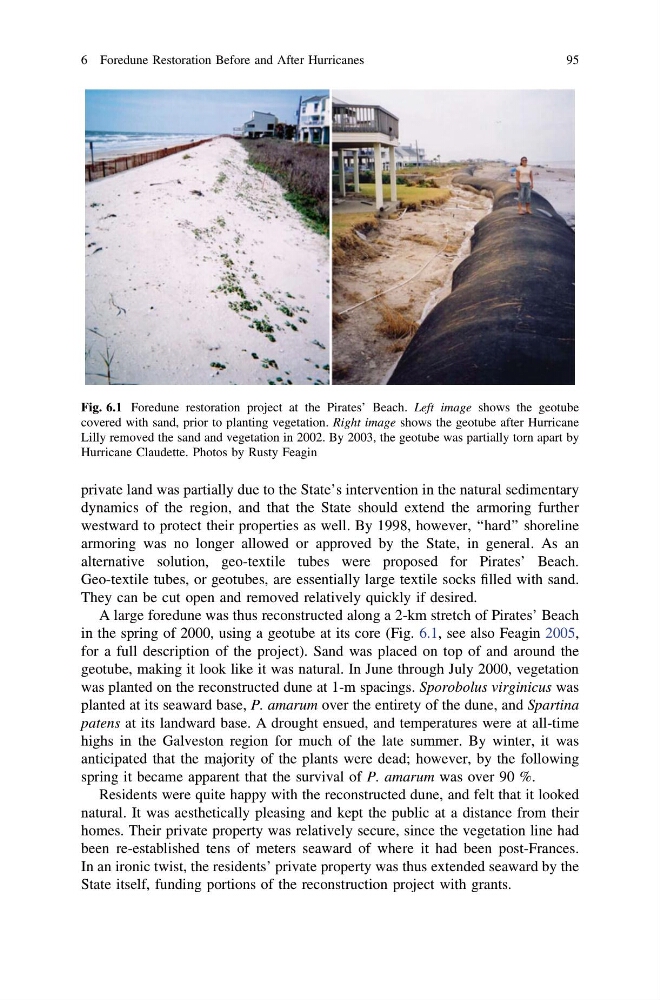
A large foredune was thus reconstructed along a 2-km stretch of Pirates’ Beach
in the spring of 2000, using a geotube at its core (Fig. 6.1, see also Feagin 2005,
for a full description of the project). Sand was placed on top of and around the
geotube, making it look like it was natural. In June through July 2000, vegetation
was planted on the reconstructed dune at 1-m spacings. Sporobolus virginicus was
planted at its seaward base, P. amarum over the entirety of the dune, and Spartina
patens at its landward base. A drought ensued, and temperatures were at all-time
highs in the Galveston region for much of the late summer. By winter, it was
anticipated that the majority of the plants were dead; however, by the following
spring it became apparent that the survival of P. amarum was over 90 %.
Residents were quite happy with the reconstructed dune, and felt that it looked
natural. It was aesthetically pleasing and kept the public at a distance from their
homes. Their private property was relatively secure, since the vegetation line had
been re-established tens of meters seaward of where it had been post-Frances.
In an ironic twist, the residents’ private property was thus extended seaward by the
State itself, funding portions of the reconstruction project with grants.
Fig. 6.1 Foredune restoration project at the Pirates’ Beach. Left image shows the geotube
covered with sand, prior to planting vegetation. Right image shows the geotube after Hurricane
Lilly removed the sand and vegetation in 2002. By 2003, the geotube was partially torn apart by
Hurricane Claudette. Photos by Rusty Feagin
6 Foredune Restoration Before and After Hurricanes
95
dynamics of the region, and that the State should extend the armoring further
westward to protect their properties as well. By 1998, however, ‘‘hard’’ shoreline
armoring was no longer allowed or approved by the State, in general. As an
alternative solution, geo-textile tubes were proposed for Pirates’ Beach.
Geo-textile tubes, or geotubes, are essentially large textile socks filled with sand.
They can be cut open and removed relatively quickly if desired.
A large foredune was thus reconstructed along a 2-km stretch of Pirates’ Beach
in the spring of 2000, using a geotube at its core (Fig. 6.1, see also Feagin 2005,
for a full description of the project). Sand was placed on top of and around the
geotube, making it look like it was natural. In June through July 2000, vegetation
was planted on the reconstructed dune at 1-m spacings. Sporobolus virginicus was
planted at its seaward base, P. amarum over the entirety of the dune, and Spartina
patens at its landward base. A drought ensued, and temperatures were at all-time
highs in the Galveston region for much of the late summer. By winter, it was
anticipated that the majority of the plants were dead; however, by the following
spring it became apparent that the survival of P. amarum was over 90 %.
Residents were quite happy with the reconstructed dune, and felt that it looked
natural. It was aesthetically pleasing and kept the public at a distance from their
homes. Their private property was relatively secure, since the vegetation line had
been re-established tens of meters seaward of where it had been post-Frances.
In an ironic twist, the residents’ private property was thus extended seaward by the
State itself, funding portions of the reconstruction project with grants.
Fig. 6.1 Foredune restoration project at the Pirates’ Beach. Left image shows the geotube
covered with sand, prior to planting vegetation. Right image shows the geotube after Hurricane
Lilly removed the sand and vegetation in 2002. By 2003, the geotube was partially torn apart by
Hurricane Claudette. Photos by Rusty Feagin
6 Foredune Restoration Before and After Hurricanes
95