

yields: 6 tonnes/ha of wheat, 10 t/ha of maize, over 3 t/ha sunflower, 50–60 t/ha
sugar beet or 30–40 t/ha potatoes.
As for the people working in these cooperatives, their already meagre wages
were further undermined after their piece rates’ accord was replaced with a
so-called “global agreement”, initiated at Ceausescu’s behest, who had been
angered by these agricultural units’ failure to meet the planned yields’ quotas.
Consequently, the work carried out on allotments, such as seeding or weeding
was not to be paid in full, but only in the percentage of the yields matching the
planned quotas, rather than in the percentage of outputs per man-hour.
On the one hand, as the planned quotas per ha were being raised constantly,
especially on those allotments that had been equipped for irrigation, the due wages
for those working in these cooperatives were being slashed at an alarming rate. On
the other hand, the state too was unable to receive any income that would’ve been
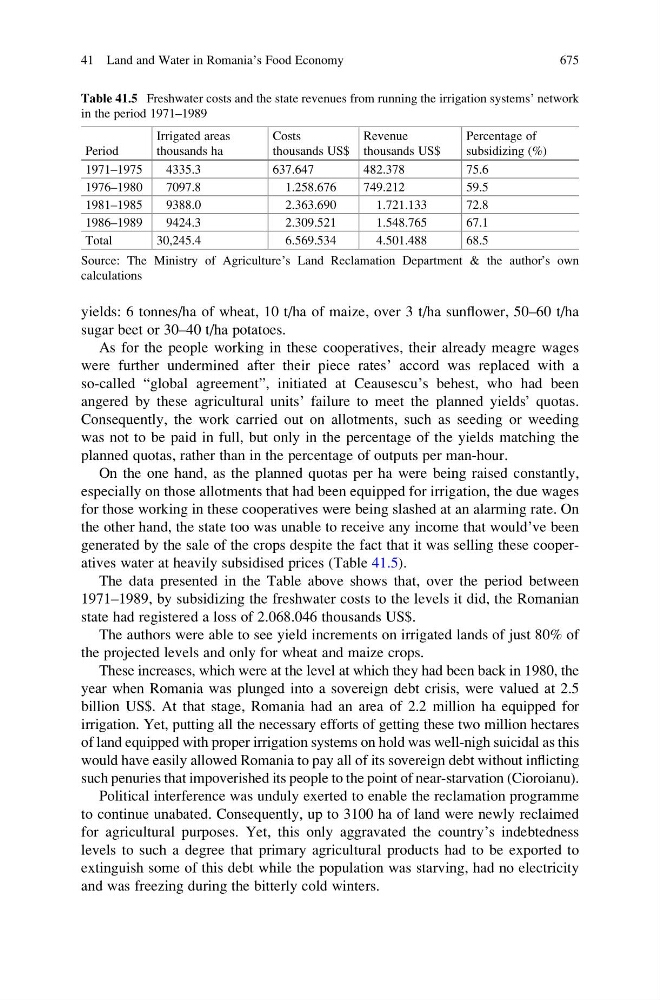
generated by the sale of the crops despite the fact that it was selling these cooperatives water at heavily subsidised prices (Table 41.5).
The data presented in the Table above shows that, over the period between
1971–1989, by subsidizing the freshwater costs to the levels it did, the Romanian
state had registered a loss of 2.068.046 thousands US$.
The authors were able to see yield increments on irrigated lands of just 80% of
the projected levels and only for wheat and maize crops.
These increases, which were at the level at which they had been back in 1980, the
year when Romania was plunged into a sovereign debt crisis, were valued at 2.5
billion US$. At that stage, Romania had an area of 2.2 million ha equipped for
irrigation. Yet, putting all the necessary efforts of getting these two million hectares
of land equipped with proper irrigation systems on hold was well-nigh suicidal as this
would have easily allowed Romania to pay all of its sovereign debt without inflicting
such penuries that impoverished its people to the point of near-starvation (Cioroianu).
Political interference was unduly exerted to enable the reclamation programme
to continue unabated. Consequently, up to 3100 ha of land were newly reclaimed
for agricultural purposes. Yet, this only aggravated the country’s indebtedness
levels to such a degree that primary agricultural products had to be exported to
extinguish some of this debt while the population was starving, had no electricity
and was freezing during the bitterly cold winters.
Table 41.5 Freshwater costs and the state revenues from running the irrigation systems’ network
in the period 1971–1989
Period
Irrigated areas
thousands ha
Costs
thousands US$
Revenue
thousands US$
Percentage of
subsidizing (%)
1971–1975
4335.3
637.647
482.378
75.6
1976–1980
7097.8
1.258.676
749.212
59.5
1981–1985
9388.0
2.363.690
1.721.133
72.8
1986–1989
9424.3
2.309.521
1.548.765
67.1
Total
30,245.4
6.569.534
4.501.488
68.5
Source: The Ministry of Agriculture’s Land Reclamation Department & the author’s own
calculations
41 Land and Water in Romania’s Food Economy
675