

41.2.3.2 Investments in Romania’s Hydro-technical Systems
Romania’s communist government had invested hugely in land irrigations,
prioritising these as the most important factor in raising production per unit area
of land.
Faithful to Marxist principles that prioritised industrial output in Romania’s
overall economic growth strategy, Nicolae Ceausescu saw it personally that more
than 30% of the country’s national revenue went to investments (a very high rate).
Yet, the petrol crises of 1973 and 1979 struck a heavy blow to the heart of
Romania’s refining industry. These crises compounded the already heavy burden
placed on an increasingly energy-dependent economy by forcing the regime to take
on petrodollar-denominated debt, with sky-high interest rates to boot (Cioroianu
2013).
This period coincides with a fast-paced programme of supplying Romania’s
agricultural lands with much-needed irrigation systems, and this is hardly accidental.
Obtaining the production yields per unit area of land (ha) at levels projected in its
5-year plans would have allowed the substantial growth in the export of agricultural
products needed to pay for the importing of raw materials on which the industry
depended.
Maize
%
100
80
60
40
20
0
1983 1984 1985 1986 1987 1988 1989
% Soybeans
100
80
60
40
20
0
1983 1984 1985 1986 1987 1988 1989
%
Sugar-beet
100
80
60
40
20
0
1983 1984 1985 1986 1987
Legend
First application
Second application
Third application
Fourth application
1988 1989
%
Sunflower
100
80
60
40
20
0
1983 1984 1985 1986 1987 1988 1989
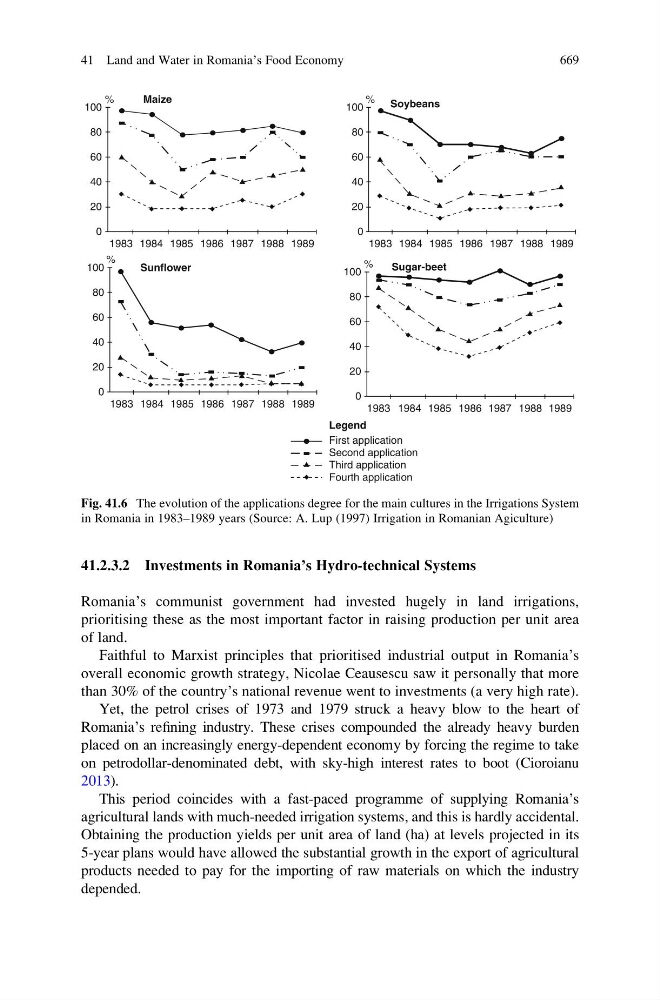
Fig. 41.6 The evolution of the applications degree for the main cultures in the Irrigations System
in Romania in 1983–1989 years (Source: A. Lup (1997) Irrigation in Romanian Agiculture)
41 Land and Water in Romania’s Food Economy
669